 Sales & Marketing Automation
The CRM and Marketing Automation Guru's You Can Trust.
Sales & Marketing Automation
By 2026, the distinction between a functional CRM and a high-performance revenue engine has become the primary driver of market leadership. If your database currently feels like an expensive filing cabinet, you aren’t alone. Many organizations struggle with fragmented data and low sales adoption that stifles growth. Engaging a strategic hubspot implementation partner allows you to move beyond basic setup and toward a precision-engineered ecosystem.
We understand that your objective isn’t just to “go live,” but to eliminate technical debt and fix broken lead-to-revenue tracking. This article demonstrates how the right partner transforms your CRM from a passive database into a proactive growth tool. You’ll learn the criteria for selecting an architect who can deliver automated lead scoring, clean data migrations, and the clear ROI reporting your stakeholders demand in this competitive market.
Distinguish between software activation and system architecture. A Customer Relationship Management (CRM) platform serves as the central nervous system of a B2B organization, yet many teams treat its deployment as a mere software installation. Standard onboarding focuses on tool proficiency, whereas a hubspot implementation partner focuses on business outcomes. This strategic gap often determines whether a platform becomes a catalyst for growth or a source of operational friction.
Standard onboarding typically follows a fixed checklist designed to get you “live” as quickly as possible. It covers the technical basics of the interface but rarely addresses the underlying business processes that drive revenue. Without a strategic lens, teams often build workflows that reflect current inefficiencies rather than solving them. This oversight leads to significant technical debt, where your portal becomes cluttered with redundant properties and broken automations that hinder long-term scalability.
A partner acts as a translator, converting high-level executive goals into granular technical workflows. This role is especially critical during high-stakes transitions from legacy systems like Salesforce or Microsoft Dynamics. Moving data between these environments requires more than a simple import; it demands a deep understanding of data mapping and record relationships. A partner ensures this migration occurs with zero downtime, protecting your historical data and maintaining sales momentum.
Analyze the limitations of HubSpot-led onboarding for complex organizations. These sessions are essentially a “Guided DIY” experience. They provide the map but don’t drive the car. Industry research has historically indicated that approximately 60% of CRM implementations fail to achieve their desired ROI when they lack a dedicated strategic lead. Relying solely on a checklist leaves your team with a configured portal that doesn’t actually solve your fragmented data problems or improve lead-to-revenue tracking.
An expert hubspot implementation partner functions as a strategic architect. They build enduring frameworks rather than just performing tasks. This involves mapping your unique business processes to specific hubs, ensuring that Marketing, Sales, and Service teams share a single source of truth. By understanding both technical API limitations and the nuances of sales psychology, a partner creates a system that reps actually use. This alignment ensures that custom dashboarding provides the visibility executives need to make data-driven decisions based on real-time performance metrics.
Construct a system that endures. A professional hubspot implementation partner understands that a portal is only as resilient as its underlying data schema. Standard configurations often fail because they don’t account for the intricate relationships inherent in enterprise B2B models. By moving beyond basic fields and architecting custom objects, you provide the granularity required for advanced revenue reporting and lifecycle management. This structural integrity ensures that as your organization scales, your CRM remains a source of truth rather than a collection of siloed data points.
Eliminate the “Garbage In, Garbage Out” cycle through rigorous data normalization. Migration is the most volatile phase of any implementation; it’s where technical debt is either cleared or compounded. A strategic partner prioritizes data integrity by establishing automated deduplication routines and validation rules before a single record is moved. This precision allows you to build a multi-channel lead scoring model that your sales team actually trusts. When reps see high-quality, accurate data, adoption rates climb, and the lead-to-revenue path becomes visible.
Establish a global governance model to maintain order across multi-region instances. For organizations operating across different territories, a “wild west” approach to portal management leads to conflicting workflows and fragmented reporting. You must define clear permissions, naming conventions, and shared property groups to ensure consistency. If you’re ready to move beyond basic setups, you can request a technical audit to identify existing gaps in your architecture.
Manage the complexity of a modern tech stack through sophisticated API integration. While middleware like Zapier offers quick fixes, enterprise-grade scalability often requires custom-coded private apps or robust syncs with ERP and Finance systems. Achieving this level of systemic integrity is precisely what professional hubspot integration services are designed to deliver, ensuring your data flows bi-directionally across every platform without creating new silos. When building this technical foundation, following a proven framework for evaluating technology partners ensures you select an expert capable of managing these high-stakes connections. Proper OAuth and API key management are not optional; they are the safeguards that secure your proprietary data across hybrid environments involving Salesforce, Pardot, or NetSuite.
Select a partner based on their ability to build, not just their ability to sell. While badges and certifications offer a baseline of tool familiarity, they don’t guarantee the strategic depth required to architect a high-performance revenue engine. Use this five-point framework to interrogate a prospective hubspot implementation partner and ensure their capabilities align with your long-term operational health.
Understand the mechanics of the HubSpot Solutions Partner Program. By 2026, HubSpot requires Diamond partners to maintain at least 75% Gross Revenue Retention (GRR), while Elite partners must hit 80%. While these metrics signal business stability and client retention, they are primarily driven by software sales volume and recurring revenue. They don’t necessarily reflect a partner’s ability to solve complex technical challenges or provide high-touch strategic guidance. A smaller, boutique hubspot implementation partner often provides deeper technical proficiency and more direct access to senior architects than a high-tier generalist firm focused on high-volume account management.
Never initiate a migration or implementation without a comprehensive tech stack assessment. A diagnostic audit identifies “hidden” inefficiencies in your current sales and marketing workflows that software alone cannot fix. It reveals where data is siloed and where lead-to-revenue tracking is broken. This assessment serves as the blueprint for your entire HubSpot rollout, ensuring that the final architecture supports your specific business goals. By identifying these friction points early, you avoid the technical debt that plagues 60% of failed CRM deployments.
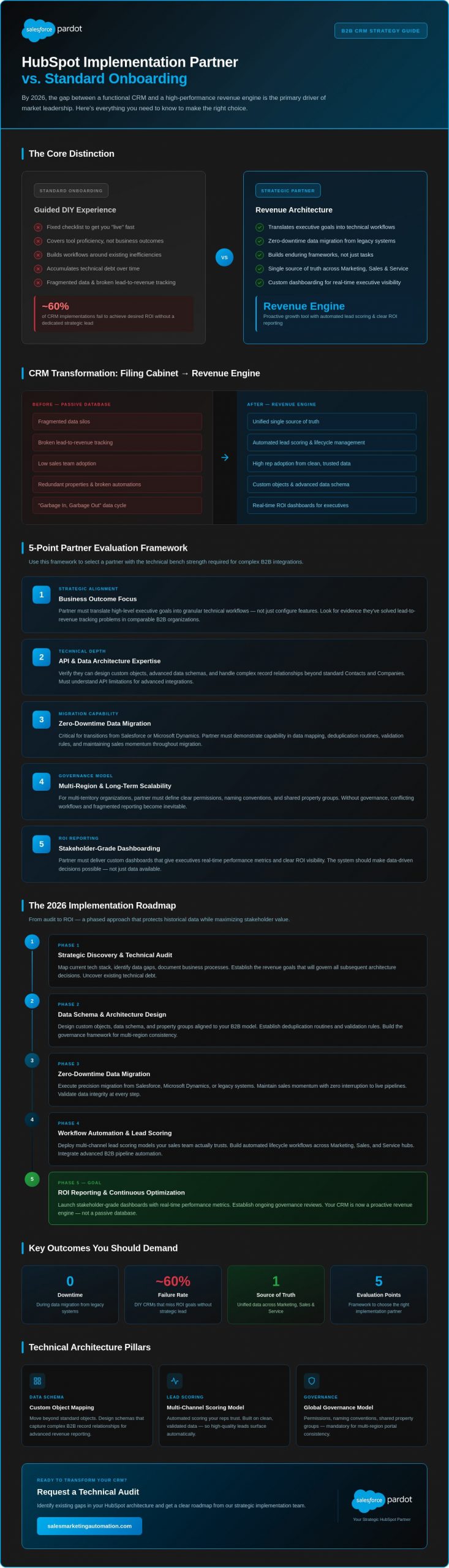
Construct a roadmap that prioritizes systemic health over speed. While generic onboarding plans often promise a 90-day setup, a strategic hubspot implementation partner recognizes that high-growth B2B firms require a more rigorous, phased approach. This methodology ensures that every technical configuration aligns with your overarching revenue goals. By following a structured progression, you eliminate the risk of building on a fractured foundation and ensure that your CRM scales alongside your business.
Execution follows five distinct stages of development:
If you require a detailed assessment of your current environment before beginning this journey, you can book a Marketing Automation Audit to establish your baseline and identify immediate friction points.
Analyze the customer lifecycle through stakeholder interviews. This diagnostic phase uncovers the friction points that prevent leads from converting into revenue. We document lead hand-off protocols between marketing and sales to ensure no prospect is lost in the transition. This phase concludes with a “Definition of Success” document. This blueprint serves as the objective benchmark for the entire project, ensuring executive alignment on ROI expectations and technical milestones.
Implement a “Clean Before You Move” strategy for your CRM Data Migration. Moving unverified or redundant data into a new HubSpot portal only recreates the problems of your legacy system. We map legacy fields from Salesforce, Dynamics, or Pardot to HubSpot properties with surgical precision. This process preserves historical context while normalizing data for future reporting. Every migration concludes with a rigorous post-migration audit to validate data integrity and ensure your new system is ready for immediate operation.
Focus on the system, not just the software. At Sales & Marketing Automation, we view HubSpot as the architectural foundation of your revenue engine rather than a standalone tool. Our methodology moves beyond basic configuration to build integrated “Revenue Systems” that align your marketing, sales, and service departments. With a proven track record of over 100 successful implementations for high-growth B2B firms, we specialize in solving the complex structural challenges that generic providers often overlook. By bridging the gap between sophisticated technical requirements and high-impact creative execution, we ensure your platform drives measurable business outcomes from day one.
Engaging a hubspot implementation partner should provide a long-term strategic advantage, not just a temporary technical fix. Our managed services model offers the continuous oversight necessary to adapt your CRM as your market evolves. We provide the technical bench strength to manage advanced API integrations and custom object schemas while maintaining a clear focus on operational health. This partnership ensures that your automation scales without accumulating technical debt, allowing your team to focus on high-value activities while we handle the systemic complexities of the platform. Organizations seeking to unlock the full potential of their platform can benefit from exploring dedicated hubspot implementation services designed to replace manual workarounds with a precision-engineered framework for scalable performance.
Prioritize precision over speed. Every engagement begins with a rigorous technical audit to identify existing data silos and process inefficiencies. We bring deep expertise to high-stakes projects, including complex Salesforce-to-HubSpot migrations and Pardot integrations. Unlike large agencies that offload work to junior staff, our boutique approach ensures you collaborate directly with senior strategists who have navigated hundreds of unique CRM environments. This level of seniority is essential for maintaining data integrity and ensuring your technical architecture supports advanced attribution and lifecycle reporting.
Secure the longevity of your investment through fractional marketing operations. Launching your portal is merely the first phase of a successful digital transformation. We provide recurring, retainer-based support that gives your organization continuous access to automation experts who understand your specific business logic. This model allows for the constant refinement of lead scoring, automated sequences, and reporting dashboards. To begin transforming your CRM into a high-performance asset, you can Optimize your revenue engine with a Strategic HubSpot Audit. This diagnostic approach ensures your hubspot implementation partner delivers a system built for precision, scalability, and long-term ROI.
Transitioning from a fragmented database to a high-performance ecosystem requires more than a standard software setup. You must prioritize technical architecture and a diagnostic methodology to ensure your CRM scales without accumulating technical debt. By applying a rigorous evaluation framework, you can select a partner who understands the nuance of B2B revenue systems. Selecting the right hubspot implementation partner is a strategic investment in your organization’s operational health and long-term ROI.
Sales & Marketing Automation brings the seasoned experience of over 100 successful implementations. As a boutique technical agency, we provide direct access to senior-level strategists with deep expertise across HubSpot, Salesforce, Pardot, and Marketo. We focus on building enduring frameworks that bridge the gap between technical complexity and business growth. Book a HubSpot Strategic Audit with Sales & Marketing Automation to identify your friction points and begin your transformation. Your CRM has the potential to be your most powerful growth asset; let’s build the foundation it needs to succeed.
A comprehensive implementation typically spans 90 to 180 days. While standard software activation might occur sooner, a strategic architect requires time for discovery, data normalization, and user acceptance testing. This timeline ensures that your technical workflows are fully aligned with your business processes before the final hand-off, preventing the technical debt that often follows rushed deployments.
Implementation costs vary significantly based on the number of Hubs, the volume of data records, and the complexity of your integration requirements. Instead of a fixed fee, pricing is typically determined by the depth of technical architecture and the level of strategic oversight required. You’ll find that costs reflect the scale of the transition and the technical bench strength of the hubspot implementation partner managing your deployment.
Yes, maintaining data integrity during a Salesforce-to-HubSpot migration is a core competency of a strategic partner. We utilize advanced mapping protocols to ensure custom objects, historical activity, and lead attribution data transfer without loss. This transition is managed with zero downtime to protect your ongoing sales momentum and ensure the historical reporting accuracy your stakeholders demand.
Solutions Partners are tiered members of the HubSpot ecosystem who meet specific performance and revenue retention thresholds. Elite and Diamond partners, for instance, must maintain high Gross Revenue Retention (GRR) scores of 75% to 80%. Solutions Providers are often entry-level agencies that may lack the technical bench strength and strategic history required for complex, enterprise-grade deployments.
You don’t need to purchase standard HubSpot onboarding if you engage an implementation partner. The partner’s scope of work is more exhaustive and tailored than the “Guided DIY” approach offered by the software vendor. A hubspot implementation partner provides white-glove service that covers technical architecture, custom integrations, and deep strategic alignment that standard onboarding simply doesn’t address.
Measure success through lead-to-customer conversion rates, lead quality improvements, and CRM adoption metrics. A successful implementation also delivers ROI by reducing manual data entry and providing clear revenue attribution. By 2026, the most critical metrics are lead quality and lead-to-revenue tracking, which demonstrate the systemic health and performance of your unified revenue engine.
Strategic partners specialize in connecting proprietary software to the HubSpot ecosystem through custom API management. Whether you require middleware like Zapier or custom-coded private apps, a partner ensures your tech stack is unified through comprehensive hubspot integration services that synchronize data bi-directionally across your entire revenue stack. This integration allows proprietary data to inform lead scoring and lifecycle management, creating a single source of truth that powers your entire organization.
Post-implementation focus shifts to continuous optimization and fractional RevOps support. The system requires ongoing refinement to adapt to changing market conditions and new HubSpot feature releases. Managed services ensure that your automation remains precise and that your team continues to leverage the platform’s full technical capabilities to drive long-term, scalable growth.
To explore how a unified framework can further streamline your lead management and business processes, you can learn more about Marketing System Solutions.