 Sales & Marketing Automation
The CRM and Marketing Automation Guru's You Can Trust.
Sales & Marketing Automation
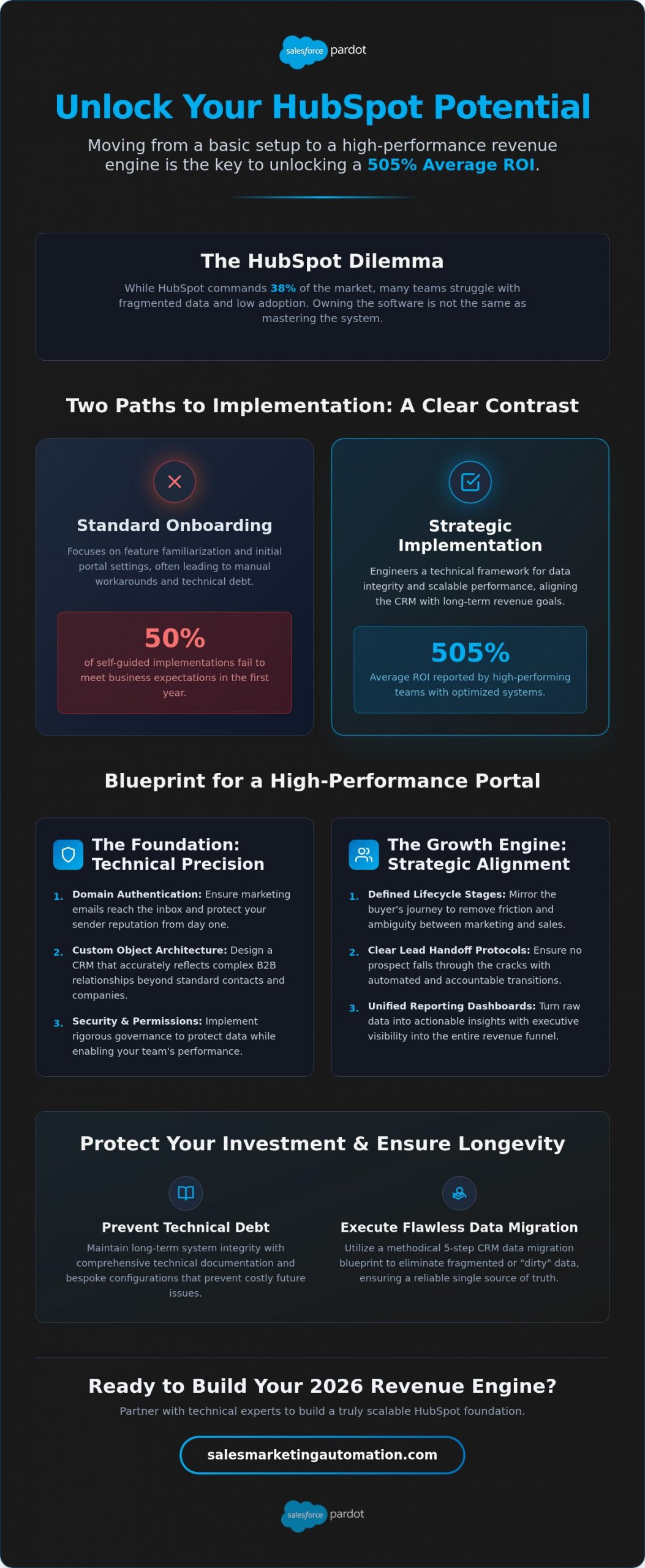
While HubSpot commands 38% of the global marketing automation market, many organizations still struggle with fragmented data and low team adoption that stifle their growth. You’ve likely experienced the friction of sales teams bypassing the CRM or the confusion caused by technical debt inherited from a previous, amateur setup. It’s a common realization that owning the software isn’t the same as mastering the system. Expert hubspot implementation services bridge this gap by replacing manual workarounds with a precision-engineered framework designed for technical integrity and scalable performance.
We promise to show you how to unlock the full potential of your platform, moving past basic configurations to achieve the 505% average ROI reported by high-performing teams. This article provides a strategic roadmap for your 2026 revenue engine. We will explore the transition from siloed operations to a unified source of truth, focusing on automated lead scoring and the technical precision required for predictable revenue reporting.
Professional HubSpot implementation services represent a fundamental departure from standard software onboarding. While basic onboarding focuses on feature familiarization and initial portal settings, a strategic implementation treats the platform as a technical framework that must be engineered to support long-term revenue goals. This process involves a meticulous blend of technical configuration, strategic alignment, and data architecture. It’s not just about setting up an inbox; it’s about building a system where every data point serves a specific business outcome.
The distinction between a self-guided setup and expert-led hubspot implementation services often determines the longevity of the platform. Some industry professionals report that approximately 50% of self-guided implementations fail to meet business expectations within the first year. This usually happens because internal teams focus on immediate needs rather than the underlying data integrity required for scale. Acting as a Strategic Architect, we bridge the gap between your business goals and the CRM’s functionality, ensuring that the system’s logic enforces your team’s best behaviors rather than creating technical debt.
Building a high-performance portal starts with technical precision. We prioritize domain authentication to ensure your marketing emails actually reach the inbox; this protects your sender reputation from the very first campaign. For organizations with complex B2B relationships, we design custom object architectures that go beyond standard contacts and companies. This ensures your CRM accurately reflects how you do business—for example, by tracking logistical assets and leasing contracts from providers like Alliance Fleet Solutions. Finally, we establish rigorous security governance protocols and user permission mapping to protect your data while giving your team the access they need to perform.
Technical setup alone won’t drive growth; you need strategic alignment across your entire revenue team. Defining lifecycle stages that accurately mirror your buyer’s journey removes the ambiguity that often leads to friction between departments. By establishing clear lead handoff protocols, we ensure that no prospect falls through the cracks during the transition from marketing to sales. The result is a unified reporting dashboard that provides executive visibility into every stage of the funnel, turning raw data into actionable insights for the leadership team.
High-performance HubSpot portals aren’t built on default settings. They require a bespoke architecture that mirrors your unique business logic. While standard onboarding might get you live, professional hubspot implementation services ensure the system evolves with your growth. We focus on creating a robust revenue environment where every property and workflow has a documented purpose. This documentation is vital. Without it, system integrity degrades as new team members introduce conflicting logic or redundant properties. By architecting the portal correctly from day one, we significantly reduce the technical debt that often plagues scaling B2B organizations.
A truly integrated digital marketing strategy requires HubSpot to communicate seamlessly with your broader tech stack. We specialize in connecting the CRM to ERP systems, finance platforms, and proprietary internal tools to eliminate manual data entry. This ensures that sales teams see real-time data from across the business, turning the CRM into a genuine single source of truth. When your finance data flows into HubSpot, your reporting moves from speculative to definitive, allowing for precise ROI calculations on every campaign. This level of technical depth is what separates a basic CRM from a scalable revenue engine. Achieving this requires robust HubSpot integration services that establish bi-directional data bridges across your entire B2B revenue stack.
Build automated workflows that move prospects through the funnel without friction. We focus on precision, ensuring that transitions between lifecycle stages are triggered by verified behavioral data rather than manual updates. Implementing a lead scoring model setup allows your sales team to prioritize high-intent buyers based on specific engagement metrics. To maintain a premium customer experience, we utilize “Zoned” automation. This architecture prevents overlapping or conflicting communications, ensuring that a lead in an active sales sequence doesn’t simultaneously receive generic top-of-funnel marketing blasts. It’s about maintaining a cohesive brand voice throughout the entire buyer’s journey.
Design is a critical component of conversion. We develop high-converting, brand-aligned landing page and email templates that feel native to your brand identity. Every asset is engineered for mobile responsiveness and accessibility, ensuring a consistent experience across all devices. By leveraging the HubSpot Content Hub, we centralize your brand messaging and media assets, making it easier for your team to deploy professional content at scale. If you’re concerned about the health of your existing system, a Marketing Automation Audit can identify exactly where your architecture needs reinforcement to support your 2026 goals.
Dirty data is the primary cause of failed marketing automation ROI. When organizations treat migration as a simple “lift and shift” exercise, they inevitably import years of technical debt and fragmented records that clog pipelines and distort reporting. Professional hubspot implementation services prioritize data integrity as the foundation of the entire build. We follow a rigorous 5-step blueprint: audit, cleanup, mapping, testing, and validation. By establishing a comprehensive CRM strategy before the first record is moved, we ensure that your new portal remains a reliable source of truth. Our audit protocols identify duplicate, stale, or incomplete records to prevent “garbage in, garbage out” scenarios that undermine sales confidence. Mapping legacy data fields to HubSpot’s property architecture is a high-precision task that ensures seamless continuity for your team, preserving the context they’ve built over years of customer interactions.
Standardizing naming conventions and data formats across your entire database is essential for reliable automation. We purge inactive or unengaged contacts to maintain high email deliverability and prevent unnecessary software tier costs. Data normalization is the process of standardizing database fields to ensure consistency, eliminate redundancy, and improve overall data reliability for reporting. This proactive refinement ensures that your lead scoring and lifecycle automation function with mathematical precision.
Technical migration from platforms like Salesforce, Pardot, or Marketo requires deep architectural knowledge. We manage the complex transfer of historical engagement data and activity logs, ensuring that your sales team doesn’t lose visibility into past buyer behaviors. Our process includes specific considerations for custom objects and unique API integrations that may exist in your legacy environment. Following the move, we conduct exhaustive post-migration validation to ensure 100% data accuracy. This methodical approach to hubspot implementation services guarantees that your new revenue engine is built on a clean, scalable foundation from day one.
Selecting the right engagement model is a strategic decision that impacts both your immediate capital expenditure and your long-term operational health. One-time project fees for hubspot implementation services typically cover the structural heavy lifting, including technical architecture, data migration, and the initial configuration of your revenue engine. While this model is ideal for organizations seeking a definitive “go-live” milestone, it’s important to recognize that a CRM is a living system. Without ongoing oversight, even the most precise setup can succumb to data bloat and system decay as your business evolves.
We advocate for a fixed-fee strategic audit as the prerequisite for any major implementation project. This diagnostic phase allows us to identify existing technical debt and broken processes before we begin the build. It ensures that we aren’t simply layering new automation on top of a fractured foundation. Furthermore, organizations often compare the ROI of a partner agency against hiring a full-time in-house HubSpot administrator. While an in-house hire provides dedicated focus, a partner offers a deeper bench of specialized talent, including technical architects and creative designers, often at a lower total cost of ownership than a senior-level RevOps salary. For teams whose portals have grown beyond basic configurations, engaging HubSpot technical consulting ensures your data schema and automation architecture are aligned with 2026 performance standards before committing to a long-term engagement model.
Diagnosing inefficiencies in your current setup is essential for preventing the recurrence of previous failures. Our audit protocols look for redundant properties, underutilized Hub features, and integration bottlenecks that stifle sales velocity. This process results in a prioritized technical roadmap, identifying “quick wins” that can provide immediate ROI during the broader implementation phase. By addressing these friction points early, we ensure that your team sees the value of the platform long before the final configuration is complete. To begin this diagnostic process for your own organization, you should request a Marketing Automation Audit to establish a baseline for growth.
Selecting the right partner to lead your hubspot implementation services is a strategic decision that determines the trajectory of your revenue operations for years to come. You aren’t simply looking for a vendor to toggle settings; you need a co-architect who understands the technical nuances of your specific B2B sales cycle. A partner should act as a diagnostic guide, identifying the friction points in your current process before they begin the build. They must possess the authority to prescribe solutions that enforce sales and marketing alignment, ensuring the platform serves as a unified engine rather than a collection of disconnected tools. If a consultant focuses exclusively on aesthetics or basic feature training without addressing your underlying data architecture, they are likely building a system that will require a costly rebuild within eighteen months.
Vetting a partner requires a focus on systemic integrity and long-term scalability. Watch for red flags such as a lack of technical documentation or a “one-size-fits-all” approach to onboarding. These shortcuts often lead to significant technical debt and low CRM adoption by sales teams who find the system too cumbersome for daily use. A high-performance agency should insist on a rigorous data governance plan and a clear roadmap for user training. They must demonstrate a deep understanding of how data flows between the Sales and Marketing Hubs to prevent the fragmented reporting that often plagues amateur setups. By choosing a partner who prioritizes precision over speed, you ensure that your investment in hubspot implementation services translates into predictable, scalable growth.
Request specific examples of custom API integrations and complex data mapping. A qualified partner must demonstrate a proven track record of migrating data from legacy systems like Salesforce or Marketo without losing historical engagement context. Review case studies that focus on tangible revenue outcomes, such as improved lead-to-close ratios or reduced sales cycle length, rather than just “portal setup” metrics. Technical depth is essential for organizations that require custom object architecture to mirror complex B2B relationships. Your partner should be able to validate every technical decision against your core business objectives, ensuring that the software adapts to your process rather than forcing your team to adapt to the software.
We bring the experience of over 100 successful implementations across diverse B2B sectors. Our methodical “Strategic Architect” approach ensures every portal we build is engineered for longevity and systemic integrity. Because we possess deep expertise in Salesforce, Pardot, and Marketo, we serve as the ideal migration partner for teams moving toward a unified HubSpot environment. We understand that a CRM is only as strong as the alignment between your sales and marketing departments. Schedule a Strategic HubSpot Audit with our experts today to ensure your revenue engine is built to scale and ready to deliver a definitive ROI in 2026.
Building a high-performance CRM requires more than just a software subscription; it demands a technical framework designed for longevity and precision. We’ve explored how professional hubspot implementation services replace fragmented data and low adoption with a unified source of truth. By prioritizing a roadmap-first approach and rigorous data migration protocols, you ensure your portal remains a scalable asset rather than a source of technical debt. Success hinges on a strategic architecture that enforces alignment between your sales and marketing teams while providing the executive visibility needed for predictable growth.
With expertise spanning HubSpot, Salesforce, and Pardot, our team has delivered over 100 successful implementations for B2B organizations. We focus on building enduring frameworks that adapt to your evolving business logic. If you’re ready to move past basic configurations and architect a system that drives tangible results, it’s time to partner with a strategic architect who understands the “how” and the “why” of revenue operations. Secure Your Revenue Foundation: Book a HubSpot Implementation Consultation. Your future growth depends on the integrity of your foundation today.
HubSpot onboarding is primarily a guided tour of the software’s features, whereas hubspot implementation services focus on engineering the platform to match your specific business logic. Onboarding ensures you know how to use the tools. Implementation ensures the tools are configured with the technical precision required for data integrity and scalable growth.
A standard implementation for a mid-market company typically spans 4 to 8 weeks, while complex projects involving advanced data migration can take 8 to 16 weeks. These timelines account for technical configuration, domain authentication, and user training. The specific duration depends on the volume of data and the number of custom integrations required to build your revenue engine.
You can migrate Salesforce data into HubSpot without losing historical context by utilizing advanced CRM data migration protocols. This involves mapping not just contact records, but also activity logs, task histories, and engagement data. We ensure that your sales team maintains full visibility into past buyer behaviors to prevent any disruption in the sales cycle.
A marketing manager typically focuses on campaign execution, while a hubspot implementation partner provides the technical architecture and RevOps expertise needed for a scalable foundation. Most internal managers don’t have the bandwidth or specialized technical depth to handle custom object architecture and API integrations. A partner builds the framework so your manager can focus on driving results.
Common hidden costs often include data normalization fees, third-party integration middleware, and the impact of HubSpot’s seat-based pricing model. Organizations often overlook the cost of cleaning “dirty data” before migration or the need for additional seats as the team grows. Strategic planning during the audit phase helps identify these variables before they impact your budget.
Implementation services drive alignment by establishing automated lead handoff protocols and unified lifecycle stages that both departments agree upon. This removes the ambiguity that often leads to friction between sales and marketing teams. When both departments operate from a single source of truth with shared reporting dashboards, they can focus on revenue instead of debating data accuracy.
A professional partner provides the API expertise required to connect HubSpot with your proprietary software or internal databases. We bridge the gap between disparate systems to ensure seamless data flows across your entire tech stack. This eliminates manual data entry and provides your team with a comprehensive view of the customer journey in real time. For organizations managing a complex array of tools, dedicated HubSpot integration services ensure every platform in your revenue stack communicates with systemic integrity.
After the initial setup is complete, most organizations transition to managed services for continuous optimization and portal health checks. This phase involves refining lead scoring models and scaling automation as your business complexity increases. We provide the technical oversight needed to prevent system decay and ensure your platform continues to support your 2026 growth targets.