 Sales & Marketing Automation
The CRM and Marketing Automation Guru's You Can Trust.
Sales & Marketing Automation
A CRM rollout is not a software installation; it’s a structural engineering project where the cost of failure is measured in years of dirty data and lost revenue. You likely recognize that without a methodical approach, your platform quickly becomes a cluttered repository rather than a high-performance revenue engine. To avoid these pitfalls, you need a hubspot implementation project plan that treats your CRM as a living architecture. This guide provides the blueprint to eliminate technical debt before it starts, ensuring your system remains clean, scalable, and fully optimized for the 2026 landscape.
We understand the anxiety that comes with migrating sensitive data and the fear of low user adoption. This article outlines a professional-grade strategy to master these complexities while securing the 505% average ROI that top-tier HubSpot deployments achieve. We’ll preview the essential components of a modern build, from managing the new date-based API versions to implementing the AI transparency required by current privacy regulations. You’ll gain a clear roadmap for automated lead management and precise reporting that turns your technical investment into a tangible business asset.
A hubspot implementation project plan serves as the structural foundation for your entire revenue operation. It is far more than a simple checklist of software settings; it is a comprehensive technical and strategic roadmap that dictates how your business will capture, nurture, and convert demand for years to come. By applying rigorous project management principles, a strategic architect ensures that every configuration decision supports long-term business health rather than just immediate utility. This methodical approach prevents the platform from becoming a disorganized repository of unverified data.
High-growth B2B teams must distinguish between standard onboarding and strategic implementation. While standard onboarding often focuses on the basic mechanics of the software, a strategic hubspot implementation project plan aligns the platform’s capabilities with complex business logic. This level of planning is essential for organizations that require sophisticated integrations and precise reporting. Building for 2026 scalability means anticipating future data needs and regulatory shifts today, ensuring the portal remains agile as the organization expands.
Technical debt is the hidden tax on unplanned portal setups. When systems are built in a reactive manner, companies often face expensive “re-dos” within the first twelve months. These costs manifest as broken integrations, redundant properties, and manual workarounds that drain productivity. A professional-grade blueprint identifies these risks early, establishing a clean environment that prioritizes systemic integrity over a rushed launch date.
Fragmented data silos are the most common result of poor initial planning. Without a central architectural vision, different departments often create conflicting properties and processes that isolate information. This fragmentation leads to broken workflows, which quickly erode the sales team’s trust in the CRM. If account executives find that lead data is missing or inaccurate, they will revert to external spreadsheets, effectively neutralizing the investment in HubSpot. Most failed implementations share a single root cause: a lack of clear architectural ownership during the build phase.
A successful blueprint must prioritize three non-negotiable pillars to ensure the system delivers a measurable return on investment:
By focusing on these objectives, you transform HubSpot from a simple tool into a robust engine for predictable revenue growth.
Effective deployment begins with a rigorous diagnostic. A professional marketing automation audit identifies the technical debt and process inefficiencies currently hindering your growth. This phase of the hubspot implementation project plan ensures you aren’t just moving existing problems into a new environment. Instead, you’re mapping the customer journey to technical lifecycle stages that reflect the reality of your sales cycle. This structural alignment is what separates a high-performing portal from a basic contact list.
Identifying third-party integrations is equally critical during the early stages of design. Whether you’re connecting a legacy ERP or proprietary software, these connections must be documented and tested before any configuration occurs. A formal Data Schema document serves as the master blueprint for your build. It outlines how data flows between systems to maintain a single source of truth, preventing the synchronization errors that often plague unguided setups. If you’re concerned about the integrity of your existing data, performing a strategic audit now will save months of corrective work later.
We interview sales and marketing stakeholders to uncover the specific friction points that delay deals. By inventorying every lead source and conversion point, we gain a granular view of your operational landscape. This discovery process is essential for identifying the “Current State vs. Future State” gap. The current state is a fragmented collection of manual processes, while the future state is a unified, automated ecosystem designed for precision.
Architectural design involves defining the custom properties and objects required for your unique business processes. We establish strict naming conventions for folders, workflows, and campaigns to ensure the portal remains organized as it scales. This is also the stage where we draft the initial lead scoring model framework. By transforming raw engagement data into actionable sales intelligence, we ensure the system provides immediate value upon launch. A successful hubspot implementation project plan treats this architecture as an enduring framework that supports long-term scalability rather than a temporary fix.
Transitioning from design to execution requires a shift in focus from theoretical architecture to technical precision. The configuration phase of your hubspot implementation project plan is where the conceptual blueprint becomes a functional revenue engine. We move beyond basic software setup to build a system that enforces operational discipline and maintains data integrity across every department. This stage ensures that your global portal settings, from time zones to complex user permissions, align with your organizational structure and 2026 compliance requirements.
Modern implementations must account for the evolving technical landscape, such as the HubSpot “2026-03” date-based API versioning. Whether you’re utilizing native connectors or building custom integrations, ensuring your tech stack communicates without friction is paramount. This technical rigor prevents the “broken data” scenarios that often plague standard setups, allowing your team to focus on growth rather than troubleshooting system errors.
Moving legacy data is the highest-risk component of any deployment. We execute a rigorous crm data migration service protocol that begins with a deep scrub of your existing database. Importing “dirty data” is the fastest way to lose sales team trust, so we prioritize de-duplication and field normalization before any records enter the new portal. We map legacy fields to new HubSpot properties with 100% accuracy, followed by a “Test Migration” using a small data subset. This validation step confirms that all relational data, such as contact-to-company associations and deal histories, remains intact before the final bulk import.
Once the data foundation is secure, we construct the automation layers that drive efficiency. This involves setting up the sales pipeline with non-negotiable exit criteria for every stage, ensuring your forecast remains accurate and objective. By implementing a revenue operations consulting framework, we synchronize marketing triggers with sales notifications to eliminate lead leakage. With 19 U.S. states now enforcing comprehensive data privacy laws, we also configure your portal to automatically honor Global Privacy Control signals and “Do Not Track” requests. This level of configuration ensures your hubspot implementation project plan delivers a system that is both high-performing and legally resilient.
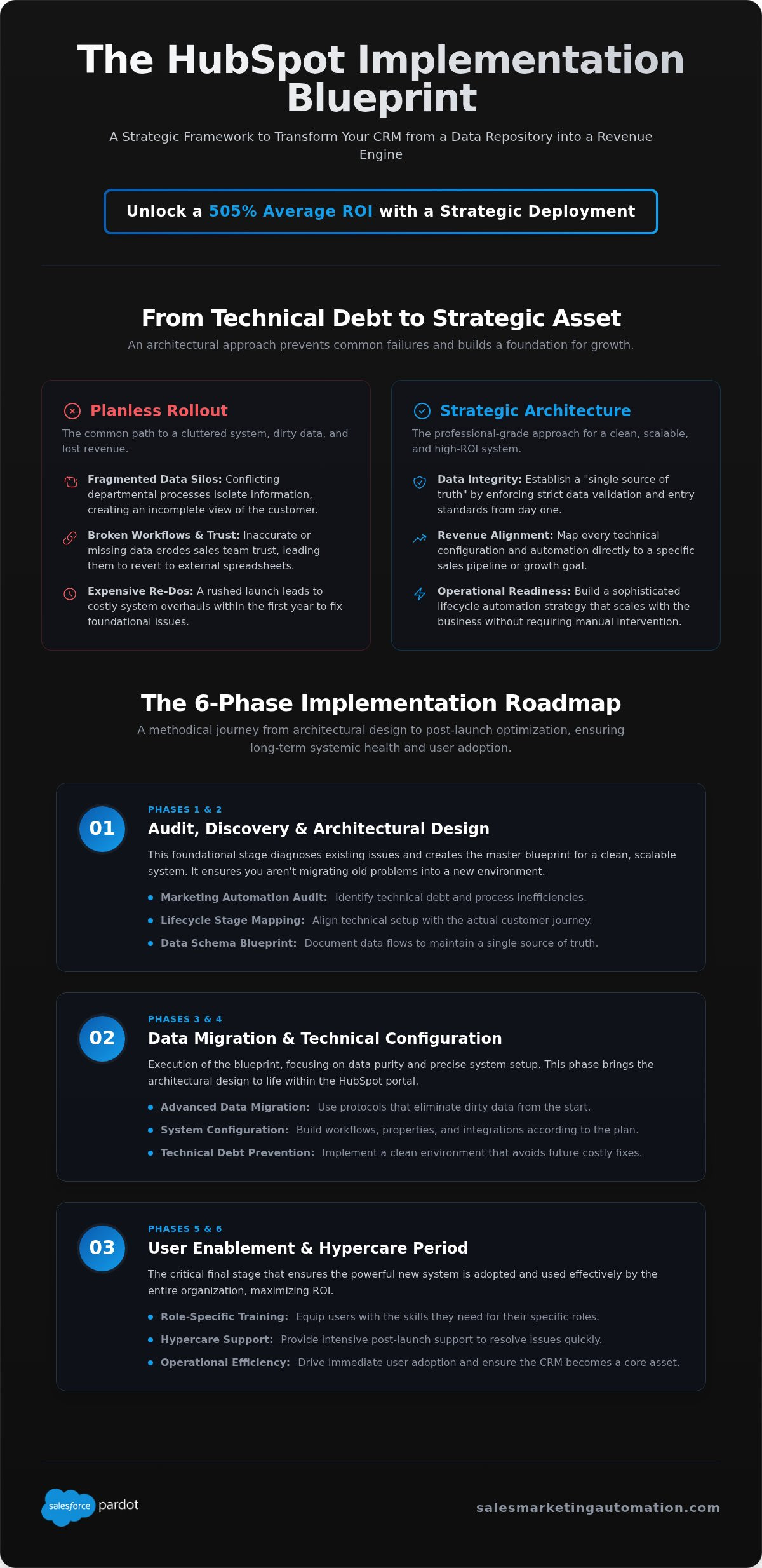
A sophisticated technical build is useless if your team refuses to inhabit the system. The final stages of a hubspot implementation project plan focus on the critical transition from technical readiness to operational fluency. We move beyond generic software tours to develop role-specific training documentation tailored to the unique daily activities of Sales, Marketing, and Service teams. This prescriptive approach ensures that every user understands exactly how to execute their specific workflows within the new architecture, turning the CRM from a perceived burden into an essential performance tool.
Before the full organizational rollout, we execute a “Soft Launch” with a small group of power users. This phase allows us to gather granular feedback on the user interface and automation triggers in a controlled environment. By addressing friction points early, we ensure the final launch is seamless and professional. To maintain this integrity over time, we establish a long-term governance plan. This framework defines property creation rights and data maintenance schedules, preventing the portal clutter and technical debt that typically degrade CRM systems within the first year.
Adoption is the ultimate metric of success for any CRM deployment. We conduct “Live Office Hours” to address user questions in real-time as they begin navigating the live portal. For the sales team, training focuses exclusively on the “What’s in it for me?” factor. We demonstrate how automated prospecting and cleaner deal tracking can contribute to the 68% reduction in campaign launch time reported by efficient HubSpot users. By monitoring login activity and tool usage through custom dashboards, we identify adoption gaps early and provide targeted support before poor habits become entrenched.
The first 30 days post-launch represent the “Hypercare” period, a time of intensive support and systemic refinement. We establish a formal feedback loop for reporting technical bugs or workflow inefficiencies, ensuring that any issues are resolved within hours rather than days. During this window, we review initial reporting dashboards to verify data accuracy and refine lead scoring models based on the first month of real-world engagement data. This iterative loop ensures the system is perfectly calibrated for your revenue goals. If your current strategy lacks this level of rigorous post-launch support, you can partner with an expert architect to secure your long-term operational health.
Attempting an in-house “trial and error” approach to CRM deployment often results in a platform that creates more friction than it resolves. While businesses using HubSpot report an average ROI of 505% over three years, this level of performance is reserved for organizations that prioritize structural integrity from day one. A strategic partner provides the architectural perspective that internal teams typically lack, identifying potential technical debt before it becomes a permanent fixture of your portal. By following a proven hubspot implementation project plan, you bypass the common pitfalls of dirty data and low adoption that frequently stall B2B growth.
Sophisticated decision-makers view HubSpot implementation pricing as a long-term investment in systemic health rather than a one-time expense. An expert-led rollout ensures that your system remains scalable as your tech stack evolves, preventing the need for costly “re-architecture” projects in the future. Sales & Marketing Automation serves as the elite technical choice for complex rollouts, leveraging insights from over 100 successful implementations to build enduring frameworks that align technical configurations with specific revenue goals.
The conclusion of your build phase marks the beginning of your journey toward operational excellence. Transitioning from implementation to managed services allows you to maintain the momentum gained during the launch while ensuring your portal remains optimized. Access to a fractional marketing ops expert provides your team with the strategic guidance needed to navigate new market demands and regulatory shifts. This ongoing refinement transforms your CRM into a scalable, high-performance revenue engine that consistently delivers actionable intelligence to your leadership. By securing professional oversight, you ensure that your hubspot implementation project plan continues to yield results long after the initial go-live date.
A professional-grade rollout requires unwavering commitment to five non-negotiable phases: Audit, Design, Build, Enable, and Optimize. Skipping any of these steps introduces unnecessary risk and reduces the long-term value of your investment. We invite you to move beyond basic software setup and embrace a strategic architectural approach that secures your operational health for 2026 and beyond. Schedule your Strategic HubSpot Assessment today.
Constructing a high-performance CRM requires more than a simple data import; it demands a rigorous architectural blueprint that aligns with your specific B2B growth goals. We’ve explored how a professional hubspot implementation project plan prioritizes data integrity, technical precision, and user enablement to prevent the accumulation of expensive technical debt. By focusing on the non-negotiable phases of audit, discovery, and governance, you ensure your platform remains a scalable asset rather than a fragmented repository.
As certified revenue operations experts with over 100 successful HubSpot implementations and a specialty in complex data migrations, we provide the seasoned experience necessary to execute these frameworks with precision. Don’t leave your revenue engine to chance or settle for basic software onboarding that ignores your unique business logic. Download Our Strategic HubSpot Implementation Checklist today to begin your journey toward a clean, high-performance portal. We’re ready to help you build a system that drives predictable, long-term growth.
A standard implementation usually spans 8 to 12 weeks, depending on the complexity of your data and the depth of required integrations. This timeline accounts for the essential phases of audit, architectural design, and technical configuration. Rushing this process often leads to significant technical debt, so we prioritize structural integrity over speed to ensure a scalable foundation for 2026 and beyond.
Onboarding focuses on basic software orientation and tool setup, while implementation is a strategic architectural project. A hubspot implementation project plan involves deep technical discovery, CRM data migration, and the creation of custom business logic. While onboarding gets you into the platform, implementation ensures the platform is engineered to support your specific revenue operations and long-term business scalability.
Internal IT teams excel at general infrastructure, but they often lack the specialized knowledge of HubSpot’s unique data schema and revenue operations logic. A strategic partner brings diagnostic expertise from hundreds of successful rollouts, preventing common architectural errors. This collaboration allows your IT team to focus on broader systems while we ensure your CRM is built as a high-performance engine for sales and marketing.
The most frequent errors include importing “dirty data” from legacy systems and failing to establish clear property naming conventions. Many organizations also skip the technical audit phase, which leads to fragmented data silos and broken workflows. Without a formal governance plan, portals quickly become cluttered with redundant properties, eroding the sales team’s trust in the CRM and reducing overall ROI.
Budgeting for a professional rollout varies based on the number of Hubs being deployed and the complexity of your existing tech stack. While HubSpot’s own mandatory onboarding fees range from $3,000 for Marketing Hub Professional to $7,000 for Enterprise, a strategic implementation requires additional investment for data migration and custom logic. You should view this as a capital investment in your company’s revenue architecture rather than a simple software expense.
Phased implementation is often the most effective strategy for complex B2B organizations. We typically recommend starting with a core CRM setup and Sales Hub deployment to establish immediate value, followed by Marketing and Service Hub integration. This methodical approach allows your team to achieve high adoption rates in stages, ensuring each department is fully enabled before moving to the next architectural phase.
Prioritize active contact records, open deal history, and essential company associations that directly impact your current sales pipeline. It’s critical to scrub and de-duplicate legacy data before the migration begins to maintain portal health. We advise against migrating stale or unverified records, as “dirty data” is the primary cause of automated workflow failures and inaccurate reporting in new implementations.
Success is measured by high user adoption rates, data accuracy across reporting dashboards, and a measurable reduction in manual operational tasks. A successful hubspot implementation project plan results in a system where sales and marketing teams trust the lead data and follow standardized processes. Ultimately, the true metric is the platform’s ability to drive predictable revenue growth through automated lifecycle management and clear ROI tracking.