 Sales & Marketing Automation
The CRM and Marketing Automation Guru's You Can Trust.
Sales & Marketing Automation
Most B2B organizations treat their CRM as a static archive of past interactions rather than a dynamic engine for future growth. You likely recognize the friction caused by fragmented data across HubSpot and Salesforce, where manual lead management creates bottlenecks and drives up acquisition costs. To remain competitive in 2026, you must pivot from reactive marketing to a sophisticated lifecycle automation strategy. This approach moves beyond simple email sequences, focusing instead on a technical architecture that synchronizes data signals across the entire customer journey to ensure no revenue is left on the table.
We understand that managing a modern buying committee, which now averages more than ten stakeholders, requires more than just creative content; it requires systemic integrity. This article provides the technical blueprint to transform your operations into a scalable, trigger-based revenue motion. You’ll learn how to engineer precise handoffs that can increase sales productivity by 14.5% and implement account-centric journeys that boost Customer Lifetime Value through automated expansion. We will explore the framework for achieving clear visibility into your stage conversion rates and building a foundation that turns raw data into a compounding business asset.
A lifecycle automation strategy isn’t a collection of disparate marketing tactics; it’s a comprehensive technical framework designed to synchronize data signals into actionable revenue outcomes. While many organizations focus on isolated campaigns, the strategic architect views the customer journey as a continuous loop of data-driven triggers. This approach shifts the focus from “what” you are saying to “how” the system detects and responds to buyer intent. By engineering a system that spans from initial awareness to long-term advocacy, you replace manual, error-prone processes with a scalable revenue engine that operates independently of human intervention.
Distinguishing between lifecycle marketing and lifecycle automation is critical for operational health. Marketing defines the messaging, brand voice, and content strategy. Automation, however, represents the technical execution layer. It involves the configuration of Marketing automation platforms to handle complex logic, lead scoring, and cross-platform data synchronization. This distinction is vital because even the most compelling message fails if the underlying architecture doesn’t deliver it to the right stakeholder at the precise moment of relevance. Moving toward an evergreen, relationship-based architecture requires a fundamental pivot from temporary campaign thinking to enduring systemic integrity.
Revenue Operations (RevOps) serves as the connective tissue in this framework. Instead of allowing marketing, sales, and customer success to operate in silos, a RevOps-driven strategy unifies these departments through a shared data schema. When your CRM functions as a single source of truth, every interaction becomes a signal that informs the next automated action. This alignment ensures that the transition from a marketing-qualified lead to a sales-accepted opportunity is seamless, governed by objective data rather than subjective intuition.
Implementing a robust lifecycle automation strategy delivers measurable financial returns. Organizations report an average ROI of 544% on marketing automation over three years, driven largely by the reduction of Customer Acquisition Cost (CAC). By automating lead qualification, you ensure that high-value sales talent only engages with prospects who have demonstrated genuine intent. Furthermore, these systems protect Net Revenue Retention (NRR) by identifying renewal risks or expansion opportunities through automated product usage signals, allowing your team to intervene proactively before churn occurs.
Linear drip campaigns often fail in complex B2B environments because they ignore the non-linear nature of modern buying journeys. Standard email marketing relies on time-based sequences that push content regardless of the recipient’s current needs. In contrast, true lifecycle automation utilizes behavioral triggers. If a prospect visits a pricing page or downloads a technical blueprint, the system reacts instantly. By connecting platform events and CRM stage changes to your workflows, you create a responsive environment that respects the buyer’s pace while maintaining constant, relevant engagement. Properly configured handoffs between departments can result in a 14.5% increase in sales productivity, proving that technical precision outweighs volume every time.
Construct a formal “Data Contract” to ensure your sales and marketing teams operate from identical field definitions. Without this agreement, any lifecycle automation strategy will eventually collapse under the weight of inconsistent data entry and conflicting stage definitions. Establish clear protocols for mandatory fields and data freshness. This alignment ensures that when a lead moves through the funnel, every stakeholder understands exactly what a “Sales Ready” status implies, preventing the friction that occurs when marketing delivers leads that sales cannot use.
Position your CRM as the undisputed source of truth for all lifecycle triggers. In a healthy B2B ecosystem, platforms like HubSpot and Salesforce must maintain a bi-directional sync that prioritizes data integrity over mere connectivity. High-intent signals, such as multiple visits to a technical documentation page or specific product usage milestones, must trigger immediate, automated actions that bypass standard nurture paths. Rapid response to these signals is vital; businesses that respond to leads within an hour are nearly seven times more likely to have meaningful conversations with decision-makers. If your current system feels disconnected, a marketing automation audit can help identify where your data flow is losing momentum.
Design a scoring model that balances demographic fit with behavioral intent. While demographic scores confirm a prospect matches your Ideal Customer Profile (ICP), behavioral scores track their engagement depth across your digital footprint. Set strict thresholds for MQL and SQL handoffs to ensure your sales team only receives leads with a high probability of conversion. Negative scoring serves as the mechanism to filter out low-value noise by deducting points for non-commercial behaviors like visiting a careers page or using a personal email domain. For a comprehensive technical walkthrough of constructing this hybrid system, our lead scoring model setup guide for B2B revenue alignment provides the methodical framework needed to distinguish casual browsing from genuine purchase readiness.
Build workflows with precise entry and exit criteria to prevent prospects from becoming trapped in redundant cycles or receiving irrelevant content. Utilize branching logic to personalize the journey based on specific variables like job role, industry, or expressed product interest. This level of precision ensures the system remains responsive to the buyer’s unique needs. Implement wait steps and frequency capping to maintain a professional cadence and avoid “automation fatigue,” which can lead to increased unsubscribe rates and brand erosion. For practical examples of how to architect these trigger-based motions inside your portal, explore these HubSpot workflow automation strategic examples for B2B revenue operations that demonstrate how to eliminate manual friction and drive predictable growth.
A sophisticated lifecycle automation strategy requires more than just a sequence of emails; it demands a technical architecture that responds to the complexities of the modern B2B buying journey. With an average of more than ten stakeholders involved in every deal, your system must orchestrate engagement across multiple personas simultaneously. By mapping specific automation triggers to the five core stages of the customer journey, you transform your CRM from a passive database into a proactive revenue engine. Each stage serves a distinct purpose in moving the account toward higher lifetime value.
Moving prospects from being problem-aware to solution-aware requires a precise content delivery system. Deploy case studies and technical whitepapers through triggers that fire when an account reaches a specific intent threshold. Implement sales alerts that notify representatives the moment a target account engages with high-value assets. If a lead goes cold for 30 days or more, the system should initiate an automated re-engagement sequence designed to address common objections or highlight recent product innovations, keeping your brand top-of-mind without manual effort.
The revenue journey doesn’t end at the signature; it merely enters a new phase of technical management. Construct onboarding sequences that drive “First Value” rapidly to secure long-term retention. Automated renewal reminders and health checks should be integrated into the workflow, providing account managers with the data they need for proactive outreach. By identifying expansion signals early, you can trigger automated motions for upsells, ensuring your lifecycle automation strategy continues to drive growth long after the initial acquisition.
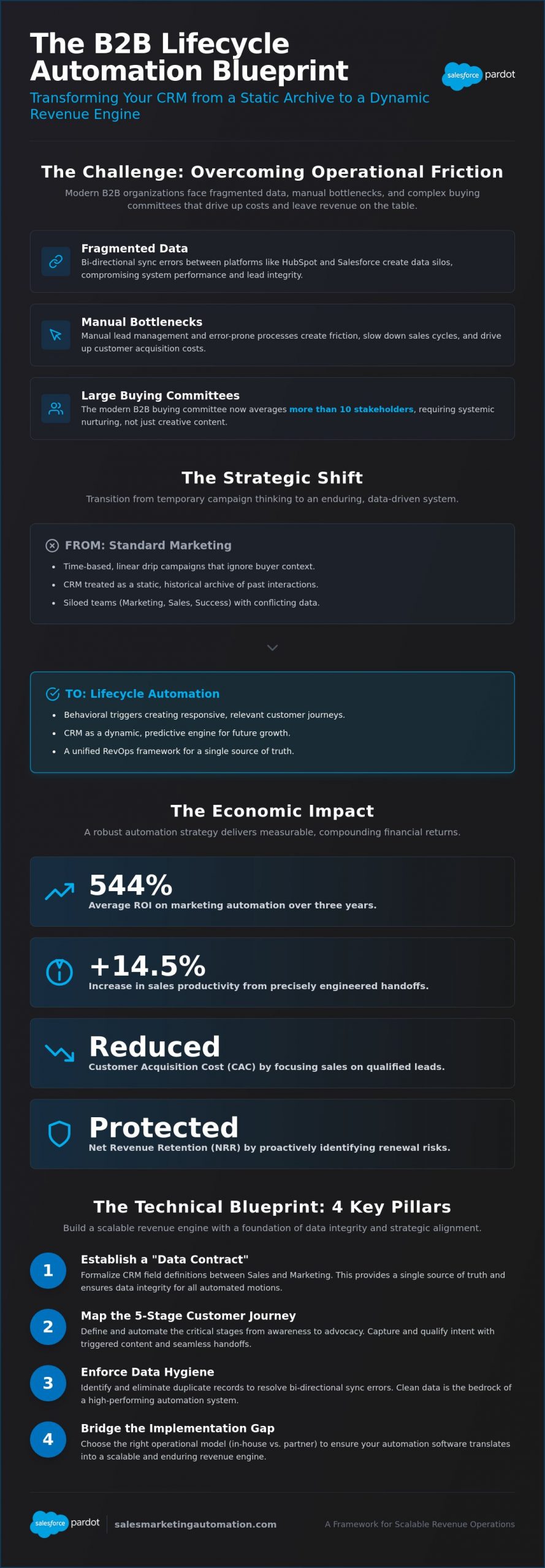
Technical debt is the silent killer of even the most sophisticated lifecycle automation strategy. When your CRM is cluttered with duplicate records and inconsistent data entry, the logic powering your triggers begins to fail. This friction doesn’t just result in minor annoyances; it leads to misaligned messaging, missed follow-ups, and a complete breakdown of the buyer’s trust. To maintain systemic integrity, you must prioritize the health of your data architecture above the complexity of your workflows. Establishing strict validation rules and standardized picklists ensures that every data point entering your system is clean, actionable, and ready to fuel your revenue engine.
Managing the bi-directional data flow between HubSpot and Salesforce presents a unique set of challenges that can derail your automation efforts. Sync errors often occur when field mappings are misaligned or when API limits are reached, causing leads to stall in the funnel. Before attempting to scale your operations, performing a comprehensive marketing automation audit is a mandatory first step. This diagnostic process identifies the specific points of failure in your tech stack, allowing you to bridge the gap between your marketing automation platform and your CRM before technical errors translate into lost revenue.
Implement a deduplication strategy that prioritizes the preservation of engagement history. Merging records must be handled with precision to ensure that lead scores and activity logs remain intact across both platforms. Verify that every custom property is mapped correctly between your systems to prevent data loss during the sync process. Data integrity is a continuous process, not a one-time project. Regular maintenance schedules and automated cleanup tools are essential for preventing the accumulation of “dirty data” that compromises your trigger accuracy.
Leads often fall through the cracks due to missing required fields or conflicting logic within complex branching paths. To mitigate this risk, utilize “Shadow Workflows” to test your logic in a controlled environment before going live. These parallel paths allow you to monitor how data moves through the system without triggering external communications. Additionally, configure automated alerts to notify your operations team the moment a sync error or API failure occurs. If your current database is too fragmented to support high-performance automation, a professional CRM Data Migration may be necessary to rebuild your foundation on solid ground.
Investing in top-tier platforms like HubSpot or Salesforce represents a significant capital commitment, yet many organizations fail to realize a return because they mistake software procurement for strategic execution. This “Implementation Gap” occurs when a business possesses the tools but lacks the technical blueprint to connect them. A high-performance lifecycle automation strategy is not a “set and forget” project; it is a complex, evolving architecture that requires constant refinement. If you need a partner to build the custom web infrastructure that powers these systems, you can visit Digital Junction to bridge the technical divide. Without a dedicated technical consultant to design and oversee this revenue blueprint, the software often becomes little more than an expensive, glorified Rolodex. Precision is mandatory for success.
Measuring the impact of your investment in 2026 requires looking beyond surface-level metrics. You must evaluate success through the lens of Customer Lifetime Value (CLV) and Net Revenue Retention (NRR). Companies that successfully engineer their automation motions report an average ROI of 544% over three years. This figure is achieved by systematically removing manual bottlenecks and ensuring that every data signal translates into a precise business outcome. Choosing between managed services and project-based engagements depends on your internal capacity for ongoing optimization and your need for long-term systemic integrity. Results depend on the caliber of your architecture.
Managed services provide access to a comprehensive team of architects, designers, and data specialists that most internal departments cannot sustain. Relying on a single internal hire creates a dangerous “single point of failure” if that individual leaves the organization, potentially taking the institutional knowledge of your complex workflows with them. External partnerships mitigate this risk while providing the continuous optimization necessary as market conditions shift. A sophisticated lifecycle automation strategy must evolve alongside your product and your audience’s behavior, requiring a level of specialized expertise that a generalist marketing team rarely possesses. Consistency is the hallmark of a professional operation.
Begin your transformation with a rigorous technical assessment to identify existing revenue leaks and data friction points. This diagnostic phase allows you to build a roadmap that prioritizes high-impact workflows, ensuring that your most critical bottlenecks are addressed first. Once the foundation is secure, you can begin the process of scaling your automated motions across the entire customer journey. This methodical approach ensures that every step you take builds toward a more resilient revenue engine. Ready to scale? Explore our HubSpot Implementation services to build your foundation and transform your fragmented data into a high-performance revenue engine.
Transitioning from fragmented data to a unified revenue motion requires a fundamental shift in how you view your technical architecture. You’ve seen how a robust lifecycle automation strategy relies on a firm data contract and precise behavioral triggers to drive compounding growth. By addressing technical debt and mapping the customer journey across five distinct stages, you replace manual inefficiency with a scalable framework that operates with precision and systemic integrity. This evolution ensures that your CRM functions as a dynamic asset rather than a static record of the past.
Building this architecture internally often leads to the implementation gap that stalls progress and drains resources. To ensure your system remains resilient and responsive to market shifts, Partner with a Strategic Architect to build your Lifecycle Automation Strategy. With deep expertise in HubSpot, Salesforce, Pardot, and Marketo, we provide the seasoned perspective needed to bridge the gap between software procurement and strategic execution. Our strategic audits uncover hidden revenue leaks, and our track record of 100+ successful technical implementations ensures your foundation is built to endure. Your path to a streamlined, automated future starts with a single, diagnostic step toward operational health.
Distinguish lifecycle marketing as the creative strategy while a lifecycle automation strategy serves as the technical architecture that enables messages to fire based on data signals. While marketing defines the narrative, automation engineers the triggers and data flows. This ensures the right content reaches the right stakeholder at the precise moment of relevance, transforming static messaging into a dynamic revenue engine.
Plan for a phased timeline rather than a single implementation event. Initial technical audits and foundational data cleanup generally require four to six weeks of focused effort. Constructing core revenue workflows often spans two to three months; however, achieving full maturity is a continuous process. Your system must evolve as your market landscape and product offerings change to maintain peak operational health.
Select tools based on your organizational complexity and existing tech stack. HubSpot remains a premier choice for mid-market organizations due to its integrated nature, while Salesforce combined with Pardot or Marketo offers the granular control required by large enterprises. For 2026, prioritize platforms that offer robust API connectivity and account-centric architectures to manage the increasing complexity of multi-stakeholder B2B buying committees.
Establish data integrity as the prerequisite for any automated motion. Attempting to automate processes using fragmented or “dirty” data will only accelerate operational errors and damage your brand reputation. Prioritize a thorough data migration or cleanup phase to create a single source of truth. This foundation ensures that your triggers fire accurately and that your reporting reflects the actual state of your funnel.
Utilize lead scoring as the primary filter for your automation logic. It distinguishes between passive interest and high-intent engagement by assigning values to specific demographic and behavioral signals. By establishing clear thresholds for MQL and SQL handoffs, you ensure that your sales team only engages with prospects who meet your ICP criteria and have demonstrated a genuine readiness to purchase.
Deploy automated systems to identify churn risks before they result in lost revenue. By monitoring product usage data and service engagement signals, you can trigger proactive alerts for account managers when a customer’s health score drops. These automated interventions allow your team to provide timely support or targeted resources, significantly increasing Net Revenue Retention through systematic, data-driven oversight.
Quantify ROI by tracking improvements in Customer Acquisition Cost (CAC) and Net Revenue Retention (NRR). You should also monitor sales productivity; properly configured handoffs can lead to a 14.5% increase in efficiency according to industry benchmarks. By analyzing stage conversion rates and the acceleration of the sales cycle, you can measure the direct impact of your automation workflows on profitability.
Evaluate the investment based on your technical debt and the complexity of your customer journey. Factors such as the number of integrated platforms, total contact volume, and the depth of required custom properties will influence the total cost. It’s vital to budget not just for software licensing but also for the strategic architecture and ongoing managed services required to maintain long-term system integrity.