 Sales & Marketing Automation
The CRM and Marketing Automation Guru's You Can Trust.
Sales & Marketing Automation
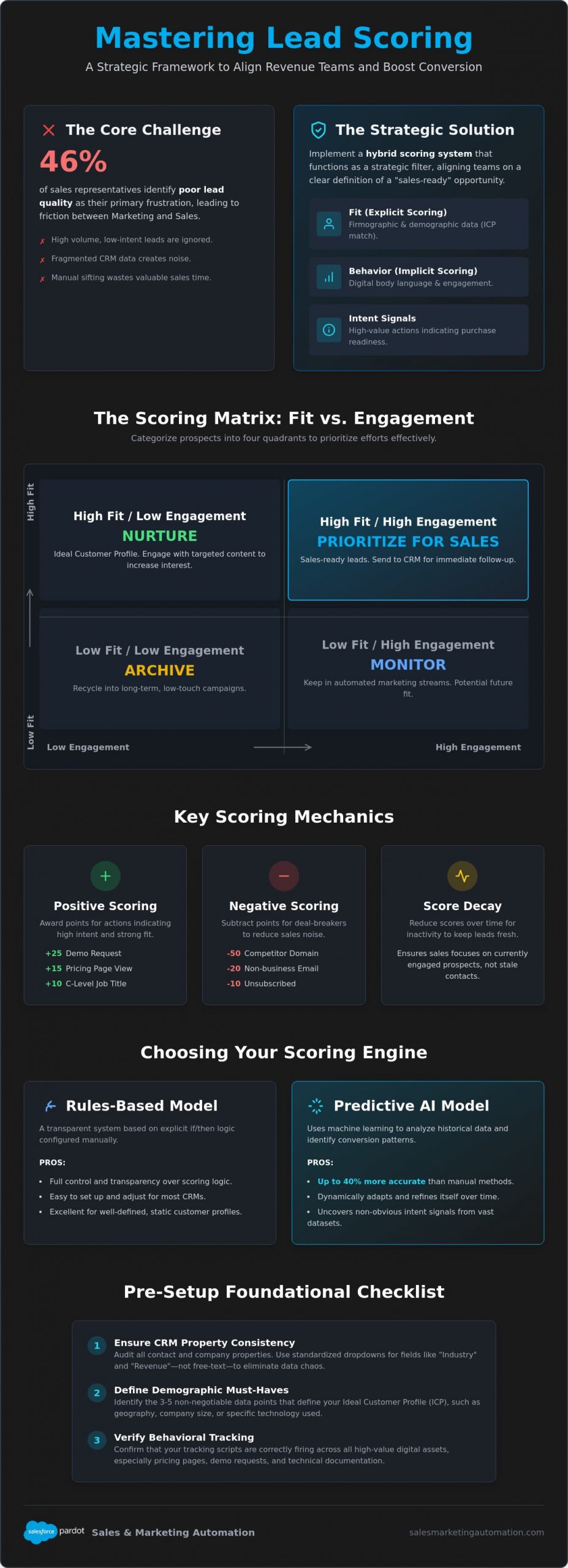
When 46% of sales representatives identify lead quality as their primary frustration, the breakdown isn’t usually a lack of data; it’s a failure of systemic architecture. You’ve likely experienced the friction that occurs when marketing delivers high lead volumes while sales continues to ignore them because they lack clear intent signals. A fragmented CRM cluttered with low-value prospects is often the direct result of an incomplete lead scoring model setup that fails to distinguish between casual browsing and genuine purchase readiness.
Master the technical framework and strategic logic required to align your revenue teams and drive significantly higher MQL-to-SQL conversion rates. This guide provides a methodical roadmap for constructing a hybrid scoring system that integrates fit, behavior, and intent. We’ll examine how to implement AI-driven predictive signals that improve accuracy by up to 40% over manual methods, ensuring your automated prioritization remains both precise and compliant with 2026 data privacy mandates like the EU AI Act.
High-performance revenue engines require more than just software; they demand a foundational logic that treats every lead as a resource allocation decision. Lead scoring functions as a strategic filter, ensuring that your sales team’s limited time is invested exclusively in prospects with the highest probability of conversion. Without this mechanism, your CRM becomes a repository of noise, forcing sales representatives to manually sift through thousands of contacts to find a single viable opportunity.
Adopting a “Strategic Architect” approach means you must resist the urge to jump directly into your CRM settings. A successful lead scoring model setup begins with strategic alignment rather than technical configuration. You’re building a framework that translates abstract buyer behaviors into concrete business value. This process requires a deep understanding of the Lead scoring methodology, moving beyond simple point-assignment to create a system that reflects your specific market reality.
Data health remains the single greatest barrier to an effective model. Dirty CRM data, such as duplicate records, missing job titles, or outdated company sizes, renders any scoring logic ineffective. Before you assign a single point, you must ensure your data is clean and standardized. This foundation allows you to establish a robust Sales-Marketing Service Level Agreement (SLA). In 2026, a “qualified” lead is no longer just someone who downloaded a whitepaper; it’s a prospect that meets specific firmographic criteria and exhibits high-intent behaviors that your teams have mutually agreed upon.
Revenue Operations acts as the bridge between marketing engagement and sales reality. Their primary objective is to align internal teams on the critical distinction between “interest” and “intent.” While marketing might see a webinar attendance as a success, sales requires evidence of a business problem that your solution can solve. RevOps establishes the necessary feedback loops to perform a regular marketing automation audit, allowing you to refine your scoring criteria monthly based on actual closed-won data rather than assumptions.
Ensure your technical infrastructure is prepared to support your lead scoring model setup by verifying these critical components:
Effective revenue alignment requires a multidimensional view of your pipeline. A linear point system often fails because it conflates interest with eligibility. By utilizing a two-axis matrix, you can distinguish between a high-value prospect researching a solution and a low-fit individual simply consuming content. This distinction is the core of a sophisticated lead scoring model setup, allowing you to categorize prospects into four distinct quadrants: high fit/high engagement, high fit/low engagement, low fit/high engagement, and low fit/low engagement.
Explicit scoring focuses on firmographic and demographic data. These are the static attributes that define your Ideal Customer Profile (ICP). If a lead doesn’t meet your geographic or revenue requirements, their behavioral engagement is irrelevant to your sales team. Conversely, implicit scoring captures digital body language. It’s the dynamic layer of your model that quantifies intent. While explicit data tells you if they can buy, implicit data tells you if they want to buy right now.
Negative scoring is your primary tool for noise reduction. It functions as a systemic safeguard, subtracting points for “deal-breaker” criteria such as competitor domains, non-business email addresses, or prolonged inactivity. If your current system is producing too much noise for sales, a comprehensive Lifecycle Automation strategy can help refine these thresholds to ensure only high-precision opportunities advance.
Assign values based on how closely a lead matches your ICP. Prioritize job titles that hold decision-making authority, such as “Director” or “VP,” while assigning lower values to individual contributors. Weight company size and industry alignment heavily; a lead from a target enterprise sector should always outscore a lead from an adjacent, non-core market. Compatibility with your tech stack should also be a high-weight explicit signal, as it often dictates the feasibility of a successful partnership.
Differentiate between educational interest and purchase intent. A visit to a pricing page or a “request a quote” submission signals high intent and should carry significant weight. In contrast, blog post views or social media clicks represent low-intent engagement and should receive minimal points. Implement a “Hand-Raiser” exception within your lead scoring model setup. This allows high-intent actions, like a demo request, to bypass the scoring threshold entirely and route directly to sales, ensuring immediate follow-up when the prospect is most active. Leads that don’t yet meet this threshold are strong candidates for a structured b2b lead nurture campaign design that systematically builds intent until they reach sales readiness.
Selecting the optimal methodology for your lead scoring model setup is a pivot point between operational simplicity and technical precision. Traditional rules-based models offer a high degree of transparency and control, making them ideal for organizations with lower lead volumes or those just beginning their alignment journey. Predictive models, by contrast, utilize machine learning to identify complex correlations within your data that escape human observation. In 2026, predictive lead scoring is documented to be 30% more accurate than manual rule-based systems, though its efficacy depends entirely on the volume and quality of your historical data.
High-growth organizations often find the most success with a hybrid approach. They use manual rules to enforce strict Ideal Customer Profile (ICP) fit while allowing AI to score behavioral intent. This ensures that while the machine identifies who is most likely to convert, your human-defined rules ensure that the leads being prioritized actually meet your business requirements. Determining which model is right for your architecture requires an honest assessment of your data maturity and monthly lead flow.
Manual systems rely on your team’s historical intuition to assign point values to specific actions. You might decide that a pricing page visit is worth 15 points while a blog post view is worth only 2. The primary benefit of this approach is absolute clarity; your sales team knows exactly why a lead reached the MQL threshold. This transparency builds trust between departments. However, these models are inherently prone to human bias and require constant manual adjustment. If your team miscalculates the value of a specific webinar, the entire prioritization logic becomes skewed until a manual intervention occurs.
Predictive models eliminate guesswork by analyzing thousands of data points across your CRM and marketing automation platforms. To achieve predictive accuracy, your system typically requires a baseline of historical data to train the algorithm effectively. AI excels at uncovering silent conversion signals, such as specific sequences of page views or unique timing intervals, that a manual lead scoring model setup would likely overlook. Integrating these sophisticated scores into a broader lifecycle automation strategy transforms your CRM from a static database into a dynamic prioritization engine that reduces false positives by up to 25%.
Transitioning from a strategic matrix to a functional technical environment requires precise configuration within your chosen CRM or marketing automation platform. Whether you’re executing a lead scoring model setup in HubSpot, Salesforce, or Pardot, the process begins by identifying the primary scoring property that will serve as the master record for prospect priority. In HubSpot, this is typically the standard “HubSpot Score” property, while Salesforce users may utilize “Einstein Lead Scoring” or custom numeric fields mapped from Pardot. Once this property is designated, you must build the specific positive and negative attribute filters that translate digital signals into numeric values.
Construct your filters by layering demographic fit with behavioral intent as defined in your earlier strategic planning. Assign positive points for high-value actions, such as multiple pricing page visits or specific job titles, while simultaneously applying negative filters for disqualifying factors like student status or competitor email domains. After the logic is built, establish your “MQL Threshold,” which is the specific numeric value that triggers a hand-off to the sales team. For most B2B organizations, this threshold should be tested against a sample of 50 to 100 historical leads to verify that the model correctly identifies converted opportunities while filtering out the noise that previously cluttered your CRM.
If your team requires expert assistance to navigate these technical complexities, our Salesforce & Pardot Consulting services ensure your scoring architecture is built for maximum technical integrity and revenue impact.
Defining the “Sweet Spot” for your MQL threshold is a balancing act between lead volume and lead quality. If the threshold is too low, your sales team will be overwhelmed with low-intent prospects; if it’s too high, you risk missing viable opportunities. Implement “Fast-Track” workflows for leads who perform high-intent actions, such as demo requests, allowing them to bypass the standard scoring accumulation and route directly to a representative. Use score-based segmentation to place lower-scoring leads into targeted nurture campaigns, ensuring they remain engaged until they reach the required threshold for sales intervention.
Systemic alignment fails if your scoring data is siloed within a single platform. Ensure that your scoring properties sync correctly between your marketing automation tool and your CRM so that sales representatives have full visibility into a prospect’s digital body language directly on the lead or contact record. Map these scores to custom fields during the lead scoring model setup to enable advanced reporting and dashboarding. Configure your CRM integration to sync scoring properties at a frequency of no more than 15 minutes to eliminate latency between marketing engagement and sales notification. Pairing your scoring logic with well-structured HubSpot workflow automation ensures that high-scoring leads trigger immediate, personalized follow-up sequences without any manual intervention from your revenue team.
A high-precision lead scoring model setup only remains effective if it adapts to the shifting realities of your market and buyer behavior. Static models inevitably suffer from drift, where the original assumptions used during construction no longer align with current conversion data. Systemic optimization ensures your scoring logic remains a reliable indicator of revenue potential rather than a legacy configuration that creates friction. This requires a transition from a “launch” mindset to a lifecycle management approach, focusing on the long-term integrity of your data and the accuracy of your hand-off thresholds.
Execution of a quarterly marketing automation audit is the most effective way to identify hidden biases or inaccuracies within your framework. During these reviews, you must analyze “False Positives,” which are leads that reached the MQL threshold but were rejected by sales or failed to progress in the pipeline. Determining why these high-scoring leads failed to convert allows you to refine your attribute weighting and tighten your filters. As your product lines expand or your Ideal Customer Profile (ICP) evolves, your model must scale accordingly to accommodate new personas without diluting the quality of existing lead flows.
Intent has an expiration date. If a prospect engaged heavily three months ago but’s remained inactive since, their score shouldn’t reflect a current state of readiness. Implement time-based degradation rules, or “Score Decay,” to automatically subtract points for prolonged inactivity. This prevents your CRM from being cluttered with “zombie” leads that appear qualified on paper but aren’t in a buying cycle. Regularly interview your sales representatives to gather qualitative feedback on lead quality. If they report that certain behaviors pass the threshold too easily, adjust those weights to reflect the competitive landscape of 2026.
Maintaining the technical integrity of a sophisticated lead scoring model setup often requires specialized expertise that internal teams lack. Ongoing managed services provide the diagnostic oversight necessary to prevent model degradation and ensure your automation remains aligned with your revenue goals. Utilizing fractional marketing operations allows your organization to access elite technical skills for periodic refinement without the overhead of a full-time architect. Ready to build a better funnel? Schedule a technical implementation audit today.
Aligning sales and marketing requires more than shared goals; it demands a technical architecture that enforces those objectives. By prioritizing a hybrid matrix of profile fit and behavioral intent, you transform your CRM from a cluttered database into a prescriptive prioritization engine. A robust lead scoring model setup ensures that your sales team focuses exclusively on high-value opportunities while marketing gains the clarity needed to refine top-of-funnel strategies. Success doesn’t come from a one-time configuration but from a commitment to continuous optimization and data integrity.
Maintaining this level of systemic precision requires seasoned expertise and a focus on long-term operational health. With over 100 successful CRM implementations, our HubSpot and Salesforce certified experts provide the strategic Revenue Operations focus necessary to build and audit complex scoring frameworks. Scale your revenue with a custom Lead Scoring Model Setup and ensure your technical infrastructure is built for precision. It’s time to replace fragmented processes with a framework designed for the complexities of the 2026 market.
Establish a benchmark threshold of 100 points to allow for granular weighting across various signals. Assign high-intent actions, such as demo requests or pricing page visits, values between 15 and 20 points, while firmographic fit attributes might carry 5 to 10 points. This spread provides enough room to distinguish between casual browsers and serious prospects without overcomplicating the initial logic.
Perform a comprehensive technical audit every quarter to ensure your weights still reflect market reality. You should also conduct brief monthly reviews with sales leadership to analyze “False Positives” and adjust thresholds if lead quality is fluctuating. Regular refinement prevents the model from becoming stagnant as your product offerings and Ideal Customer Profiles evolve.
Yes, utilizing multiple scoring properties is a best practice for organizations with diverse business units. Platforms like HubSpot Enterprise and Salesforce allow you to build separate logic for different product lines, which is essential if your buyer journeys vary significantly in length or complexity. A multi-model lead scoring model setup ensures that a prospect’s interest in a low-cost entry product doesn’t trigger the same sales priority as a high-value enterprise solution.
Lead scoring quantifies a prospect’s digital behavior to measure intent, while lead grading evaluates their firmographic data to measure fit. Scoring is typically a dynamic numeric value that fluctuates based on engagement, whereas grading is often a static letter grade (A through F) based on how well they match your ICP. Integrating both allows your sales team to prioritize high-fit leads that are also exhibiting high-intent behaviors.
Implement automated score decay rules to degrade point totals after specific intervals of inactivity. For example, you might subtract 10 points for every 30 days a lead fails to engage with your content. This systemic safeguard ensures that your sales queue remains focused on active buyers rather than prospects whose interest has gone cold.
Predictive scoring offers superior accuracy for organizations with high lead volumes, typically requiring thousands of historical records to train the machine learning algorithm effectively. For smaller companies or those with limited data, manual rules-based models are often more effective because they provide total transparency and control. In 2026, predictive models are documented to reduce false positives by 25% when supported by sufficient data maturity.
Involve sales leadership in the initial definition of your scoring attributes and thresholds. When representatives understand the specific logic behind an MQL notification, they’re more likely to prioritize those leads. Establishing a formal Service Level Agreement (SLA) that outlines the expected follow-up time for high-scoring leads further solidifies this departmental trust.
Avoid the trap of scoring every digital interaction, which creates noise rather than clarity. The most frequent errors in a lead scoring model setup include failing to use negative scoring for competitors, ignoring score decay for inactive leads, and neglecting to standardize CRM data before implementation. Technical precision is impossible without a foundation of clean, consistent data and strategic alignment between teams.