 Sales & Marketing Automation
The CRM and Marketing Automation Guru's You Can Trust.
Sales & Marketing Automation
Research indicates that 70% of CRM implementations fail. The culprit is rarely the technology, but rather a fundamental disconnect between software features and business strategy. If you’re currently facing inaccurate reporting that leadership ignores or sales teams that refuse to log their activities, you’re likely experiencing the fallout of common hubspot implementation mistakes. These errors create structural CRM debt that prevents your organization from reaching its full revenue potential.
We agree that a CRM should be a source of truth, not a source of friction. You deserve a platform that empowers your team instead of slowing them down. This guide provides the blueprint to transform your portal into a high-performing revenue engine that actually converts. This article explores the critical technical and strategic pitfalls to avoid, ensuring your data structure is ready for the 2026 AI-driven landscape. From seamless lead handoffs to advanced reporting, you’ll discover how to build a scalable framework that supports long-term operational health and maximizes your HubSpot investment.
HubSpot’s greatest marketing asset is its intuitive interface. This accessibility often lures leadership into a false sense of security; they believe they can simply “turn it on” and watch revenue grow. This mindset is the root of many common hubspot implementation mistakes. Treating a sophisticated Customer Relationship Management (CRM) system as a plug-and-play tool ignores the reality that software is merely a vehicle for your business strategy. Without a defined strategy, you’re simply automating inefficiency at a higher velocity.
The “Ease of Use” paradox creates immediate structural debt. Because it’s easy to create properties, pipelines, and workflows, teams often build them on the fly without considering how these elements interact across the entire customer journey. This leads to a fragmented portal where data exists in silos, and reporting becomes impossible to trust. B2B scalability requires moving beyond the “Default Setup.” While a default setup is designed for everyone, a strategic architecture is designed exclusively for your specific revenue goals. The primary symptom of this mistake is a portal cluttered with unused features and “ghost” data that provides no actionable insights.
Successful implementations begin long before the first user invite is sent. You must map your business processes outside of HubSpot first to identify every touchpoint, handoff, and data requirement. Building as you go without a documented data schema leads to records that exist but serve no purpose. CRM Architecture is the foundational framework of data structures, integrations, and logic that ensures your technology supports long-term revenue growth rather than constraining it.
Deploying features like Sequences or Playbooks before defining your sales process is a recipe for low adoption. High-performing teams reverse this logic. Start with the desired business outcome, such as reducing time-to-close, and then select the HubSpot tool that facilitates that result. This workflow-first approach ensures that technical configuration mirrors real-world activity. Secure stakeholder alignment early by involving both sales and marketing leaders in the mapping phase. When the platform reflects their actual daily challenges, the CRM becomes an indispensable asset rather than a complicated administrative burden.
Structural debt in a CRM is the cumulative cost of technical shortcuts and architectural compromises taken during the initial setup. While Harvard Business Review identified the four common pitfalls of CRM decades ago, many organizations still fall into the trap of prioritizing speed over systemic integrity. This is one of the most damaging common hubspot implementation mistakes. When your data architecture is flawed, every automation you build and every report you generate sits on a fractured foundation. The reality for B2B teams is simple: dirty data in results in dysfunctional insights out. If your leadership doesn’t trust your dashboards, it’s likely because your data structure doesn’t mirror your business reality.
Property bloat occurs when a lack of governance allows every user to create custom fields at will. This leads to redundant properties; for example, “Job Title” and “Position” might be used interchangeably across different departments. This fragmentation paralyzes sales productivity because reps spend more time deciphering which field to update than they do engaging with prospects. To prevent this, you must standardize naming conventions and implement a rigid property audit. Pruning redundant data points and restricting creation rights ensures your portal remains lean and functional. Maintaining this level of order is essential for long-term scalability and prevents the CRM from becoming a digital graveyard that users eventually abandon.
Many teams view migration as a simple “lift and shift” exercise. This is a critical error. Moving garbage from an old system into a new HubSpot portal only accelerates your failure. You must engage in rigorous data mapping and cleansing before the import begins. Handling historical data requires a strategic approach. You shouldn’t clutter active pipelines with legacy information that has no current utility. Utilizing professional crm data migration services allows you to preserve essential history while starting with a clean, high-integrity database. If your current migration strategy feels overwhelming, a strategic CRM data audit can help identify exactly what needs to be purged before you make the leap. This ensures your new HubSpot environment is optimized for growth from day one.
Misalignment in lifecycle stages represents a critical failure point in many B2B organizations. When Marketing and Sales operate with different definitions of lead readiness, prospects inevitably fall through the cracks. This disconnect creates a leaky pipeline where potential revenue vanishes into a void of administrative confusion. Relying on HubSpot’s default lifecycle stages is one of the most frequent common hubspot implementation mistakes. These defaults are designed for general use, but they rarely accommodate the nuanced, multi-stakeholder journey typical of a complex B2B sales cycle. Strategic growth requires a custom framework that mirrors your specific buyer journey.
Solving this friction requires a holistic revenue operations consulting approach. Alignment isn’t just about software settings; it’s about establishing a shared vocabulary between departments. Without this agreement, your Marketing Qualified Leads (MQL) will continue to be ignored by Sales, and your Sales Qualified Leads (SQL) will lack the contextual data necessary for a successful conversion. True alignment ensures that every department understands exactly what a lead must do to move from one stage to the next.
Establishing objective, binary criteria for every stage transition is essential for operational health. Relying on manual stage updates introduces human error and data inconsistency, which ultimately degrades the integrity of your reporting. Instead, you should leverage a robust lifecycle automation strategy to trigger stage changes and sales alerts based on deterministic behaviors. This ensures that the handoff is seamless. Sales reps should receive notifications only when a prospect has met the specific engagement thresholds your team has verified. This automation protects your brand reputation by ensuring timely, relevant follow-up.
Creating too many pipelines is another of the common hubspot implementation mistakes that often generates more confusion than clarity. Each pipeline should serve a distinct business purpose rather than merely separating product lines or territories. Stagnant stages, where leads sit indefinitely without progress, distort executive reporting and make accurate forecasting impossible. Every stage in your pipeline must represent a clear, binary action in the buyer journey. If a stage doesn’t require a specific outcome to move forward, it’s a source of friction that should be eliminated to maintain systemic integrity and support advanced AI reporting.
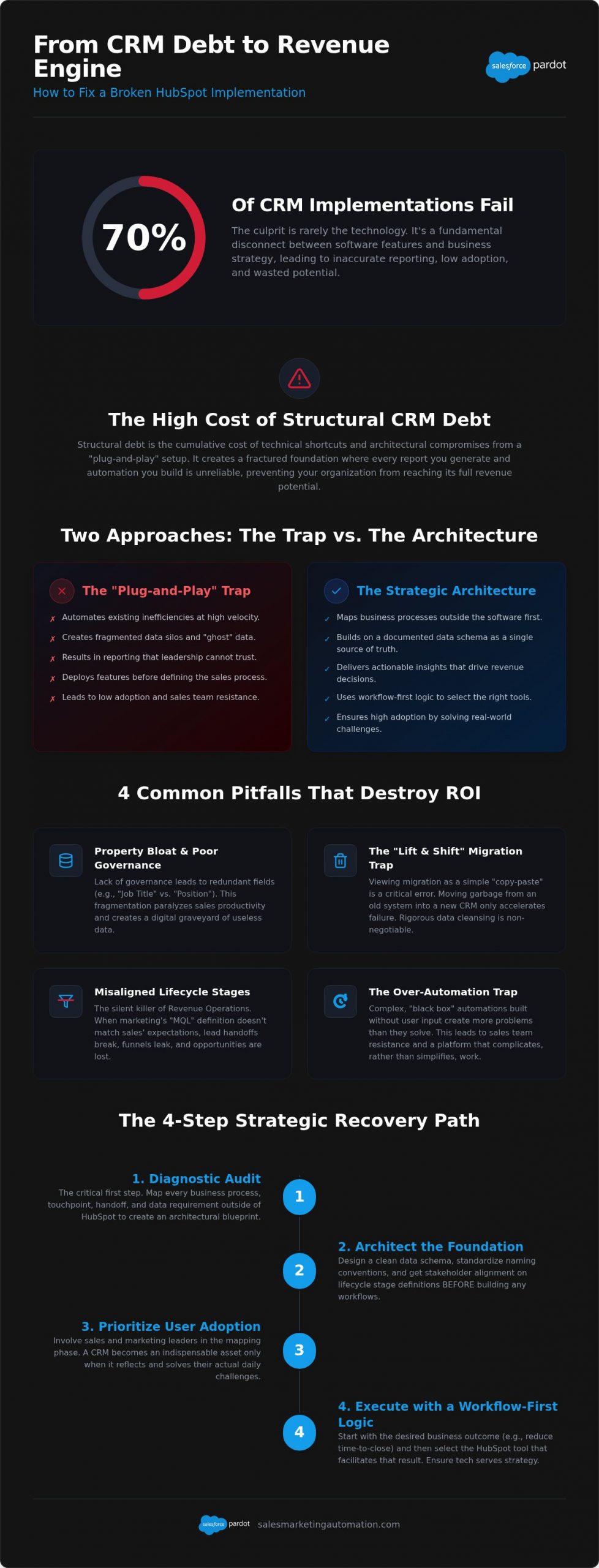
Automation should serve the user, not the other way around. Over-engineering leads to the “Black Box” problem, where technical logic becomes so dense that even the admins can’t explain why a lead received a specific communication. This lack of transparency is one of the most frustrating common hubspot implementation mistakes because it directly damages brand reputation. When automations fire incorrectly, prospects receive irrelevant content, and sales teams lose confidence in the system’s reliability. You must avoid the temptation to automate a process that hasn’t been proven manually. If a manual lead handoff is messy, an automated one will only accelerate that dysfunction.
Maintain systemic health by auditing existing workflows for redundancy and “collision.” Collision occurs when multiple automations are triggered by the same event, resulting in a chaotic and unprofessional experience for the prospect. A high-performing portal requires a lean automation stack where every workflow has a documented purpose and a clear owner. If your current portal feels like a maze of conflicting workflows, a professional marketing automation audit is the most efficient way to identify and resolve these technical bottlenecks.
User adoption is the ultimate metric of implementation success. If the sales team finds the interface overwhelming or cluttered with irrelevant fields, they’ll eventually revert to spreadsheets. You can prevent this by utilizing custom Record Views to simplify the user experience. These views ensure that reps only see the data essential to their specific role, reducing cognitive load and increasing productivity. Support this technical refinement with a comprehensive HubSpot Playbook. This internal documentation establishes team consistency and serves as the definitive guide for how your organization utilizes the platform.
Portal chaos often stems from “Super Admin” sprawl. Granting full access to every user is a shortcut that inevitably leads to accidental data deletion and configuration errors. You must structure permissions based on specific roles to protect the integrity of your CRM architecture. Define clear Record Ownership rules to ensure accountability throughout the sales process. When ownership is ambiguous, leads are neglected and reporting becomes skewed. Establishing a rigid hierarchy of permissions and clear lines of responsibility ensures that your HubSpot environment remains secure, organized, and scalable as your revenue operations grow.
Postponing the resolution of common hubspot implementation mistakes is the most expensive operational decision a leadership team can make. Every day spent operating within a fractured portal compounds technical debt and further erodes the trust of your sales and marketing teams. Recovery requires a fundamental shift from merely “fixing bugs” to re-architecting the entire system for sustainable growth. The first step in this technical restoration is a comprehensive marketing automation audit. This diagnostic process identifies the root causes of systemic failure rather than just treating the surface-level symptoms that frustrate your users.
Sales & Marketing Automation specializes in these complex technical recoveries. We act as the Strategic Architect, diagnosing structural flaws and implementing precise interventions that return your CRM to a state of high performance. By moving beyond reactive fixes, we help you build a durable framework that supports advanced reporting and AI integration, ensuring your technology finally aligns with your revenue goals.
Identify the red flags in your current portal usage, such as duplicate records, orphaned workflows, and disconnected integrations. Map every existing automation against actual business outcomes to determine if your technology is facilitating or hindering the sales process. You must prioritize your interventions based on revenue impact. If a misaligned lead handoff is causing high-value prospects to stall, that structural repair must take precedence over aesthetic dashboard adjustments or minor property updates.
Cleanse your database by consolidating redundant properties and purging historical data that no longer serves a strategic purpose. You must redefine your lifecycle stages and pipeline logic to ensure they represent binary, actionable steps in your specific buyer journey. This phase is about re-establishing a single “Source of Truth” for your organization. When the data foundation is solid, your reporting becomes a reliable instrument for executive decision-making rather than a source of internal debate.
Understand that a high-performing HubSpot environment isn’t a “one-and-done” project. As your organization scales and market conditions shift, your portal requires ongoing oversight to prevent the accumulation of new structural debt. Managed services provide the technical mastery needed for continuous optimization, ensuring your workflows remain efficient and your data stays clean. This proactive approach allows your HubSpot portal to scale alongside your business growth, providing the flexibility and precision required to maintain a competitive edge in a data-driven landscape.
Constructing a high-performing CRM requires more than just a technical setup; it demands a commitment to strategic business architecture. By prioritizing data integrity and aligning your lifecycle stages with actual buyer behaviors, you transform a cluttered portal into a powerful revenue engine. Addressing common hubspot implementation mistakes early prevents the accumulation of structural debt that eventually paralyzes sales productivity and executive reporting. Precision in your data foundation is the only way to ensure your technology supports, rather than constrains, your long-term growth.
You don’t have to navigate this technical recovery alone. Our team consists of technical architects with over 10 years of CRM experience and a proven methodology for B2B Revenue Operations. We specialize in complex data migrations and lifecycle automation, ensuring your platform is built to last. Request a Strategic HubSpot Audit to Fix Your Implementation Mistakes and begin re-architecting your portal for maximum ROI. With the right framework in place, you can finally achieve the operational clarity and scalability your organization deserves.
Most failures stem from a lack of strategic planning before technical setup, which results in a CRM that doesn’t reflect the actual sales process. Organizations often rush into configuration without mapping their unique buyer journey first. This misalignment creates a system that users find irrelevant to their daily tasks. To avoid these common hubspot implementation mistakes, you must treat the project as a business overhaul rather than a simple software installation.
A technical and strategic implementation for a mid-market B2B firm usually takes 60 to 90 days. This timeline accounts for deep architectural design, data cleansing, and complex integration requirements. While a basic setup might appear faster, skipping the strategic mapping phase often leads to long-term structural debt. A methodical approach ensures the platform is fully optimized for your specific revenue operations from the first day of use.
Yes, most messy portals can be salvaged through a comprehensive strategic audit and data re-architecting. You don’t always need a full migration to resolve existing issues. By identifying redundant properties and cleaning historical data, you can restore the integrity of your reporting. However, be prepared for significant structural changes to your pipelines and workflows to ensure the system finally provides a trusted source of truth for leadership.
While basic setup is possible internally, an expert partner provides the architectural depth required to ensure the system scales. DIY implementations often suffer from common hubspot implementation mistakes like property bloat and misaligned lifecycle stages. A partner brings seasoned experience from over 100 successful deployments, helping you avoid the structural debt that plagues unguided setups. This expertise ensures your CRM becomes a high-performing asset rather than a source of administrative friction.
HubSpot onboarding is typically a software-led walkthrough of specific platform features. In contrast, implementation is a strategic service that builds the entire system around your unique business workflows and revenue goals. Onboarding teaches you how to use the tools, while implementation ensures the tools are configured to drive specific business outcomes. Investing in strategic implementation provides the durable framework necessary for long-term operational health and high user adoption.
The cost of remediation varies based on the level of technical debt and the complexity of your data. It’s almost always more expensive to fix a broken system than it is to implement it correctly during the initial phase. Remediation requires an intensive audit to undo previous errors before new, scalable logic can be applied. Investing in a professional audit is the most efficient way to determine the precise scope and cost of your recovery path.
No, you shouldn’t automate a process that hasn’t been proven manually. One of the greatest risks is over-automating before your team has validated the underlying workflow. This often leads to collision where leads receive conflicting communications, damaging your brand reputation. Start with high-impact, simple automations and scale your complexity only after user adoption increases and the manual process demonstrates consistent, predictable results.