 Sales & Marketing Automation
The CRM and Marketing Automation Guru's You Can Trust.
Sales & Marketing Automation
Why does a million-dollar tech stack so often result in fragmented data and manual workarounds that stall your growth? Most B2B organizations find themselves trapped between powerful platforms like Salesforce and HubSpot that refuse to speak the same language, leading to inaccurate forecasting and friction during every lead handoff. Professional revenue operations consulting addresses these systemic failures by treating your technology not as a collection of tools, but as a unified engine for scale. It’s the bridge between high-level business strategy and the technical architecture required to execute that strategy with precision.
This guide details how to move beyond basic CRM management to build a sophisticated framework for 2026. You’ll discover how to align your sales, marketing, and customer success teams through strategic automation and lifecycle refinement. We’ll examine the process of dismantling data silos, implementing automated lead scoring, and establishing the clean, actionable data sets your executive team needs for confident decision-making. By the end of this article, you’ll understand the roadmap for turning operational complexity into a distinct competitive advantage.
Revenue operations consulting is the strategic alignment of sales, marketing, and customer success functions through a unified technical architecture. It represents a shift from reactive troubleshooting to the proactive design of a scalable revenue engine. Instead of managing tools in isolation, consultants act as strategic architects who dismantle data silos to create a single source of truth. This approach ensures that every team member, from the front-line representative to the executive suite, operates with the same set of clean, actionable data. The ultimate goal isn’t just to make software work; it’s to drive predictable growth by eliminating the friction that naturally occurs when departments operate independently.
Traditional operations models that separate sales, marketing, and success are increasingly insufficient for the complex B2B cycles of 2026. When these functions remain siloed, the organization suffers from fragmented reporting and manual workarounds that inflate Customer Acquisition Cost (CAC). Modern revenue operations consulting integrates the entire funnel, ensuring that marketing’s lead generation efforts align perfectly with sales’ pipeline requirements and success’s retention goals. This holistic view is essential for the Chief Revenue Officer to effectively manage the business and maximize Lifetime Value (LTV). By unifying these operations, companies can transition from disjointed tactics to a synchronized strategy that scales without increasing overhead.
Successful revenue operations consulting requires a deep mastery of both business logic and technical execution. Consultants don’t simply suggest improvements; they build the frameworks that support them. This involves a rigorous focus on technical stack optimization, ensuring that your CRM, Marketing Automation Platform, and sales tools communicate without data loss. Core responsibilities include:
This methodical approach transforms your operations from a cost center into a strategic asset. By focusing on the “how” of technical execution as much as the “why” of business strategy, consultants create enduring frameworks that support long-term growth and operational health.
Begin every high-impact engagement with a comprehensive marketing automation audit to establish a clear baseline for your operational health. This diagnostic phase isn’t a superficial check-up; it’s a rigorous assessment of how data flows through your organization and where friction prevents conversion. Effective revenue operations consulting identifies the subtle “leaks” in your revenue bucket, such as misaligned lead scoring models or lifecycle stages that don’t reflect the modern buyer’s journey. By diagnosing these inefficiencies early, you can move from reactive firefighting to a proactive, architected growth model that supports long-term scalability.
Uncovering systemic weaknesses requires a deep dive into CRM data integrity. “Dirty data” is more than a nuisance; it’s a direct threat to conversion rates and sales rep confidence. When records are duplicated or fields are left empty, your automation sequences fail and your forecasting becomes a guessing game. We analyze your automated workflows to identify broken triggers or redundant sequences that create a disjointed experience for the prospect. Beyond the technical configuration, we assess platform adoption rates. If your team isn’t utilizing the tools as intended, the most sophisticated architecture in the world won’t drive ROI. We focus on streamlining these processes so your technology serves the team, rather than the team serving the technology.
Transition from diagnosis to execution by developing a strategic roadmap that prioritizes technical fixes based on their potential revenue impact. This roadmap serves as your blueprint for construction, aligning with Gartner’s RevOps Best Practices to ensure your framework meets elite industry standards. We define the “North Star” metrics, such as lead-to-opportunity conversion rates and pipeline velocity, that your RevOps infrastructure must support. Setting a clear timeline for technical implementation and team enablement ensures that every stakeholder understands the path to a unified view of the customer. If you’re ready to move beyond fragmented tools, engaging with a strategic RevOps partner can provide the clarity needed to scale your operations effectively.
By evaluating lead scoring models and lifecycle stages during this phase, we ensure that the handoff between sales and marketing is governed by logic rather than intuition. This alignment is critical for maintaining a clean pipeline and ensuring that your tech stack spend translates into tangible business outcomes. A methodical audit transforms your infrastructure from a collection of disconnected apps into a cohesive system designed for precision and performance.
Choosing the optimal engagement model for revenue operations consulting is a critical decision that must align with your organization’s maturity and internal resource availability. There isn’t a “one-size-fits-all” approach; instead, you must evaluate whether your current bottleneck requires a surgical intervention or a long-term architectural partner. High-growth B2B firms often struggle to maintain the balance between building new systems and managing daily operational noise. By selecting the correct service model, you ensure that your technical infrastructure evolves alongside your revenue targets without creating unnecessary overhead or executive bloat. This strategic choice determines how quickly you can dismantle silos and establish a truly unified customer journey.
Project-based engagements are most effective when you have a clearly defined technical challenge with a specific beginning and end. These interventions focus on high-stakes transitions that require specialized knowledge your internal team may lack. Common scenarios include technical CRM data migration services, such as transitioning from Salesforce to HubSpot, where data mapping and workflow preservation are paramount. You might also engage a consultant for the initial setup of advanced lead scoring or multi-touch attribution models. This model allows you to clear “process debt” and clean legacy data without committing to a long-term contract, providing a clean slate for your revenue teams to operate with maximum efficiency.
For organizations that require continuous refinement rather than a one-time fix, managed services offer a scalable solution. This model provides your team with ongoing access to a suite of experts rather than relying on a single generalist who may be stretched thin across multiple departments. Leveraging marketing automation managed services ensures that your campaign execution remains flawless and your tech stack stays optimized as your lead volume increases. It’s helpful to compare this approach to outsourced marketing operations, which focuses on the long-term health and performance of your systems through consistent monitoring and iterative improvement.
While managed services handle the execution, fractional marketing ops provide the elite leadership and strategic oversight necessary to guide your technical roadmap. This fractional model is particularly valuable for mid-market firms that need the vision of a seasoned architect but don’t yet require a full-time executive headcount. It bridges the gap between high-level strategy and granular execution, ensuring that every technical decision supports your overarching business goals. Whether you need a surgical project or a comprehensive managed framework, the right revenue operations consulting partner will adapt their delivery to match your specific growth trajectory and operational needs.
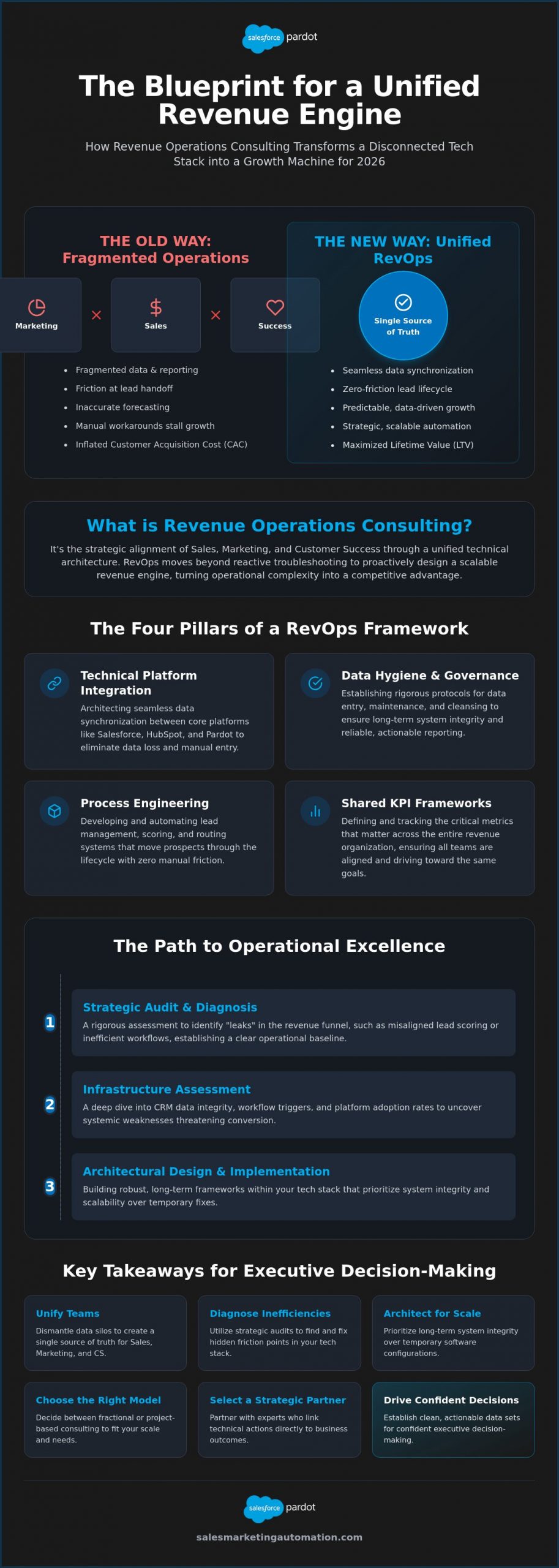
Construct a technical foundation that supports long-term scalability by moving beyond basic software configuration into true architectural design. Technical mastery of the “Big Three”, Salesforce, HubSpot, and Pardot, is the cornerstone of effective revenue operations consulting. While many agencies focus on surface-level settings, a strategic architect builds frameworks that ensure data integrity and seamless synchronization across the entire lifecycle. This level of technical execution ensures that your Marketing Automation Platform (MAP) and CRM function as a unified engine; it provides a clear view of the customer journey from the first touchpoint to the final renewal.
Optimizing the Salesforce-Pardot connection requires a deep understanding of the v2 connector and real-time prospect-to-lead synchronization. We focus on configuring the technical bridge to eliminate data latency, ensuring that sales reps engage with leads at the moment of highest intent. Implementing Connected Campaigns is essential for tracking ROI accurately across the sales cycle, as it links marketing activities directly to Salesforce opportunities. We also build advanced automation rules to govern complex B2B buyer journeys, ensuring that lead routing and assignment remain precise even as your organization scales in complexity.
Designing a HubSpot implementation involves architecting the CRM to support sophisticated multi-touch attribution and granular revenue reporting. It’s not just about setting up deal stages; it’s about creating a system that captures every interaction. We focus on building a robust lifecycle automation strategy that moves leads through the funnel with zero manual intervention. By customizing the technical setup to match your unique sales processes, we ensure that the platform supports your specific growth requirements rather than forcing your team into a generic workflow.
The final layer of technical implementation is the construction of custom reporting dashboards that reflect the entire customer journey. These dashboards provide executive leadership with the clean data required for confident decision-making, showing exactly where revenue is generated and where friction remains. If your current systems feel like a collection of disconnected tools, it’s time to transition to a professionally architected environment through expert revenue operations consulting. Contact our team to learn how our Salesforce and HubSpot implementation services can transform your tech stack into a high-performance growth engine.
Selecting a partner for revenue operations consulting requires looking beyond platform certifications to evaluate a consultant’s ability to link granular technical actions directly to high-level business outcomes. A true strategic architect doesn’t just perform tasks; they build enduring frameworks that ensure your technology supports your revenue targets rather than hindering them. You must prioritize partners who demonstrate a methodical, diagnostic approach. Avoid agencies that propose “one-size-fits-all” solutions, as these rarely account for the unique complexities of your specific buyer journey or data architecture. Your choice should be grounded in a partner’s ability to provide a unified view of the customer while maintaining strict data integrity across every integrated platform.
Experience is the most reliable predictor of success in complex technical environments. Prioritize agencies with a proven track record of over 100 successful implementations. This volume of experience ensures the consultant has encountered and solved the edge cases that often derail growth in B2B tech stacks. The ideal partner functions as a sales and marketing alignment consulting expert, bridging the gap between technical configuration and human workflow. When your technical systems are built to support the way your teams actually work, you eliminate the friction that leads to low adoption and wasted tech spend.
Vet your potential revenue operations consulting partner by moving past surface-level discussions and focusing on technical methodology and accountability. Use these questions to gauge their level of mastery:
At Sales & Marketing Automation, we approach every engagement as a Strategic Architect. Our focus remains exclusively on building enduring frameworks that scale with your business. We provide deep technical expertise across HubSpot, Salesforce, Pardot, and Marketo, ensuring that your tools communicate with surgical precision. We don’t believe in temporary fixes or manual workarounds that create technical debt. Instead, we commit to transparency, data-driven logic, and seamless integration.
By treating your tech stack as a unified revenue engine, we turn operational complexity into a distinct competitive advantage. Our methodical process ensures that every automated workflow and data field serves a strategic purpose. We help you move from reactive troubleshooting to a future of predictable, data-driven growth. When you’re ready to architect a system that delivers tangible results, our team is prepared to guide your technical transformation.
Scaling a B2B organization in 2026 requires more than adding new tools to your stack; it demands a fundamental shift toward systemic alignment. By dismantling data silos and establishing a single source of truth, you empower your sales and marketing teams to operate with unprecedented precision. Professional revenue operations consulting provides the technical roadmap necessary to turn fragmented workflows into a cohesive, automated lifecycle. This strategic approach ensures that every platform investment translates into measurable ROI and long-term operational health.
It’s essential to prioritize a partner that balances elite technical mastery with pragmatic business strategy. Sales & Marketing Automation is a boutique agency with over 100 successful implementations and deep expertise as certified HubSpot and Salesforce partners. We focus on building the enduring frameworks your business needs to achieve predictable growth. Schedule a Strategic Audit with Sales & Marketing Automation today to begin refining your technical architecture. Your path to a streamlined, data-driven future starts with a single diagnostic step.
A revenue operations consultant architects the technical and process-driven alignment between sales, marketing, and customer success teams. They focus on dismantling data silos, optimizing tech stack configurations, and engineering automated workflows that support the entire customer lifecycle. Their role is both diagnostic and prescriptive, ensuring that every technical decision directly contributes to predictable growth and operational health.
Sales consulting typically focuses on improving the performance and tactics of the sales team, whereas revenue operations consulting addresses the underlying infrastructure of the entire revenue organization. While a sales consultant might work on closing techniques or territory management, a RevOps partner ensures that marketing leads flow seamlessly into the CRM, data remains clean, and reporting reflects the full funnel. It’s a holistic approach that integrates every department involved in generating revenue.
The ideal time to engage a firm is when your organization experiences friction during lead handoffs, inaccurate forecasting, or excessive tech stack spend with low adoption. If your sales and marketing teams are operating in silos with conflicting data sets, a consultant can provide the strategic framework needed to unify these departments. Implementing these frameworks before operational debt stalls your growth is critical for scaling businesses.
Yes, professional consultants specialize in CRM data migration services to ensure that the transition between platforms like Salesforce and HubSpot occurs without data loss or downtime. They manage the technical mapping of custom fields, preserve historical activity data, and rebuild automated workflows in the new environment. This precision maintains business continuity and ensures that your new system is architected for performance from day one.
A successful engagement results in a unified view of the customer journey, improved lead-to-opportunity conversion rates, and clean, actionable data for executive decision-making. Organizations typically see a reduction in manual workarounds through strategic automation. This allows teams to focus on high-value activities rather than administrative tasks or data entry corrections, leading to increased pipeline velocity and better forecasting accuracy.
Costs for revenue operations consulting vary based on the complexity of your tech stack and the scope of the engagement, whether it is a project-based audit or a fractional managed service model. While pricing is tailored to specific organizational needs, firms often find that the investment is offset by reduced software waste and improved operational efficiency. You should evaluate the cost against the long-term ROI of a scalable, professionally architected revenue framework.
An external consultant often complements an internal RevOps manager by providing specialized technical expertise for high-stakes projects like platform migrations or complex architectural audits. While your internal manager handles daily operations, a consultant acts as a strategic architect to implement new frameworks or solve systemic issues. This partnership provides the bandwidth and deep diagnostic perspective required for significant technical transformations.
A typical implementation timeline depends on the scale of the project, with strategic audits usually completed in two to four weeks and full technical implementations taking three to six months. This duration ensures that systems are not only configured correctly but also rigorously tested for data integrity. A methodical timeline allows for proper team enablement and adoption, ensuring the new architecture supports your business goals for years to come.