 Sales & Marketing Automation
The CRM and Marketing Automation Guru's You Can Trust.
Sales & Marketing Automation
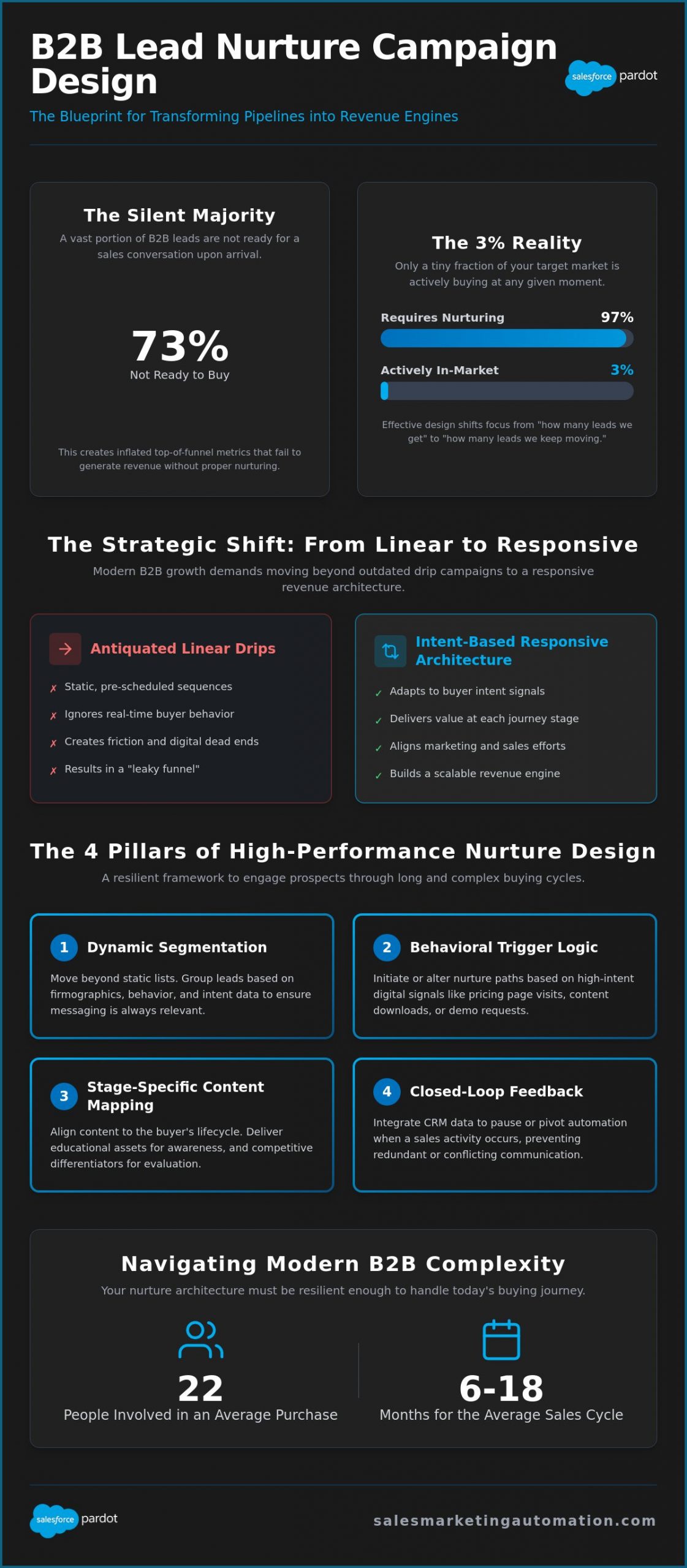
73% of B2B leads arrive without the immediate readiness to buy, leaving marketing teams with inflated top-of-funnel metrics that fail to generate actual revenue. You’ve likely felt the friction of manual follow-ups that don’t scale and the frustration of fragmented data between HubSpot and Salesforce. It’s exhausting to manage high lead volumes when the bridge to a sales conversation remains broken; it’s a systemic failure that wastes both time and potential. This guide provides the blueprint to master b2b lead nurture campaign design, allowing you to transform stagnant pipelines into scalable revenue engines through precise architectural principles.
We’ll examine a repeatable framework that improves lead-to-MQL conversion rates and ensures your marketing automation infrastructure operates with surgical precision. By aligning technical execution with strategic intent, you can finally build a system that values the buyer’s journey as much as your bottom line. We’ll explore how to move beyond basic email sequences into a diagnostic architecture that responds to buyer intent with the accuracy your 2026 growth targets demand. This approach ensures that every automated touchpoint serves as a deliberate step toward a closed-won opportunity.
B2B lead nurture campaign design represents far more than a scheduled series of emails. It functions as a sophisticated revenue architecture designed to capture the vast majority of your market that isn’t ready to sign a contract today. While many marketers focus exclusively on the immediate conversion, strategic architects recognize that high-intent leads often evaporate due to structural gaps in the follow-up process. Moving from antiquated, linear drip campaigns to intent-based responsive architectures is no longer optional; it’s a requirement for maintaining a healthy pipeline. This systemic approach sits at the core of a robust lifecycle automation strategy, ensuring that no prospect is left in a digital dead end. When you treat nurture as a foundation rather than an afterthought, you eliminate the “leaky funnel” syndrome that plagues fragmented marketing departments.
Research consistently indicates that only 3% of your target B2B prospects are actively in-market at any given moment. This means that 97% of your lead volume requires a structured environment to mature before they’re ready for a sales engagement. Effective lead nurturing allows you to maintain presence and authority throughout the long tail of the buyer’s journey. Lead Nurture Architecture is the technical bridge between initial awareness and sales readiness. Without this bridge, you’re essentially discarding potential revenue simply because the timing wasn’t perfect during the first interaction. Design focus shifts the priority from “how many leads can we get” to “how many leads can we keep moving.”
Successful b2b lead nurture campaign design bridges the traditional chasm between marketing qualified leads and sales opportunities. It ensures that every automated touchpoint aligns with the specific expectations of your sales team, delivering prospects who are educated and primed for a conversation. Data integrity remains the cornerstone of this alignment. If your CRM isn’t accurately capturing intent signals, the wrong message will inevitably reach the wrong lead, creating friction rather than momentum. You need a Strategic Architect to build these cross-departmental bridges. This role ensures that technical actions in HubSpot or Salesforce translate directly into operational health and business growth. By treating nurture as a core RevOps function, you create a repeatable framework that scales alongside your revenue goals. A well-structured lead management automation framework ensures that high-intent buyers never slip through the cracks of manual follow-up as your pipeline grows.
Constructing a high-performance b2b lead nurture campaign design requires more than a series of scheduled emails. It demands a structural framework built on four essential pillars: dynamic segmentation, behavioral trigger logic, stage-specific content mapping, and closed-loop feedback. Since the average B2B purchase now involves 22 people and spans a cycle of 6 to 18 months, your design must be resilient enough to maintain engagement across long durations and multiple stakeholders. This isn’t about sending more messages; it’s about ensuring every automated interaction adds tangible value to the prospect’s specific evaluation process. If your current system feels stagnant, it’s likely because one of these pillars has suffered a structural failure.
Feedback loops represent the most often overlooked component of this architecture. Your nurture paths shouldn’t operate in a vacuum; they must remain subservient to real-world sales activity. When a lead engages with a high-intent page or schedules a discovery call, the nurture sequence must pause or pivot immediately to avoid redundant or conflicting communication. Integrating CRM data ensures that your marketing automation doesn’t work against your sales team’s manual outreach. Before scaling these complex paths, it’s prudent to conduct a marketing automation audit to identify existing friction points in your data flow.
Effective design starts with a clean CRM database and a commitment to data hygiene. Rather than relying on static, generic lists, use custom properties in HubSpot or Salesforce to drive dynamic content delivery. This allows you to segment leads by persona, industry, and specific pain points in real-time. Precision is vital, but avoid the trap of “over-segmentation,” which creates unmanageable complexity for your team. Focus on the data points that actually influence the buyer’s decision-making process, ensuring your architecture remains both sophisticated and scalable.
The traditional “every three days” approach to lead nurturing often ignores the buyer’s actual pace. Strategic architects prioritize action-triggered communication, where high-value actions like webinar attendance or repeated visits to a pricing page initiate specific flows. This ensures that your brand responds when intent is highest, rather than following an arbitrary calendar. High-performance hubspot workflow automation handles these triggers in real-time, allowing for surgical precision in your b2b lead nurture campaign design. By focusing on intent signals, you transform your nurture from a passive sequence into a responsive, revenue-driving engine.
Deploying a singular nurture strategy across your entire database is a recipe for inefficiency. A sophisticated b2b lead nurture campaign design recognizes that prospects at different lifecycle stages require distinct architectural patterns to progress. You must align your communication with the specific psychological and operational hurdles your leads face as they move from initial problem awareness toward a final vendor selection. By categorizing your nurture builds into functional patterns, you ensure that your automation remains relevant, diagnostic, and high-converting. This approach prevents the common error of treating a cold awareness lead with the same intensity as a high-intent prospect evaluating technical specifications.
When leads enter the evaluation stage, the conversation shifts from “what is the problem” to “why are you the best partner.” Your architecture must prioritize high-authority content like case studies, technical whitepapers, and third-party validation. It’s critical to implement a robust lead scoring model setup to identify the exact moment a lead crosses this threshold. By monitoring intent signals, you can trigger social proof assets that reduce buyer anxiety precisely when the stakes of the decision feel highest. This level of precision in b2b lead nurture campaign design transforms your CRM from a static list into a responsive sales tool.
Every database contains cold leads that have stalled in their journey. A dedicated re-engagement architecture attempts to “wake up” these contacts through high-value resource offers or diagnostic “break-up” emails. These communications test for remaining interest by offering a low-friction way to re-enter a more active nurture path. However, a strategic architect also knows when to let go. Setting clear exit criteria for leads that remain unresponsive after a re-engagement attempt is vital for maintaining data hygiene and deliverability. If they don’t respond to a final, high-value offer, they should be moved to a long-term “dormant” list or removed to protect the integrity of your primary automation sequences.
Building a high-performance nurture sequence requires a literal blueprint to ensure every technical component functions in harmony. Engineering replaces guesswork here. A successful b2b lead nurture campaign design moves beyond simple email drafts and enters the realm of systems engineering. You must approach the construction phase with a disciplined, five-step methodology. First, map the buyer journey and identify the specific friction points where leads historically drop off. Second, define precise entry and exit criteria for every automation workflow to prevent communication overlaps. Third, develop a multi-channel cadence that orchestrates Email, LinkedIn, and Retargeting Ads. Fourth, build the technical infrastructure within your CRM, ensuring HubSpot or Salesforce properties are correctly mapped for data flow. Finally, implement A/B testing for subject lines, CTAs, and delivery timing to drive continuous refinement. If your current infrastructure lacks this level of detail, it’s time to consult with an expert in lifecycle automation services to shore up your technical foundations.
Overlapping nurtures are a primary cause of brand erosion and prospect fatigue. If a prospect receives two different nurture tracks simultaneously, it signals a lack of internal coordination and technical oversight. Use suppression lists and exclusion logic to ensure a lead only exists in one primary flow at any given time. Goal-Based Exit Criteria is the mechanism that stops a nurture once a lead converts. This prevents the embarrassing scenario where a lead receives an “introductory” email hours after they’ve already scheduled a demo with your sales team. Professionalism in b2b lead nurture campaign design depends on these invisible guardrails.
Orchestration across platforms ensures your message remains top-of-mind without becoming intrusive. Timing is critical for success. For example, you should time your LinkedIn outreach to follow a high-engagement email within 24 hours to capitalize on brand recall. Use retargeting ads to reinforce the nurture message outside the inbox, creating a surround-sound effect for your key value propositions. Don’t rely solely on automation; include “Tasks” for sales reps as manual touchpoints within your design. This hybrid approach ensures that high-value leads receive the personal attention they require while the system maintains the heavy lifting of consistent engagement.
Executing a sophisticated b2b lead nurture campaign design requires moving from the conceptual blueprint to the rigorous reality of CRM implementation. This phase is where many strategic visions fail, often due to a lack of technical precision or an unstable data foundation. You must approach the launch with the same architectural discipline used during the design phase. Choosing between out-of-the-box templates and custom-engineered flows is a pivotal decision. While templates offer speed, they rarely accommodate the intricate logic required for a 2026 B2B buyer journey. Custom-engineered flows, though more complex to build, provide the responsive architecture necessary to link technical actions directly to scalable revenue outcomes. Partnering with professional marketing automation services ensures that your custom builds are engineered with the technical depth required to bridge the gap between lead generation and measurable revenue.
Managed services play a critical role in this ecosystem. High-performance nurture systems aren’t “set and forget” assets; they require constant monitoring and refinement to maintain peak efficiency. Entrusting the technical maintenance to experts ensures that your internal team remains focused on high-level strategy while the infrastructure remains healthy. This collaborative approach allows for the seamless integration of new intent signals and content assets as your market position evolves. Ultimately, the success of your execution depends on your ability to translate strategic intent into a foolproof technical reality.
Building a complex nurture sequence on a “broken” or disorganized CRM is a guaranteed path to automation failure. Before you deploy a single workflow, you must verify the integrity of your underlying data and identify any existing silos that prevent accurate lead tracking. Conducting a comprehensive marketing automation audit is a non-negotiable prerequisite for success. This diagnostic process uncovers friction points in your current setup, ensuring that your new b2b lead nurture campaign design sits on a foundation of clean, actionable data. Without this step, you risk automating inefficiency and alienating prospects with irrelevant communication.
Design for the future, not just for the current quarter. Systemic integrity requires a commitment to quarterly reviews of nurture performance data to identify where leads are stalling or dropping off. As your product line expands or your market matures, your nurture architecture must scale accordingly. Partnering with a certified HubSpot implementation partner ensures that your technical excellence keeps pace with your growth ambitions. This partnership provides the seasoned experience needed to navigate complex builds and maintain a streamlined future for your revenue operations. If you’re ready to transform your stagnant pipeline into a high-velocity revenue engine, our team is prepared to serve as the Strategic Architect for your next implementation.
Building a resilient pipeline requires a departure from generic messaging. You’ve seen that high-performance b2b lead nurture campaign design relies on intent-based triggers and precise lifecycle mapping rather than arbitrary schedules. This architectural approach ensures that your marketing automation infrastructure serves as a diagnostic tool that identifies and captures the 97% of the market not currently in a buying cycle. By prioritizing technical integrity within HubSpot and Salesforce, you transform fragmented data into a unified revenue engine that scales alongside your growth ambitions.
Achieving this level of precision demands a methodical, data-driven partner. With over 100 successful CRM and automation projects completed, Sales & Marketing Automation specializes in the technical implementation required for complex builds. We provide the expert oversight needed to link granular technical actions to tangible business outcomes. Schedule a Strategic Audit to Optimize Your Nurture Architecture and secure the systemic health of your pipeline. Your growth deserves a framework built for longevity and precision.
The primary goal of b2b lead nurture campaign design is to systematically guide prospects through the decision-making process until they reach a state of sales readiness. It focuses on maintaining brand authority and providing educational value to the 97% of the market not currently in an active buying cycle. By engineering these touchpoints, you ensure that high-intent leads don’t evaporate due to neglect or poor timing.
A standard sequence typically consists of five to ten emails per lifecycle stage, though the total volume depends on your specific sales cycle duration. Since B2B purchases often take six to eighteen months, your architecture must be durable enough to sustain engagement without causing fatigue. Focus on the quality of the intent-based triggers rather than hitting an arbitrary number of messages.
Drip campaigns follow a rigid, time-based schedule where every lead receives the same content regardless of their actions. In contrast, sophisticated lead nurturing is a responsive architecture that pivots based on real-time behavior and intent signals. Nurture design uses behavioral data to ensure the communication remains diagnostic and relevant to the prospect’s current hurdles.
Lead nurturing is highly effective for existing customers to drive onboarding success, retention, and expansion opportunities. Extending your b2b lead nurture campaign design post-purchase ensures that users realize the full value of your solution, which directly impacts long-term lifetime value. It transforms the customer relationship from a transactional interaction into a sustained, value-driven partnership.
Success is measured through lead-to-MQL conversion rates, pipeline velocity, and influenced revenue attribution. Monitor how quickly prospects move through lifecycle stages and identify specific friction points where engagement drops off. Technical architects prioritize these bottom-line metrics over surface-level data like open rates to ensure the system drives tangible growth.
Utilizing multiple channels like LinkedIn outreach and retargeting ads alongside email is essential for creating a surround-sound effect. This multi-channel approach reinforces your core message across different platforms where B2B decision-makers spend their time. Orchestrating these touchpoints within your CRM ensures a consistent brand experience that doesn’t rely solely on the prospect’s inbox.
Prevent impersonality by using dynamic content and personalization tokens that reflect the prospect’s specific industry, persona, and documented pain points. Automation shouldn’t sound like a machine; it should sound like a well-informed advisor who understands the lead’s current challenges. Relevancy is the highest form of personalization in the B2B sector.
Advanced nurturing requires a robust CRM like HubSpot or Salesforce integrated with a sophisticated marketing automation platform. You also need data enrichment tools and behavioral tracking capabilities to fuel your trigger logic. This technical stack allows you to build the enduring frameworks necessary for linking automated actions to predictable business outcomes. Pairing this infrastructure with a structured lead management automation strategy ensures your entire lead lifecycle is orchestrated with the precision needed to convert high-intent buyers at scale.