 Sales & Marketing Automation
The CRM and Marketing Automation Guru's You Can Trust.
Sales & Marketing Automation
Your HubSpot portal is likely functioning as an expensive digital filing cabinet rather than the high-performance revenue engine your business requires. While the platform offers immense potential, many enterprise teams find that without specialized hubspot technical consulting, they remain trapped by fragmented data schemas, inaccurate lead routing, and workflows that fail under the pressure of scale. You understand that a CRM should be a source of truth; however, the reality often involves manual workarounds and underutilized high-tier features that drain operational efficiency.
This strategic approach bridges the gap by treating your portal as a piece of sophisticated business architecture. By aligning your technical infrastructure with the latest 2026 API standards and Breeze AI capabilities, you can transition from reactive troubleshooting to proactive growth. This article explores how to build a unified data schema, integrate complex hubs seamlessly, and establish an automated revenue operation that scales without friction. We will provide a clear roadmap to ensure your HubSpot environment remains a precise, durable asset that supports your long-term commercial objectives.
Purchasing a HubSpot license is a significant investment in your growth infrastructure, but the platform’s utility is entirely dependent on its underlying architecture. Many firms mistake the initial setup phase for long-term system design. Standard onboarding is a functional introduction; it ensures your team knows which buttons to press and how to navigate the interface. In contrast, hubspot technical consulting is an engineering discipline. It treats your portal as a complex engine that must be precision-tuned to handle high-volume data, intricate lead routing, and multi-layered reporting requirements.
As we move through 2026, the complexity of the HubSpot ecosystem has reached a point where “out-of-the-box” configurations are no longer sufficient for enterprise-level demands. With the transition to date-based API versioning and the introduction of advanced Breeze AI agents, the technical requirements for a stable environment have shifted. Modern Customer Relationship Management (CRM) strategies require more than just contact storage; they demand a robust data architecture that can evolve alongside your business objectives.
Onboarding teaches you how to use the tool. Consulting designs how the tool serves your strategy. Standard setups often focus on immediate “go-live” metrics, which frequently leads to significant technical debt within the first six months. This debt manifests as cluttered property groups, inconsistent naming conventions, and lifecycle stages that don’t align with actual buyer journeys. While onboarding might get your emails out the door, it rarely addresses the systemic integrity needed for accurate revenue attribution. High-performance organizations don’t just “set up” a hub; they architect a revenue engine that prioritizes data hygiene and operational longevity.
You’ll hit a “Technical Ceiling” when your standard setup can no longer support your operational complexity. Signs of this friction include data silos between departments, broken synchronizations with external ERPs, and an over-reliance on manual workarounds to fix automated errors. This is the point where hubspot technical consulting becomes essential. It provides the deep-tier expertise required for sophisticated HubSpot integration services, ensuring that your Marketing, Sales, and Service Hubs communicate without friction.
Strategic architects look beyond the immediate interface. They evaluate how data flows across your entire tech stack, identifying potential points of failure before they impact your bottom line. Transitioning to advanced consulting ensures that your cross-departmental alignment is hard-coded into the system rather than left to chance. It’s the difference between a tool that functions and a framework that scales.
Architecting a high-performance revenue engine requires a fundamental shift from feature adoption to data-centric engineering. While many agencies focus on surface-level tool configuration, hubspot technical consulting prioritizes the underlying data schema as the primary source of truth. This “Data First” approach ensures that every contact, company, and deal record serves as a reliable building block for your reporting and automation layers. Without this foundational integrity, even the most advanced AI agents will struggle to deliver accurate insights or execute meaningful tasks.
Constructing a unified data schema involves more than just creating custom properties. It requires a meticulous mapping of your real-world business entities into HubSpot’s relational database. For firms with complex product hierarchies or multi-faceted service models, standard objects often fall short. We utilize custom objects to model unique business processes, ensuring that your CRM reflects your actual operations rather than forcing your operations into a rigid software template. This structural precision is the technical solution to Ending the War Between Sales and Marketing; when both teams operate from a single, architected data source, friction dissolves.
Establishing strict data governance is equally critical. You must define clear rules for how data enters, moves through, and exits your system. Clean data is the prerequisite for a successful lifecycle automation strategy. If your data entry points are unprotected, your automation will inevitably fail, leading to duplicate records and inaccurate lead scoring. If you are uncertain about your current portal health, consider a professional technical assessment to identify hidden structural weaknesses.
Modern tech stacks rarely rely solely on native integrations. In high-volume environments, hubspot technical consulting involves developing a sophisticated API strategy that accounts for HubSpot’s 2026 date-based versioning system. Relying on outdated endpoints can lead to catastrophic sync failures during the March and September update cycles. When standard connectors lack the necessary logic or throughput, we implement middleware solutions like Workato or Tray.io to orchestrate complex data flows between your ERP, CRM, and marketing platforms. This ensures that your revenue engine remains resilient, scalable, and capable of handling the heavy data loads required by enterprise-level operations.
Begin every structural transformation with a rigorous diagnostic phase. Most organizations attempt to resolve operational friction by adding more software; however, the root cause is typically a lack of architectural integrity. A comprehensive marketing automation audit serves as the essential diagnostic foundation for high-performance hubspot technical consulting. This process identifies the specific bottlenecks preventing your portal from reaching its full potential, moving beyond surface-level symptoms to address the core logic of your system.
A professional assessment evaluates three critical areas: portal health, automation efficiency, and data hygiene. These audits often reveal significant “hidden” costs that drain your budget without providing value. For instance, duplicate records can inflate your marketing contact tier pricing, while unused seat licenses represent unnecessary overhead. By identifying these inefficiencies, you can reallocate resources toward high-impact growth initiatives. The resulting roadmap provides a clear, prioritized sequence of interventions designed to stabilize your environment and prepare it for rapid scaling.
Analyze your existing workflows to identify redundancies that slow down system performance. Over time, portals accumulate “ghost” automations; these are legacy processes that no longer serve a purpose but continue to consume API limits and trigger conflicting actions. We audit user permissions and security settings to ensure your environment remains compliant with evolving data privacy standards. By mapping your technical debt, we help you prioritize resolutions based on their impact on system stability and user experience. This systematic cleanup ensures your team operates in a lean, responsive environment.
Technical consulting is a strategic investment in efficiency rather than just an operational expense. Precision-engineered systems reduce your customer acquisition cost (CAC) by ensuring that leads are routed to the right representative at the optimal moment without manual intervention. Clean, structured data directly correlates with increased sales velocity, as your team spends less time verifying information and more time closing deals. When evaluating hubspot implementation pricing, consider the total cost of ownership over several years. The long-term savings generated by an error-free, scalable architecture far outweigh the initial cost of professional consulting.
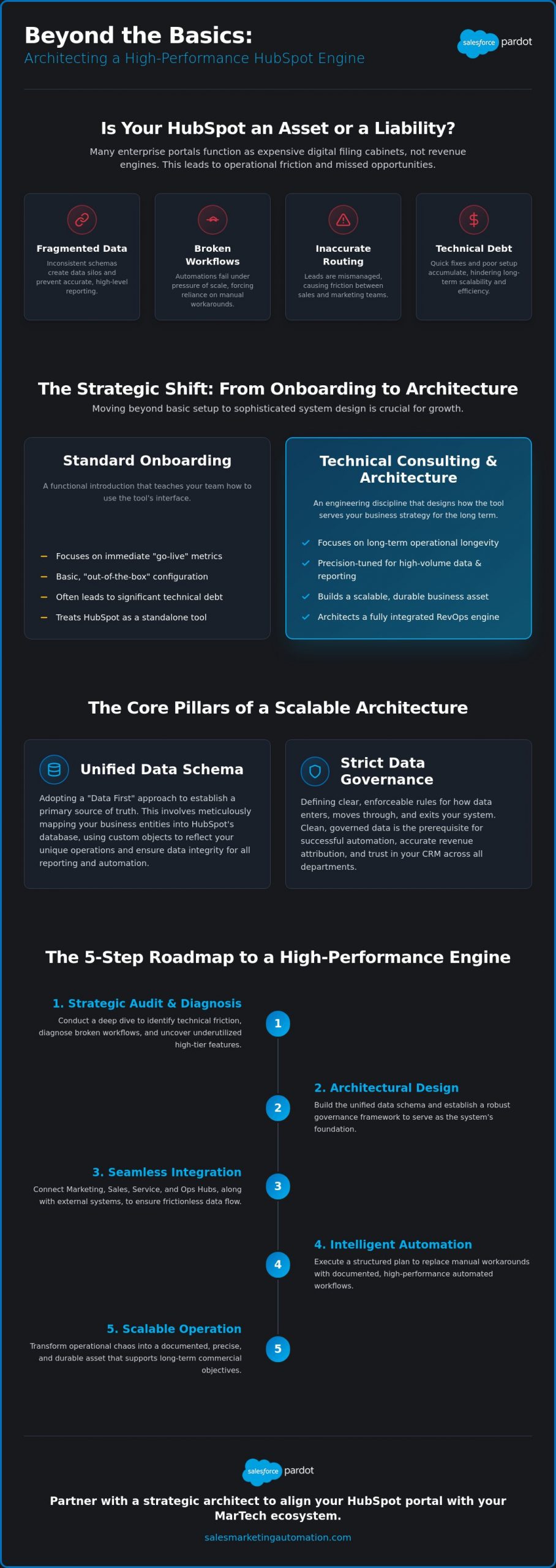
Transitioning from a diagnostic audit to a fully operational system requires a methodical, phased approach. Execution without a documented roadmap often leads to fragmented workflows and inconsistent data entry. High-performance hubspot technical consulting follows a 5-step journey designed to eliminate operational chaos: Audit, Blueprint, Build, Train, and Optimize. This structured progression ensures that every technical decision aligns with your commercial objectives, moving your portal from a state of reactive maintenance to proactive scalability.
While the build phase is critical, the longevity of your revenue engine depends on comprehensive documentation and rigorous team training. Systems only remain “clean” if the users understand the logic behind the architecture. We provide detailed technical wikis and standard operating procedures (SOPs) that serve as the internal manual for your HubSpot environment. This focus on knowledge transfer allows your team to maintain system integrity long after the initial implementation is complete. For firms seeking enduring stability, transitioning from one-off projects to managed hubspot technical consulting ensures that your portal evolves alongside new API releases and platform updates.
Define your technical requirements before a single workflow is constructed. This phase involves aligning sales and marketing stakeholders on essential data definitions, such as what constitutes a “Marketing Qualified Lead” or how “Original Source” data should be preserved across custom integrations. We map the entire journey of a record to ensure no data is lost during handoffs between departments. System Blueprinting is the process of mapping data flow between all connected platforms to ensure structural consistency across the tech stack. This blueprint serves as the master plan for our hubspot implementation services, ensuring that the final build is both precise and durable.
Implement advanced lead scoring and automated routing models that reflect the complexity of your sales cycle. In this phase, we build multi-channel nurture sequences that react dynamically to user behavior rather than following a static, linear path. This ensures that every technical touchpoint supports the customer journey, providing a seamless experience from initial awareness to final purchase. We leverage HubSpot’s 2026 Breeze AI capabilities to automate routine prospecting tasks, allowing your sales team to focus on high-value interactions. If you are ready to stabilize your operations and unlock new levels of efficiency, request a strategic technical consultation to begin your architectural blueprinting.
Selecting a partner to manage your CRM infrastructure is a decision that determines your organization’s operational ceiling. Many agencies offer basic support, but few provide the level of hubspot technical consulting required to navigate a complex, multi-platform MarTech ecosystem. Sales & Marketing Automation positions itself as an elite alternative to generic consulting by acting as a Strategic Architect. We don’t just solve immediate tickets; we build enduring frameworks that align with your long-term commercial goals. Our deep expertise in Salesforce and Pardot migrations ensures that we understand the nuances of cross-platform data flow, allowing us to prevent the integration friction that often cripples high-growth firms. When evaluating your options, reviewing a rigorous framework for identifying the best HubSpot implementation agency can help you establish the criteria needed to select a partner capable of building a truly scalable revenue engine.
Forging a long-term relationship with a dedicated HubSpot implementation partner provides your business with a continuous layer of technical oversight. This partnership ensures that your portal remains optimized as HubSpot releases new API versions and AI capabilities throughout 2026. By treating your CRM as an evolving piece of business architecture, you ensure that your technical capabilities never become a bottleneck for your sales and marketing teams.
Custom-engineered solutions consistently outperform generic best practices because they account for your specific operational logic. Every business has unique deal stages, attribution requirements, and data validation rules that a standard template cannot capture. With over 100 successful implementations, we leverage significant institutional knowledge to anticipate and neutralize potential roadblocks before they impact your data integrity. This proactive approach to hubspot technical consulting ensures that your system remains lean and high-performing, avoiding the technical debt that accumulates when using rigid, pre-packaged configurations.
System health is not a one-time achievement but a continuous process of refinement. A monthly managed services retainer provides you with access to a full team of technical architects, developers, and automation specialists for a fraction of the cost of a single full-time hire. This model ensures that your HubSpot environment evolves as fast as your business does. We monitor your portal’s performance, refine your lifecycle automation, and ensure that your data governance rules remain effective as your database grows. If you are ready to move beyond basic CRM usage and architect a high-performance revenue engine, request a strategic technical assessment today to identify your next phase of growth.
Transitioning your portal from a standard CRM into a precision-engineered revenue engine requires a definitive shift from tactical fixes to strategic architecture. You’ve seen how a data-first approach and a robust API strategy prevent technical debt while ensuring your system remains resilient against the platform updates scheduled for 2026. By prioritizing structural integrity over simple feature adoption, you position your organization to leverage advanced automation and AI-driven insights with absolute confidence.
Professional hubspot technical consulting provides the diagnostic expertise needed to identify hidden inefficiencies and build a scalable roadmap for growth. With over 100 successful implementations and a deep specialization in complex CRM data migrations, our team brings a national perspective to your technical challenges. We focus exclusively on creating enduring frameworks that grow alongside your business. Schedule Your Strategic HubSpot Technical Audit Today to begin the process of refining your business architecture. Your path to a high-performance, integrated revenue engine starts with a single diagnostic step.
A HubSpot admin focuses on the daily maintenance, user support, and basic configuration within your portal. Conversely, hubspot technical consulting involves the high-level architectural design and engineering of the system to ensure long-term scalability. Consultants address complex data migrations, custom object mapping, and cross-departmental alignment that fall outside the scope of standard administration. This strategic oversight ensures your portal functions as a cohesive engine rather than a collection of siloed tools.
Industry data for 2026 indicates that specialized project fees for enterprise-level implementations typically range from $12,000 to $60,000. Monthly retainers for ongoing optimization and technical oversight vary based on complexity, with enterprise-tier support often exceeding $20,000. These costs reflect the high level of technical expertise required to manage advanced API versioning and AI-driven operations. Investing in this level of precision prevents the high costs associated with technical debt and system failure.
Data hygiene is a foundational component of any technical engagement. Consultants identify and resolve duplicate records, inconsistent property values, and fragmented data schemas that hinder accurate reporting. This cleanup phase ensures that your automation logic operates on a reliable source of truth, preventing the “garbage in, garbage out” cycle that often derails CRM performance. Establishing these data governance rules is critical for the success of any high-performance revenue engine.
The duration of an engagement depends on the complexity of your existing tech stack and the scope of the architectural changes required. A strategic audit typically takes two to four weeks to complete. Comprehensive implementation projects or complex data migrations often span three to six months to ensure thorough testing and team training before full deployment. This timeline ensures that every workflow is precision-tuned and every stakeholder is aligned with the new system architecture.
Technical consultants specialize in building and maintaining custom API connections when native integrations are insufficient for your business logic. They manage the transition to HubSpot’s date-based API versioning system, ensuring that data flows seamlessly between your CRM and external platforms like ERPs or proprietary databases. This expertise is critical for maintaining system stability during major platform update cycles. Properly engineered integrations eliminate manual data entry and provide a unified view of your customer journey.
Even organizations using only the Marketing Hub benefit from hubspot technical consulting to maximize their ROI. Advanced consulting ensures that your lead scoring models, multi-channel nurture sequences, and attribution reporting are architected for precision. Without technical oversight, complex marketing workflows can quickly become disorganized, leading to broken customer journeys and inaccurate performance data. Ensuring your marketing infrastructure is technically sound is the only way to achieve repeatable, scalable growth.
A technical audit is a diagnostic assessment of your portal’s health, automation efficiency, and data integrity. It serves as the essential first step because it uncovers hidden technical debt and identifies structural bottlenecks that may not be apparent to daily users. This audit provides the data-driven roadmap necessary to prioritize interventions and ensure that your investment in consulting delivers tangible results. You cannot build a scalable architecture on a foundation of unaddressed technical errors.
Technical consulting improves sales handoffs by hard-coding objective criteria into your lead scoring and routing logic. Consultants build automated workflows that move leads through lifecycle stages based on real-time behavior, ensuring that sales representatives receive high-intent prospects immediately. This alignment reduces friction between departments and increases sales velocity by eliminating manual lead distribution errors. Precision in the handoff process ensures that no revenue opportunities are lost due to system delays or data inconsistencies.