 Sales & Marketing Automation
The CRM and Marketing Automation Guru's You Can Trust.
Sales & Marketing Automation
While 82% of C-suite executives believe their organizations are perfectly synchronized, 65% of the employees actually executing those workflows disagree. This disconnect often manifests as a costly friction where marketing generates leads that sales simply ignores, or disparate data between HubSpot and Salesforce makes accurate reporting impossible. You understand that cultural buy-in isn’t enough to fix a broken funnel. Real growth requires a structural intervention that addresses the underlying technical friction.
This guide to sales and marketing alignment consulting demonstrates how to transform disconnected departments into a unified revenue engine through architectural precision and automated workflows. By prioritizing technical execution over generic strategy, you can bridge the gap between lead generation and closed-won revenue. We will examine the specific frameworks needed to engineer automated lead scoring that both teams trust, establish seamless data flows, and secure clear ROI tracking from the first touch to the final handshake.
True sales and marketing alignment consulting is the technical and strategic engineering of your revenue funnel. It moves beyond the outdated notion that alignment is simply about “better communication” or shared office spaces. In the 2026 market, where B2B organizations with aligned operations achieve 27% faster profit growth according to recent industry analysis, alignment is a matter of systemic integrity. It requires a unified Go-To-Market motion where every digital touchpoint is mapped to a specific sales outcome through architectural precision.
The “Silo Tax” represents the quantifiable financial drain caused by fragmented operations. This tax manifests as lead leakage, where expensive prospects disappear into the gaps between HubSpot and Salesforce, or as duplicate data that forces your team to manually reconcile records instead of closing deals. According to 2026 benchmarks from Prospeo, companies with strong alignment achieve 20% annual revenue growth, while those with poor alignment see a 4% decline. This 24% swing is the literal cost of inefficiency. When your tech stack lacks a unified architecture, you aren’t just losing efficiency; you’re actively funding your competitors’ growth through missed opportunities.
To eliminate this tax, leadership must shift their perspective from “people management” to “systemic health.” This involves ensuring that your demand generation strategies are not operating in a vacuum. Instead, they must be hard-coded into your CRM logic so that every lead is captured, scored, and routed with zero manual friction.
A misaligned revenue engine produces visible friction that stalls growth. You’ll likely notice Sales ignoring more than 50% of marketing-generated leads because they don’t trust the source or the timing. This distrust often stems from inconsistent lifecycle stage definitions. For example, if Marketing defines an MQL based on a single whitepaper download while Sales expects a direct demo request, the resulting “Reporting Gap” allows Marketing to claim success even as Sales misses their quarterly quota. These teams are effectively running two different races on the same track, using data that doesn’t reconcile.
Resolving these deep-seated issues requires the objective perspective of a Strategic Architect. There’s a critical difference between a “Strategy Consultant” who offers high-level advice and a “Technical Implementation Partner” who builds the actual frameworks that enforce alignment. An expert consultant performs a diagnostic role, identifying where data breaks during the handoff. A comprehensive marketing automation audit is the essential starting point for this transformation. It reveals the root causes of friction within your tech stack, allowing you to move from a culture of finger-pointing to a culture of shared, auditable data.
Alignment is a technical protocol, not a cultural aspiration. While many organizations rely on weekly meetings to bridge the gap between departments, elite sales and marketing alignment consulting focuses on the “Technical Handshake.” This is the automated transition of data between your marketing automation platform and your CRM. It ensures that every interaction a prospect has with your brand is captured, logged, and surfaced to sales in real time. Without this architectural precision, your revenue engine relies on manual effort, which inevitably leads to data decay and missed quotas.
Construct a unified Data Schema across HubSpot, Salesforce, or Marketo to eliminate ambiguity. A shared schema ensures that a “Lead Source” in marketing matches the “Lead Source” in sales, preventing the reporting discrepancies that plague unaligned teams. This structural integrity allows for the deployment of “Lead Intelligence,” providing sales representatives with the behavioral context they need to personalize their outreach. When a rep knows exactly which whitepapers were downloaded and which pricing pages were visited, they move from cold calling to informed consultation. If your current systems lack this depth, a professional CRM data migration can reset your foundation for 2026 performance.
Establish a universal “Source of Truth” for lead status and prospect ownership. By mapping your lifecycle automation strategy directly to the actual buyer journey, you ensure that no prospect is left in a digital limbo. This requires precise configuration of multi-platform syncs, such as the Salesforce-Pardot connector, where field mapping and sync behaviors must be perfectly aligned to maintain data integrity. Hard-coding these rules into your CRM workflows prevents human error and ensures that every lead follows a predetermined, optimized path toward conversion.
Develop objective, data-driven lead scoring models that your sales team actually trusts. Effective models incorporate both fit and intent data, using “Negative Scoring” to automatically filter out non-ideal customer profiles (ICP) before they reach a sales rep’s queue. Research into A 7-Step Alignment Framework highlights that consistent enforcement is as vital as the strategy itself. Use automated alerts and “Task Queues” to trigger immediate follow-up when a lead hits a specific threshold. This level of automation ensures that your highest-value opportunities receive immediate attention, maximizing your win rates and protecting your marketing investment.
Many organizations attempt to resolve departmental friction through recurring “Smarketing” meetings. While these sessions improve communication, they often lack the technical oversight required to enforce systemic change. Internal teams typically focus on immediate campaign execution, which leaves little room for the deep architectural work necessary to sync complex platforms. Relying on internal coordination alone frequently results in a “vibe-based” alignment that collapses the moment lead volume increases or the tech stack requires a significant update.
Specialized sales and marketing alignment consulting provides the cross-platform expertise that internal hires often lack. It’s rare to find an internal team member who possesses advanced proficiency in both HubSpot and Salesforce while also understanding the API-level nuances of data synchronization. A consultant acts as a Strategic Architect, viewing the revenue engine as a single integrated system rather than two separate departments. This perspective is essential for building a unified Data Schema that remains stable as your company scales. Organizations looking to extend this systemic thinking across all go-to-market functions should explore revenue operations consulting as a framework for unifying sales, marketing, and customer success under a single technical architecture.
Political neutrality is another critical advantage of external consulting. Internal managers often struggle to enforce data standards across departments due to existing corporate hierarchies or interpersonal dynamics. A consultant provides an objective, diagnostic assessment that removes emotion from the equation. They can mandate CRM hygiene and lead-handling protocols that an internal peer might find difficult to suggest. This allows leadership to focus on growth while the consultant handles the friction of operational enforcement.
The ROI of a one-time alignment project far outweighs the ongoing cost of inefficient lead management. Consider that organizations with tightly aligned teams can generate 208% more revenue from marketing efforts. Investing in professional sales and marketing alignment consulting eliminates the “Silo Tax” permanently, replacing manual workarounds with automated, high-velocity workflows that drive measurable profit.
Certain business milestones demand an objective third party to ensure operational health. Seek external expertise during a major platform migration, such as moving from a legacy CRM to HubSpot, to prevent data loss. Scaling from a founder-led sales model to a high-volume revenue team also requires a structural reset. Additionally, mergers and acquisitions necessitate a consultant to consolidate disparate tech stacks into a single, functional source of truth without disrupting current revenue streams.
Maintaining alignment long-term requires consistent technical muscle. Leveraging outsourced marketing operations allows your business to access elite talent without the overhead of a full-time executive hire. This model provides a balance between the “Strategic Architect” who designs the framework and the “Tactical Executor” who manages daily optimizations. As sales processes evolve throughout 2026, fractional support ensures your tech stack adapts to new market dynamics, keeping your revenue engine at peak performance.
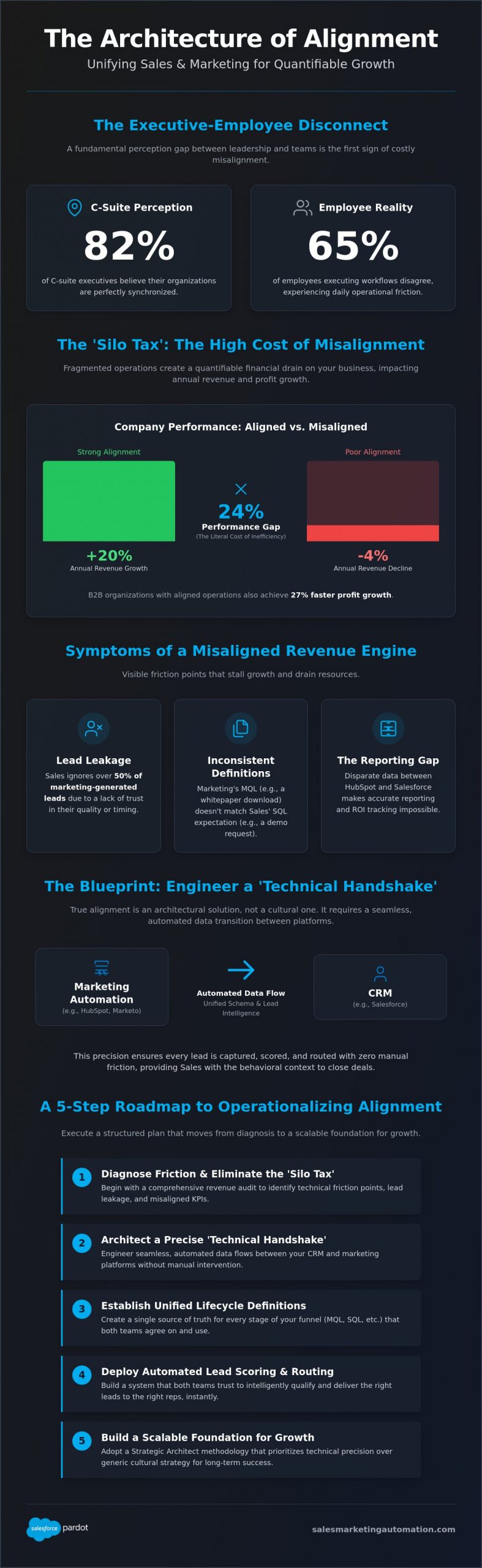
Operationalizing alignment requires a methodical transition from high-level strategy to granular technical execution. This roadmap serves as the definitive framework for sales and marketing alignment consulting, ensuring that every adjustment to your tech stack directly correlates with revenue growth. It moves your organization away from vague “Smarketing” goals and toward a hard-coded system of accountability. If your current roadmap lacks this technical depth, consider a professional Salesforce & Pardot consulting engagement to build a framework that lasts.
The process begins with Step 1: The Revenue Audit. This diagnostic phase identifies the specific technical friction points and data discrepancies that cause lead leakage. By mapping the current flow of information between your marketing automation and CRM, you uncover the bottlenecks where opportunities stall. This audit provides the baseline data required to justify the structural changes that follow in the subsequent stages of the roadmap.
Move beyond abstract concepts by standardizing definitions for your ICP, MQL, SQL, and Opportunity stages. A single sentence must define an MQL, ensuring that both the CMO and VP of Sales sign off on the criteria with total clarity. Once these definitions are finalized, they are translated into technical configurations within your CRM. Create “Enforced Fields” in Salesforce to ensure data quality from the sales team, making certain that no opportunity moves forward without essential prospect intelligence. Configure “Lead Rotation” logic to prevent lead stagnation, ensuring that high-intent prospects are routed to the right rep instantly based on territory, industry, or expertise.
Establish a Service Level Agreement (SLA) that is hard-coded into your automated workflows. This isn’t a handshake agreement; it’s a system that tracks follow-up times and triggers management alerts if a lead isn’t contacted within the agreed window. Implement “Lead Recycling” protocols where Sales can send cold or unresponsive leads back to Marketing for automated nurturing. Finally, build Closed-Loop Reporting dashboards that track revenue and attribution rather than just “leads.” This proves which marketing channels drive the most profit and allows for a monthly “Alignment Audit” to refine scoring and workflows based on real-world closed-won data. This continuous refinement ensures your revenue engine remains optimized for 2026 market dynamics.
Effective sales and marketing alignment consulting requires a shift from abstract advice to architectural precision. At Sales & Marketing Automation, we utilize a “Strategic Architect” methodology that treats your revenue funnel as a single, integrated machine. Rather than offering high-level suggestions that fail during execution, we focus on the technical infrastructure that powers your growth. This approach ensures that your HubSpot, Salesforce, and Pardot environments are not just repositories for data, but active drivers of closed-won revenue.
Foundational health begins with project-based implementation. We have completed over 100 successful implementations, providing the technical muscle needed to bridge the gap between lead generation and sales closing. By establishing a solid architectural foundation first, we eliminate the structural weaknesses that lead to missed targets. This methodical setup allows your teams to operate with total confidence in their data, knowing that every automated workflow has been engineered for maximum efficiency and scalability.
Maintaining a unified funnel requires more than a one-time setup. As your business evolves, your tech stack can accumulate “Technical Debt”—inefficient workflows, outdated scoring models, and fragmented data that slow down your momentum. Our marketing automation managed services transition your organization from initial setup to continuous optimization, converting technical debt into a high-performance engine that drives predictable revenue. We prioritize Lifecycle Automation to maximize customer lifetime value, ensuring that your communication remains relevant at every stage of the buyer journey. To support this technical precision, our creative design services ensure that every digital touchpoint maintains brand consistency, providing a seamless experience that builds trust with high-value prospects.
Every successful transformation starts with a diagnostic assessment. We begin by identifying the specific friction points in your current processes, moving your organization from broken, manual workflows to a scalable, automated pipeline. This diagnostic approach allows us to prescribe the exact technical interventions needed to synchronize your departments and secure a higher ROI from your marketing investment. We don’t just build systems; we build enduring frameworks that adapt to the shifting dynamics of the 2026 B2B market.
Stop allowing lead leakage and data silos to drain your resources. It’s time to engineer a revenue engine that operates with total precision and predictability. Schedule a Strategic Audit with our Revenue Architects to begin your transition toward a fully aligned, high-performance organization.
Transitioning from departmental friction to a unified revenue engine requires more than cultural buy-in; it demands a structural reset. You’ve seen how the Silo Tax drains profit through lead leakage and inconsistent data, and how a technical blueprint can bridge these gaps. By implementing a hard-coded roadmap that includes unified definitions and automated SLAs, you replace manual workarounds with a scalable architecture that drives predictable growth. This systemic integrity ensures that your organization doesn’t just survive market shifts but actively capitalizes on them.
Securing this level of precision often requires the objective authority of a Strategic Architect. Our team brings global reach and a track record of over 100 successful implementations across HubSpot, Salesforce, and Pardot. We specialize in the deep technical execution that generic sales and marketing alignment consulting often overlooks, ensuring your tech stack evolves alongside your business objectives. It’s time to stop managing symptoms and start building a foolproof framework for operational health.
Request a Strategic Revenue Audit to Unify Your Tech Stack and take the first step toward a seamless, data-driven future. Your path to a high-performance funnel starts with architectural clarity and ends with sustainable scalability.
A consultant acts as a Strategic Architect to bridge the technical gap between lead generation and sales closing. They audit your existing tech stack, standardize lead definitions, and configure automated workflows in platforms like HubSpot or Salesforce. This intervention ensures that data flows seamlessly and both teams operate from a single, auditable source of truth.
Most engagements follow a phased approach that begins with a diagnostic audit and moves into a 90-day implementation cycle. While the initial technical “handshake” can be established within weeks, achieving full operational maturity typically requires three to six months of refinement. Long-term success is then sustained through monthly managed services that adapt to shifting market dynamics.
Investing in sales and marketing alignment consulting is critical for small teams to prevent the accumulation of technical debt that stalls future growth. Smaller organizations often have limited resources, making it essential that every marketing lead is handled with maximum efficiency. Establishing a unified revenue engine early ensures you can scale without the friction of fragmented data or broken handoffs.
RevOps is the overarching business function that unifies sales, marketing, and customer success operations to drive revenue. Sales and marketing alignment is a specific, high-impact initiative within that framework focused on the technical and strategic bridge between those two specific departments. While revenue operations consulting manages the entire lifecycle, alignment consulting fixes the most common point of failure: the marketing-to-sales transition.
You rarely need to replace your CRM to achieve alignment; instead, you must optimize the way it integrates with your marketing automation. Most friction points stem from poor configuration or disparate data schemas rather than the software itself. Specialists in HubSpot and Salesforce can typically re-engineer your existing environment to enforce the necessary workflows and data integrity.
ROI is measured through quantifiable improvements in win rates, customer retention, and lead-to-close velocity. Research from 2026 indicates that aligned organizations see 38% higher win rates and 36% higher retention. By tracking these metrics alongside marketing attribution, you can prove the direct financial impact of sales and marketing alignment consulting on your bottom line.
Lead scoring and attribution are core components of any technical alignment strategy. A consultant develops objective, data-driven scoring models that Sales actually trusts, ensuring that only high-intent prospects are routed for follow-up. They also build closed-loop reporting dashboards that track which marketing channels drive the most closed-won profit, providing clear visibility into your true ROI.
Disparate goals are the primary driver of the “Silo Tax” and must be reconciled through a unified Service Level Agreement (SLA). A consultant facilitates the creation of shared KPIs that hold both teams accountable for revenue, not just vanity metrics. By hard-coding these shared objectives into your CRM workflows, you ensure that both departments are incentivized to work toward the same financial outcomes.