 Sales & Marketing Automation
The CRM and Marketing Automation Guru's You Can Trust.
Sales & Marketing Automation
Hiring a full-time Marketing Ops Manager is often viewed as the gold standard for growth, yet for many scaling organizations in 2026, this traditional hire becomes a single point of failure. You likely recognize the friction of fragmented data across HubSpot and Salesforce or the frustration of losing a specialized architect just as your systems begin to align. Transitioning to outsourced marketing operations allows you to move beyond these structural bottlenecks by acquiring a resilient technical architecture rather than just a temporary headcount.
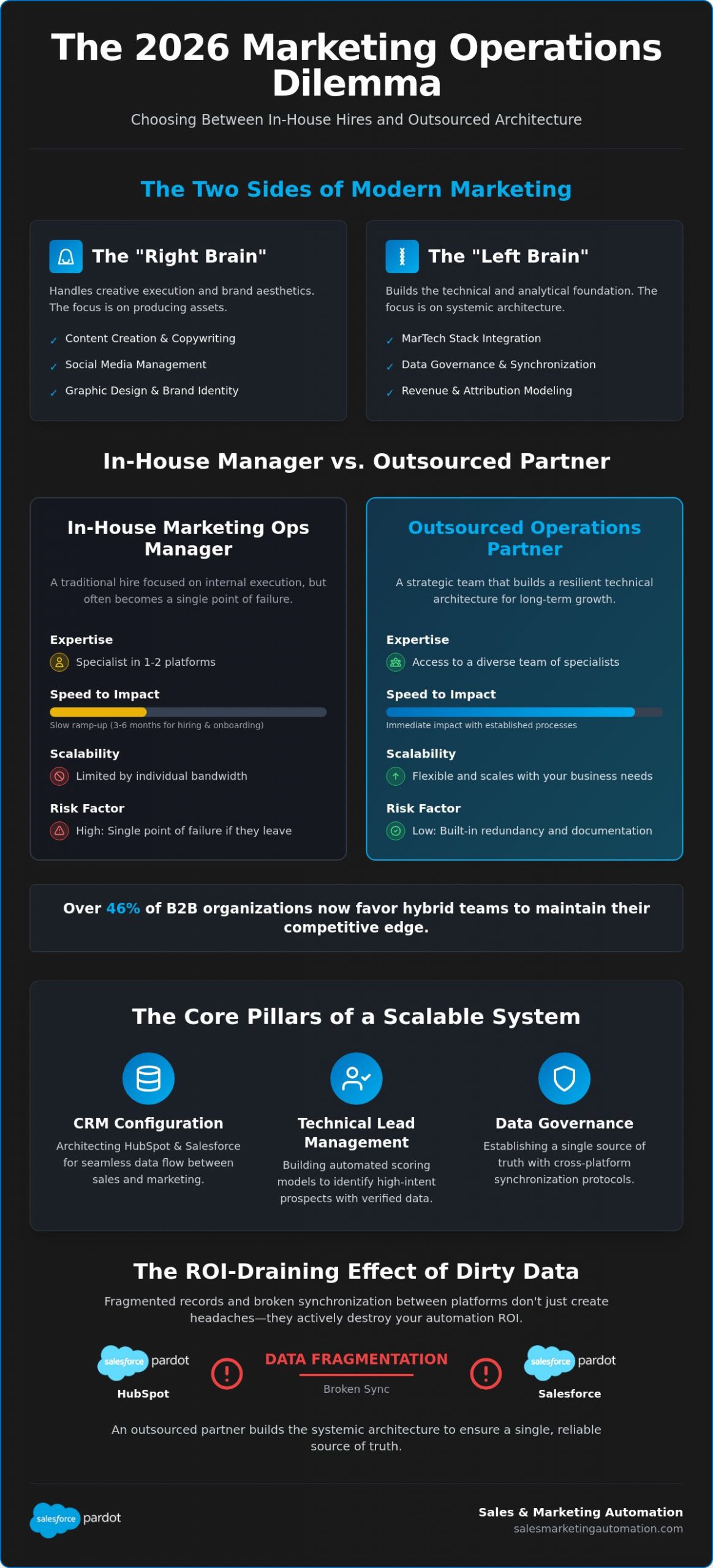
Discover how to scale your technical infrastructure by comparing the strategic merits of in-house hiring against diverse outsourced models. This guide provides a clear path to achieving clean, actionable lead data and seamless integration between your critical sales and marketing tools. You will learn how to build a scalable framework that ensures systemic integrity and provides the data-driven logic necessary to prove ROI in an environment where over 46% of B2B organizations now favor hybrid marketing teams to maintain their competitive edge.
Modern business leaders often conflate creative agency support with technical infrastructure management. While traditional outsourcing focused on delegating repetitive tasks to reduce costs, outsourced marketing operations in 2026 represents a sophisticated shift toward systemic architecture. This discipline prioritizes the health of your MarTech stack and the integrity of your data flows over the production of creative assets. It’s the difference between hiring a designer to build a landing page and partnering with an engineer to ensure that the lead data from that page synchronizes perfectly across your CRM, marketing automation platforms, and attribution models.
Distinguish between the “Right-Brain” and “Left-Brain” of marketing to understand where your gaps exist. Right-brain outsourcing handles content creation, social media management, and brand aesthetics. Conversely, left-brain operations focus on the analytical and technical foundations. This technical side governs how systems communicate, how data is cleaned, and how revenue is tracked. You don’t just need someone to send emails; you need a partner to build the logic that determines who receives them and why.
Adopt the mindset of a Strategic Architect when evaluating your operational needs. This professional doesn’t merely execute tickets; they build enduring business frameworks. By designing systems that are both diagnostic and prescriptive, a Strategic Architect ensures your technology scales alongside your revenue. They look for friction points in your lifecycle automation and propose systemic interventions that prevent data decay before it impacts your bottom line.
Outsourced marketing operations is the strategic delegation of a company’s technical infrastructure, CRM architecture, and data synchronization protocols to an external specialist to ensure systemic integrity and revenue scalability.
Effective operations require a deep focus on the underlying machinery of your business. This includes the following core pillars:
The complexity of B2B environments has reached a tipping point. AI-driven automation now requires precise data inputs that internal teams often struggle to maintain. Platform updates occur with such frequency that generalist staff can’t keep pace with the technical nuances of HubSpot or Pardot. 2026 marks the transition from task-based models to results-based operational models, where the focus is on the output of the system rather than the hours spent on a project. Using outsourced marketing operations allows brands to access this high-level technical mastery without the overhead of a full-time executive hire.
Historically, marketing operations functioned as a back-office support mechanism. It was the department tasked with formatting lists or fixing broken links. Today, that paradigm has shifted entirely. Marketing operations has evolved into a primary revenue driver, serving as the technical engine that powers the modern enterprise. This transition is fueled by the realization that automation is only as effective as the data integrity behind it. When you invest in outsourced marketing operations, you aren’t just buying hours; you’re acquiring the technical mastery required to turn complex MarTech stacks into high-performance growth systems.
Dirty data acts as a silent tax on your growth. Fragmented records, duplicate entries, and broken synchronization between HubSpot and Salesforce don’t just create administrative headaches; they actively destroy your automation ROI. Without a clean data foundation, your conversion rates suffer because your messaging lacks the precision that modern B2B buyers expect. Mastering these platforms requires more than a surface-level understanding of the interface. It demands deep technical fluency in HubSpot, Pardot, and Marketo to ensure every stage of the customer journey is tracked with absolute precision. A critical component of this success involves mastering lifecycle automation strategy, which provides the technical blueprint necessary for sustainable B2B growth in a saturated market.
Establishing a high-integrity system requires a partner who understands the nuance of business architecture. If your current setup feels disjointed, it’s likely time to consult a specialist in RevOps integration to realign your tools with your revenue goals.
Technical debt accumulates when systems are patched together rather than properly architected. A “Frankenstein” tech stack, built from disparate tools connected without a unified data strategy, inevitably leads to leaking pipelines. These broken workflows result in lost revenue that is often difficult to trace until the damage is significant. Beyond the financial loss, technical debt creates operational friction. Sales teams lose valuable time chasing unvetted or low-intent leads because the automated scoring models aren’t functioning correctly. This inefficiency erodes trust between sales and marketing, further stalling your growth trajectory.
Scalability is built on a foundation of precision and order. Constructing a lead scoring model that identifies ready buyers requires a deep understanding of behavioral data and system logic. When evaluating the strategic considerations for outsourcing marketing, leaders must prioritize technical competence over creative flair. Harvard Business Review notes that the shift from creative-centric to analytical-led marketing has redefined organizational success, making technical infrastructure the primary determinant of commercial viability. A comprehensive technical audit is the only reliable way to diagnose these system inefficiencies before they scale into larger liabilities.
Deciding between a full-time hire and a managed service provider is a choice between individual capacity and collective capability. While a dedicated employee offers immediate proximity, they often lack the technical breadth required to manage a modern, interconnected stack. Selecting outsourced marketing operations provides access to a tiered team of specialists who’ve refined their skills across hundreds of unique implementations. This model eliminates the “single point of failure” risk where your entire technical history resides in the mind of one person. If that person leaves, your operational momentum often leaves with them.
Implementation speed is a critical differentiator in competitive markets. A single in-house hire must spend weeks researching new CRM features or API documentation before execution. Conversely, an agency utilizes pre-built frameworks and proven blueprints to deploy complex integrations in days. This efficiency is particularly vital for firms utilizing fractional marketing ops to bridge the gap between their current state and their desired growth targets. It allows you to acquire senior-level strategic oversight without the long-term commitment or overhead of an executive salary.
Some leaders worry that an external partner won’t grasp their specific internal business logic. This concern is usually addressed through a collaborative agency model that prioritizes deep discovery and technical audits. An effective partner doesn’t operate in a vacuum; they act as a diagnostic guide, documenting your unique workflows to ensure systemic integrity. They don’t just run campaigns. They build the enduring frameworks that make those campaigns possible. This partnership ensures your internal logic is codified and improved rather than lost in translation. For organizations where marketing generates leads that sales consistently ignores, sales and marketing alignment consulting provides the structural intervention needed to transform disconnected departments into a unified revenue engine.
A single Marketing Ops Manager is rarely an expert in every facet of the stack. They might excel at HubSpot workflows but struggle with complex Salesforce Apex triggers or Pardot synchronization errors. Agencies provide a “bench” of specialists, ensuring that the right expert handles each specific technical challenge. This institutional knowledge prevents the loss of operational history. When your technical lead is an agency, the system documentation remains intact regardless of individual staff turnover. You’re buying a result, not just a person’s time.
Managed services move your organization from a reactive “break-fix” cycle to a proactive optimization rhythm. Retainer-based outsourced marketing operations ensure that your platform health is monitored continuously rather than only during a crisis. This model utilizes strategic roadmaps to schedule essential maintenance and feature updates well in advance. It also provides the flexibility to scale technical resources up or down based on your campaign cycles. You won’t pay for idle capacity during slow periods or face technical bottlenecks during high-growth launches.
Selecting a partner for outsourced marketing operations requires a fundamental transition from evaluating creative portfolios to scrutinizing technical blueprints. This is not a “plug-and-play” service. It is a deep integration into your business architecture that demands a high degree of professional confidence and proven technical mastery. Your evaluation framework must prioritize systemic integrity over simple task execution. Demand proof of platform-specific certifications, such as HubSpot Platinum status or Salesforce Pardot Specialist credentials, to ensure your partner possesses the elite technical fluency required to manage complex B2B environments.
Analyzing the total cost of ownership is a vital step in this selection process. You must look beyond monthly retainers to understand the long-term value of a scalable infrastructure. Referencing HubSpot implementation pricing provides a strategic guide for evaluating these costs in 2026, helping you distinguish between budget-driven vendors and high-level strategic partners. If you are ready to secure your technical foundation, schedule a comprehensive technical audit to identify the friction points currently stalling your growth.
A comprehensive marketing automation audit is the only ethical starting point for a high-stakes engagement. This diagnostic phase should uncover hidden technical debt, redundant workflows, and fragmented data flows that lead to leaking pipelines. A qualified partner must demonstrate the ability to map every technical action directly to revenue growth. Be wary of “red flags” in agency proposals, such as a lack of specific data migration expertise or a failure to mention data governance protocols. If a potential partner cannot explain how they will maintain data integrity during a CRM migration, they lack the architectural depth required for outsourced marketing operations.
Success depends on a seamless communication rhythm that matches your corporate environment. Establish clear expectations for technical reviews and documentation standards from the outset. You should prioritize “white-box” operations, where your organization retains full ownership and visibility of all platform assets and configurations. Never permit a partner to build proprietary logic that you cannot access or manage internally if the engagement ends. Finally, define specific KPIs for operational health to move beyond vague metrics. Focus on tangible results such as system uptime, data accuracy percentages, and lead velocity to ensure your technical framework remains a high-performance revenue driver.
Selecting a partner for outsourced marketing operations is ultimately an investment in the systemic health of your organization. Sales & Marketing Automation serves as a specialized RevOps partner, focusing exclusively on the technical orchestration of HubSpot, Salesforce, and Pardot ecosystems. We adopt the role of the Strategic Architect, prioritizing the construction of enduring business frameworks that support long-term scalability rather than merely executing isolated campaigns. With a proven track record of over 100 successful implementations, our team provides the seasoned experience necessary to solve complex integration challenges that stall revenue growth.
Our methodology is rooted in data-driven logic and systemic integrity. We understand that a high-performance revenue engine requires more than just software; it requires a methodical approach to business architecture. To accommodate varying organizational needs, we provide three core engagement models:
We specialize in delivering high-integrity technical setup and data migration services tailored for complex B2B environments. Whether you’re navigating a transition between HubSpot and Salesforce or consolidating disparate data sources, our team ensures that your technical infrastructure remains robust. Our monthly managed services provide ongoing platform optimization, allowing your internal leadership to focus on strategy while we handle the granular technical execution. Every engagement begins with a diagnostic audit, ensuring that every systemic intervention is backed by a clear roadmap for revenue growth.
The journey from internal operational chaos to automated precision begins with a clear understanding of your current state. Initiating a CRM data assessment or a technical audit allows us to identify the specific bottlenecks in your lead management and lifecycle automation. This prescriptive process provides the clarity needed to realign your sales and marketing tools for maximum impact. By codifying your business logic into a scalable framework, we help you eliminate technical debt and build a foundation for sustained commercial success. Construct a scalable revenue engine with Sales & Marketing Automation today to secure your operational future.
Establishing a high-performance technical framework requires a transition from tactical interventions to strategic architecture. You’ve recognized how fragmented data and technical debt stifle growth. Choosing outsourced marketing operations provides the specialized mastery necessary to maintain systemic integrity across your HubSpot and Salesforce environments. Prioritizing clean lead data ensures your MarTech stack functions as a unified revenue engine. Precision is the foundation of scale.
Sales & Marketing Automation delivers this systemic health through a boutique focus on technical architecture. Our team brings the authority of 100+ successful CRM implementations and the deep expertise of certified HubSpot and Salesforce Pardot experts. We eliminate operational friction by building enduring frameworks tailored to your business logic. Take the first step toward long-term scalability and Request a Strategic Marketing Automation Audit to secure your technical foundation. Your systems should be a catalyst for growth, not a bottleneck. Build with confidence.
Outsourced marketing typically focuses on creative execution, brand aesthetics, and campaign management. In contrast, outsourced marketing operations prioritizes the technical infrastructure, data governance, and MarTech integrations that power those campaigns. It’s the difference between hiring someone to write an email and hiring an expert to ensure the underlying automation logic delivers that email to the right segment at the optimal time.
Outsourcing often provides a higher ROI by eliminating the heavy overhead associated with full-time technical hires. In-house roles require competitive salaries, benefits, and continuous training to keep pace with platform updates. Partnering with an agency allows you to access a tiered team of specialists for a predictable fee, providing elite expertise without the recruitment risks or long-term liability of a specialized headcount.
Specialized agencies, such as CWS Marketing (Client Winning Strategies), are designed to manage complex environments like HubSpot, Salesforce, and Pardot. These partners provide certified experts who understand the deep architectural nuances and API limitations of each platform. They don’t just use the software; they design the synchronization protocols and data flows that ensure your CRM remains a clean, actionable source of truth for your sales and marketing teams.
Your company is likely ready if you’re experiencing “data silos” where HubSpot and Salesforce records don’t align. Other indicators include an inability to accurately track lead attribution or a high turnover rate of specialized technical staff. If your marketing team spends more time fixing system errors than executing strategy, it’s time to transition to a managed operational model.
The primary risks involve data security and “black-box” operations where you lose visibility into your own technical logic. You can mitigate these risks by choosing a partner that prioritizes “white-box” transparency. Ensure you maintain full ownership of all platform assets and that the agency follows rigorous data governance protocols to protect your proprietary lead and customer information during outsourced marketing operations engagements.
A sophisticated technical partner uses diagnostic discovery to codify your unique B2B sales process into the system architecture. By conducting a deep dive into your lead lifecycle, the agency ensures that every automated workflow reflects your specific business logic. This collaborative approach ensures that the technology serves the strategy, rather than forcing your team to adapt to rigid, generic templates.
A comprehensive audit should identify technical debt, redundant workflows, and gaps in your data synchronization. It must evaluate your lead scoring models, automated lifecycle stages, and platform security settings. This diagnostic phase provides a clear roadmap for system refinement, ensuring your technical foundation is robust enough to support your revenue goals before you scale your marketing efforts.
Fractional marketing ops provides senior-level strategic guidance on a part-time basis to oversee system architecture and long-term planning. Managed services focus on the ongoing technical execution and platform maintenance required to keep systems running smoothly. While fractional roles set the strategic blueprint, managed services provide the specialized “hands-on-keys” support needed to build and optimize the framework daily.