 Sales & Marketing Automation
The CRM and Marketing Automation Guru's You Can Trust.
Sales & Marketing Automation
Your marketing automation platform is not a simple utility; it is the sophisticated operating system of your revenue engine. Many organizations now leverage marketing automation managed services to escape the cycle of fragmented workflows and unreliable CRM data that often plagues internal operations. It’s a common struggle to see high-cost software licenses underutilized while staff turnover continually stalls your technical momentum and prevents true scalability.
This guide reveals how a professional management model converts technical debt into a high-performance engine that drives predictable revenue. We will explore the precise methods for cleaning your data, aligning sales and marketing, and building a strategic roadmap that ensures your software delivers measurable ROI in 2026. By treating your tech stack as a structured architecture rather than a collection of tools, you can finally achieve the growth your business requires and maintain systemic integrity in an increasingly complex digital landscape.
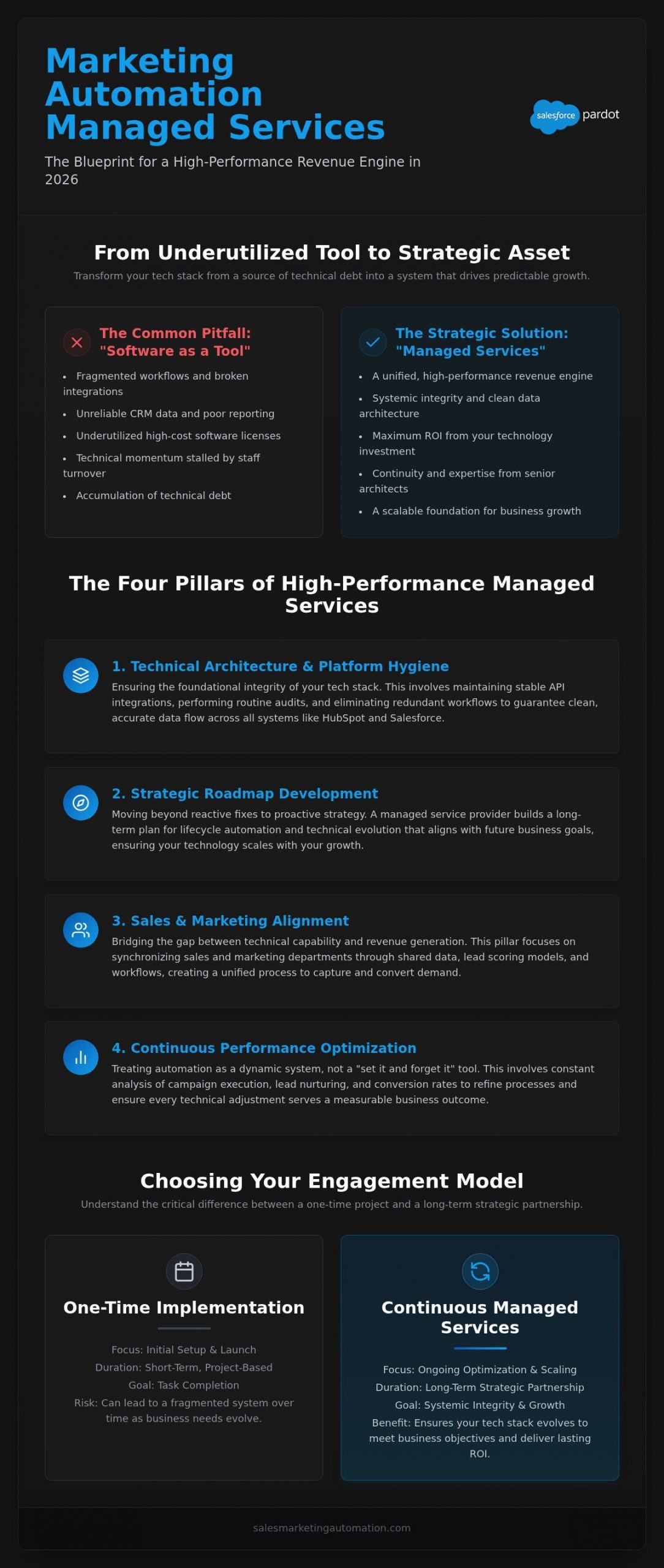
Modern revenue growth requires more than a subscription to a SaaS platform. While the foundational question of What is Marketing Automation? focuses on software that automates repetitive tasks, the reality in 2026 is far more complex. Marketing automation managed services represent an ongoing, high-level partnership between your organization and a team of technical architects. This relationship isn’t about buying a tool; it’s about investing in a strategy that ensures your technology evolves alongside your business objectives.
Many B2B leaders treat software as a standalone solution, yet tools only provide the capacity for work, not the direction for it. Transitioning from “software as a tool” to “managed services as a strategy” allows you to move beyond basic email sequences. It aligns your technical stack with revenue operations consulting principles, ensuring every workflow contributes directly to the bottom line. This shift is necessary because an unmanaged tech stack quickly accumulates technical debt, leading to broken integrations and unreliable reporting.
Internal teams often fail to keep pace with the rapid release cycles of platforms like HubSpot or Salesforce. Without a dedicated specialist, your CRM data becomes “dirty,” and advanced features remain underutilized. Managed services provide the consistent, expert oversight needed to maintain systemic integrity, turning a collection of disconnected tools into a unified revenue engine.
A professional MSP acts as the primary steward of your marketing ecosystem. Their work is characterized by precision and proactive maintenance rather than reactive troubleshooting. Key responsibilities include:
It’s a mistake to view managed services as simple task outsourcing. A Strategic Architect doesn’t just perform tasks; they build enduring frameworks. Traditional outsourcing often focuses on one-off task completion, which can lead to a fragmented system over time. In contrast, managed services focus on systemic integrity. The architect bridges the gap between your high-level marketing goals and the granular technical execution required to achieve them. They ensure that every automation rule and data field serves a documented purpose within your broader business architecture, providing a level of continuity that internal staff turnover often disrupts.
High-performance automation is never a static achievement; it is a dynamic state of operational health maintained through rigorous standards. Relying on “set it and forget it” workflows is a primary reason why many B2B tech stacks fail to scale. Instead, effective marketing automation managed services treat your platform as a living architecture that requires constant refinement. This engineered approach ensures that every technical adjustment serves a specific business outcome, such as increasing lead velocity or reducing sales friction.
A core component of this architecture is sales and marketing alignment consulting, which serves as the bridge between technical capability and revenue generation. Without this alignment, even the most sophisticated workflows will struggle to deliver meaningful ROI. By synchronizing these departments, you create a unified front that captures and converts demand with surgical precision.
Systemic integrity begins with the underlying structure of your tech stack. Managed services provide the oversight necessary to keep API integrations stable and ensure that your platform configuration adheres to established B2B best practices. A Strategic Architect performs routine audits to identify and eliminate redundant workflows or “ghost” automations that can trigger conflicting actions. This proactive maintenance prevents technical debt from accumulating, ensuring your system remains lean and responsive as you grow.
Precision in lead management demands models that reflect the nuances of the modern buyer’s journey. High-performance services involve designing sophisticated scoring systems that distinguish between casual browsers and high-intent buyers. By implementing multi-stage nurture sequences, you can create personalized customer journeys that build trust over time. Automating the hand-off between marketing and sales is equally vital; it prevents lead leakage and ensures that your sales team only engages with prospects who are truly ready to buy.
Clean data is the fuel for accurate reporting and predictive analytics. Managed services establish strict data governance standards to prevent the creation of “dirty” or duplicate CRM records. By standardizing field mapping and property usage across your entire stack, you ensure that information remains consistent as it moves between platforms. Regular data cleansing and enrichment processes support a “source of truth” that B2B leaders can rely on for strategic decision-making. To ensure your system is operating at peak efficiency, consider requesting a marketing automation audit to identify and resolve hidden bottlenecks.
Distinguish between the construction of a technical system and its continuous optimization. A project-based implementation provides a critical foundation, but it’s a static event that focuses on the “now.” In contrast, marketing automation managed services act as the ongoing growth engine that prevents your tech stack from becoming a collection of obsolete workflows. Organizations that rely on a “set it and forget it” approach often find that their systems degrade within months due to platform updates, shifting business requirements, or data decay.
While initial implementation fees are a one-time capital expense, the cost of managed services is an investment in recurring ROI. Continuous optimization ensures your software licenses deliver tangible value rather than becoming expensive, underutilized tools. For companies that need a middle ground between a full agency partnership and an in-house hire, fractional marketing ops offers a flexible way to inject senior-level expertise into your team. This model allows you to scale your technical capabilities without the overhead and long-term risk of a full-time executive hire.
Select a project-based model when your primary need is a clean start or a major transition. This engagement type is focused on specific, high-impact tasks such as:
This approach is best for companies with a strong, existing internal operations team that simply needs an expert architect to design the initial framework before they take over daily maintenance.
Managed services become a strategic necessity when your campaign orchestration reaches a level of complexity that internal teams can’t sustain. It’s a foolproof way to solve the “revolving door” problem of marketing ops staffing, where high turnover leads to lost institutional knowledge and broken automations. By leveraging marketing automation managed services, you gain consistent access to technical architects who understand your entire ecosystem. This ensures that every lifecycle stage is monitored and every integration is optimized for peak performance, regardless of internal staffing changes. You move from reactive troubleshooting to proactive growth, ensuring your revenue engine never stalls due to technical neglect.
Selecting a partner for marketing automation managed services requires a diagnostic approach rather than a simple review of service tiers. You’re looking for a firm that views your tech stack as a cohesive architecture, not a series of disparate tasks. This distinction is vital when evaluating outsourced marketing operations; a tactical vendor will simply follow instructions, but a strategic partner will challenge your assumptions to ensure long-term scalability. Platform-specific certifications for HubSpot, Salesforce, and Pardot are non-negotiable. These credentials ensure the partner understands the native logic of your software, which prevents the “hacks” that lead to technical debt.
Demand transparency in all technical workflows. Avoid “black box” agencies that guard their processes as trade secrets. A true partner provides full visibility into how automations are built and documented, ensuring that you retain ownership of your technical infrastructure. If an agency cannot explain the strategic “why” behind a specific workflow configuration, they’re likely building on a fragile foundation that will eventually fail under the weight of your growth.
Use these criteria to vet the maturity of a potential partner’s service model:
Identify these warning signs early to avoid costly technical errors. Be wary of agencies that rely heavily on junior-level staff for high-level technical architecture. While junior technicians can handle basic execution, they often lack the seasoned experience needed to solve complex integration challenges. Another red flag is a lack of focus on data integrity. If an agency doesn’t prioritize CRM hygiene and field mapping, your reporting will remain unreliable regardless of how many campaigns you run. Finally, trust your judgment on pricing. Senior-level strategic consulting has a specific market value; if a quote seems suspiciously low, you’re likely sacrificing the expertise required to build an enduring framework. To ensure your partner selection aligns with your scalability goals, request a technical audit to review your current system architecture.
Sales & Marketing Automation functions as the technical steward for organizations that demand systemic precision. We move beyond the role of a traditional vendor to act as your Strategic Architect, ensuring your technology supports, rather than hinders, your growth trajectory. By choosing our marketing automation managed services, you gain direct access to senior-level consultants who possess deep technical mastery across the most complex B2B ecosystems. This boutique approach ensures that your account is never delegated to junior staff, providing a level of continuity and expertise that large-scale agencies often fail to deliver. We focus on building enduring frameworks that evolve with your business, ensuring your software investment translates into a scalable revenue engine.
We begin every engagement with a comprehensive Marketing Automation Audit to diagnose underlying inefficiencies and technical debt. This diagnostic phase allows us to develop a custom roadmap for technical implementation or CRM data migration that aligns with your specific revenue goals. Once the foundation is secure, we provide ongoing lifecycle automation through a methodical, retainer-based model. This structure ensures your platform remains optimized for peak performance, allowing you to scale your operations without the friction of broken workflows or dirty CRM data. Our process is designed to be prescriptive, identifying and resolving bottlenecks before they impact your lead flow or sales alignment.
Our reputation is built on over 100 successful platform implementations for national B2B leaders. We specialize in high-growth tech stacks, including HubSpot, Salesforce, Pardot, and Marketo, providing the specialized knowledge required to navigate these sophisticated tools. Our commitment to data integrity and revenue-driven results means we don’t just report on vanity metrics; we build the frameworks that drive predictable lead flow. It’s time to move from a state of tech stack frustration to a future of operational health. By partnering with a team that values systemic integrity as much as you do, you can finally transform your marketing technology into a high-performance revenue engine that scales with your business objectives.
Building a scalable revenue engine requires a shift from reactive troubleshooting to proactive technical stewardship. Prioritizing systemic integrity and continuous optimization ensures your tech stack remains a high-performance asset rather than a source of technical debt. We have explored how the right framework for marketing automation managed services converts fragmented tools into a unified growth vehicle, bridging the gap between high-level strategy and granular execution.
As you evaluate your path forward, consider the advantage of a Strategic Architect approach. With over 100 successful implementations and a team of HubSpot and Salesforce certified partners, we provide the seasoned expertise necessary to stabilize and scale your operations. Scale with confidence. It’s time to move beyond the limitations of underutilized software and staff turnover to achieve a future defined by clean data and predictable lead flow.
Scale Your Revenue Engine with Expert Managed Services and secure the operational health your business deserves.
Managed services prioritize technical architecture and systemic health, whereas a traditional marketing agency typically focuses on creative execution and content production. A managed service provider acts as a Strategic Architect, ensuring your tech stack is integrated, documented, and scalable. This partnership is designed to maintain platform hygiene and data integrity rather than just executing one-off creative campaigns.
Industry data for 2026 indicates that software licensing alone ranges from $15 per month for startups to over $4,200 per month for enterprise solutions. Technical implementation and onboarding fees typically fall between $1,000 and $50,000 depending on complexity. Managed service costs are structured around the depth of strategic oversight required to maintain these systems, reflecting the value of senior-level expertise compared to the higher expense of hiring full-time internal staff.
Yes, because managed services provide high-level strategic roadmapping that often exceeds the scope of daily administration. While an internal admin manages routine tasks, a managed service partner focuses on architectural integrity and long-term scalability. This collaborative model ensures your internal team has access to specialized technical mastery, preventing the accumulation of technical debt and ensuring your roadmap aligns with evolving revenue goals.
Data integrity is a core pillar of marketing automation managed services. This includes performing a rigorous Marketing Automation Audit to identify “dirty” records and executing CRM Data Migration with precision. These services ensure that your field mapping and property usage are standardized across your entire tech stack, which is essential for accurate reporting and predictable lead scoring.
Technical expertise is focused on high-growth B2B platforms, specifically HubSpot, Salesforce, Pardot, and Marketo. Support includes end-to-end implementation, lifecycle automation, and strategic consulting for these specific ecosystems. By specializing in these industry-standard tools, the service ensures that every integration and workflow follows established best practices for technical excellence and revenue operations.
Technical improvements, such as resolved integration errors and cleaner CRM data, are often realized within the first 30 days. However, a more comprehensive ROI, characterized by stabilized lead flow and improved sales alignment, typically manifests within three to six months. This timeline allows for the full deployment of optimized lead scoring models and the maturation of multi-stage nurture sequences that mirror the buyer’s journey.
A comprehensive Marketing Automation Audit is the necessary diagnostic foundation for any successful engagement. This audit identifies existing friction points and underutilized features, allowing for the creation of a prescriptive roadmap. Starting without this diagnostic phase risks building new automations on a flawed foundation, which can lead to systemic failure as your business attempts to scale.
Partnerships are generally structured as annual retainers to ensure operational continuity and long-term systemic health. This duration allows for the steady execution of a strategic roadmap and provides a buffer against the disruptions caused by internal staff turnover. For specific foundations, such as a HubSpot Implementation or CRM Data Migration, project-based agreements are utilized to achieve immediate technical milestones.