 Sales & Marketing Automation
The CRM and Marketing Automation Guru's You Can Trust.
Sales & Marketing Automation
What if your CRM wasn’t just a digital filing cabinet, but a predictive engine capable of forecasting revenue with surgical precision? Most leaders recognize that a CRM serves as the central nervous system of their revenue operations, yet the transition often triggers a justified fear of dirty data sabotaging automation and sales teams resisting unfamiliar tools. This hubspot implementation checklist 2026 provides the strategic architecture required to bypass these common pitfalls and execute a flawless setup. By focusing on systemic integrity rather than just technical toggles, you can transform HubSpot into a scalable asset that drives sustainable growth.
You likely understand the frustration of seeing budgets vanish into unused features or witnessing marketing and sales teams drift apart due to fragmented reporting. It’s difficult to justify a premium investment when the resulting data remains unreliable. We’ll guide you through a methodical framework that prioritizes data integrity and seamless alignment. This guide covers everything from leveraging the July 2026 Breeze AI updates to managing the critical August 31 sunsetting of classic themes. You’ll gain a comprehensive blueprint for building a streamlined lead management system that generates accurate, actionable insights for your entire organization.
Successful HubSpot adoption begins long before the first user seat is provisioned. It requires a fundamental shift from a “software setup” mentality to a Strategic Architect mindset. This approach ensures that every technical configuration serves a specific revenue objective rather than just checking boxes on a technical list. By utilizing a comprehensive hubspot implementation checklist 2026, leaders can align their Customer Relationship Management (CRM) architecture with long-term scalability and systemic health.
Assemble a core implementation team that balances organizational authority with technical execution. You must identify an Executive Sponsor to remove roadblocks and secure budget, a Project Lead to oversee the implementation timeline, and a Technical Admin to manage granular system settings. This triad ensures that the project remains grounded in business reality while maintaining technical precision. Without this structure, implementations often succumb to “feature creep” or lack the necessary buy-in to drive team-wide adoption.
Document your current operational state against a clear 2026 growth vision to pinpoint specific technical gaps. This diagnostic phase reveals where existing processes fail to support your scaling goals. Establish “North Star” KPIs early in the process, focusing specifically on Customer Acquisition Cost (CAC) and Pipeline Velocity. These metrics provide a clear lens through which to evaluate every automation, custom property, and workflow you eventually build within the portal.
Identify specific friction points in your current lead-to-revenue journey, such as delayed lead handoffs or inconsistent data entry between departments. Define cross-departmental data requirements to ensure that Sales, Marketing, and Service teams operate from a single source of truth. To maintain focus, craft a single sentence defining your primary goal. For example: “We will build a unified data ecosystem that accelerates deal progression through automated, high-integrity lifecycle management.” This statement serves as the final arbiter for all architectural decisions during the setup process.
Establish baseline metrics for lead conversion and sales cycle length before you begin the migration. These figures act as the “before” state in your ROI calculations. Determine a specific “Go-Live” definition for each department to manage internal expectations. For Marketing, this might include the launch of the first automated nurture sequence; for Sales, it could be the successful migration of the active deal pipeline. Draft a phased rollout timeline that introduces complex features gradually. This methodical approach prevents organizational burnout and ensures users feel confident at every stage of the transition.
Once the strategic framework is established, the focus shifts to technical execution. This stage of the hubspot implementation checklist 2026 involves configuring the foundational environment where your revenue operations will live. Begin by finalizing core portal settings, including timezone, primary currency, and branding consistency. These settings are often overlooked but serve as the baseline for accurate global reporting and professional external communication. Ensure your primary and secondary domains are connected with verified DKIM and SPF records to maintain high email deliverability and robust tracking across all web assets.
Security is a non-negotiable pillar of modern CRM management. Enforce two-factor authentication (2FA) across the entire organization and establish granular user permission sets that follow the principle of least privilege. This proactive measure prevents unauthorized data exports and protects your system’s integrity. In 2026, initializing HubSpot Breeze is equally critical. Configure your AI agents and define specific content assistant permissions to ensure that generative tools align with your brand voice and data privacy standards. Taking these steps early prevents the “Wild West” scenario where AI tools are used inconsistently across different teams.
Design a data model that reflects your unique business logic by defining Custom Objects where standard contacts and companies fall short. Audit your existing property list to prune redundant fields that contribute to “portal bloat.” Adhering to database migration best practices ensures that your architectural foundation remains robust as you transition from legacy systems. Organize your remaining properties into logical Property Groups. This simple step significantly improves the user experience for sales teams, allowing them to find relevant data without scrolling through hundreds of irrelevant fields.
Connect your essential business tools to create a unified ecosystem. Install and configure deep integrations for Slack, Zoom, and LinkedIn Sales Navigator, ensuring that data flows bidirectionally and triggers relevant notifications. Verify the API health of any custom-built connections or middleware to prevent synchronization failures that lead to data gaps. For those managing complex ecosystems, our guide on Revenue Operations Consulting provides deeper insights into scaling your B2B tech stack. If you’re unsure about your current portal health, a marketing automation audit can identify hidden technical debt before it impacts your growth.
Data migration represents the highest point of risk in any HubSpot transition. A flawed migration doesn’t just disrupt your current workflow; it actively corrupts the “Breeze AI” models you initialized in Phase 2, leading to inaccurate predictions and automated errors. To ensure a successful outcome, your hubspot implementation checklist 2026 must prioritize a rigorous “Keep, Archive, Delete” audit. This strategy forces stakeholders to justify every record before it enters the new environment, effectively neutralizing the threat of legacy “dirty data” before it can take root.
Execute a “Pilot Migration” using a subset of your most complex records to identify mapping errors or formatting discrepancies before the final import. This trial run allows for surgical adjustments to your data architecture without risking your entire database. When you are ready for the full transfer, map every legacy field to HubSpot properties with 100% precision. For organizations managing sophisticated B2B datasets, following a strategic marketing automation framework provides the necessary governance to maintain order during this high-stakes transition.
Standardize your naming conventions across companies, contacts, and deals to ensure reporting consistency from day one. Remove duplicate records and purge bounce-heavy email addresses that could damage your sender reputation. This level of hygiene is essential for maintaining a high-performance portal. For a more granular breakdown of the technical requirements involved in this process, consult our Strategic Architect’s Guide to CRM Data Migration Services. Professional CRM data migration ensures that your historical context remains intact while your system remains lean.
Perform random record spot-checks immediately after the final import to confirm that property mapping remains accurate across all objects. Verify that historical activity, including emails, calls, and internal notes, has transferred without loss of context or metadata. Neglecting these checks is a costly oversight that often surfaces months later. Dirty data increases the total cost of ownership by forcing expensive human talent to manually correct errors instead of leveraging the platform’s automation. Establish a rigid data governance policy now to prevent future record duplication and maintain the systemic integrity you’ve built.
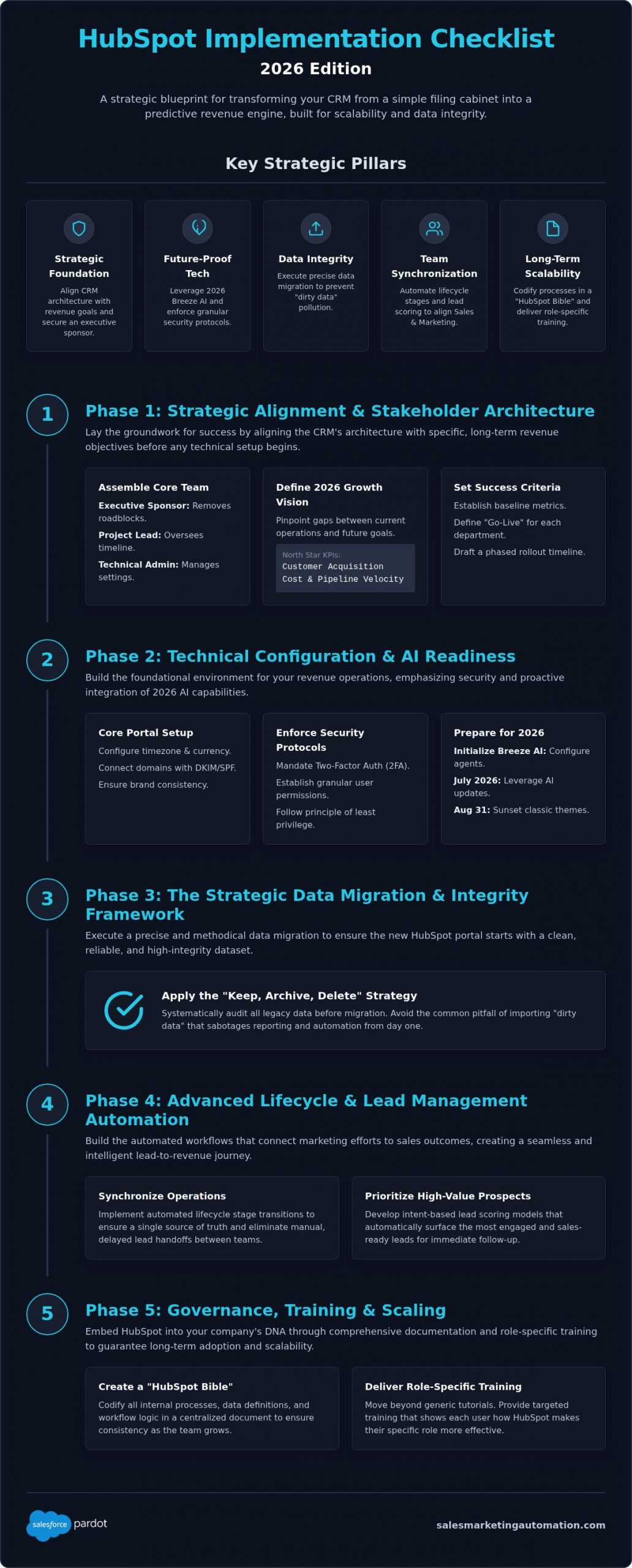
Designing a high-performance lead management engine is the culmination of your architectural efforts. This hubspot implementation checklist 2026 ensures that your portal doesn’t just store data, but actively accelerates the buyer journey. Start by constructing a Lead Scoring model that balances demographic fit with behavioral intent. Assign values to firmographic traits like industry and revenue, then weight them against high-intent actions such as pricing page visits or demo requests. This dual-layered approach identifies prospects who aren’t just interested, but are actually qualified to buy.
Automate Lifecycle Stage transitions to eliminate manual bottlenecks and ensure total Sales-Marketing alignment. Build a robust “MQL to SQL” handoff workflow that triggers immediate task notifications for your sales team when a prospect crosses your scoring threshold. This step is a non-negotiable part of any hubspot implementation checklist 2026 aimed at high-growth environments. Implement lead rotation logic to ensure equitable distribution among sales reps, preventing lead stagnation and maximizing pipeline velocity. These systemic interventions transform your CRM from a passive database into an active sales catalyst.
Develop persona-based “Welcome” and “Re-engagement” sequences to maintain consistent touchpoints throughout the buyer lifecycle. Set up internal notification triggers for high-intent website actions, allowing your team to engage while the prospect is actively researching. For a deeper dive into campaign architecture, consult our guide on Mastering Lifecycle Automation Strategy. If your current workflows are underperforming, our lifecycle automation services can refine your logic for maximum impact.
Create a “Marketing Contribution to Revenue” dashboard to provide leadership with clear visibility into how automation drives growth. Set up “Sales Activity” reports to monitor outreach consistency and identify high-performance behaviors. Configure Multi-Touch Attribution to move beyond simple “first-click” or “last-click” models. This sophisticated reporting identifies which content channels and campaigns are truly moving the needle, allowing you to reallocate budget with surgical precision based on actual performance data.
The successful activation of your portal is not the conclusion of the project; it is the commencement of your system’s operational life. To prevent the gradual erosion of data integrity, you must establish a rigid governance framework immediately following go-live. Develop a “HubSpot Bible” to serve as your organization’s definitive source for standard operating procedures. This internal Wiki should document the naming conventions, workflow logic, and property definitions established during your hubspot implementation checklist 2026 process. Without this documentation, the architectural precision you’ve built will inevitably dissolve into “portal bloat” as new users introduce inconsistent data practices.
Conduct role-specific training sessions that focus on the specific outcomes each department needs to achieve. Sales teams require deep dives into deal management and meeting scheduling, while marketing users need mastery over the Breeze AI content assistants and lead nurture workflows. Establish a monthly “Portal Health Check” schedule to monitor technical debt and ensure compliance with the latest platform updates, such as the August 31, 2026, sunsetting of classic themes. This proactive maintenance identifies minor friction points before they escalate into systemic failures. When evaluating your long-term administrative needs, consider whether managed services offer a more sustainable total cost of ownership compared to hiring a full-time in-house admin for a complex B2B stack.
Implement a “Super-User” program by identifying at least one champion in each department to provide immediate, localized support. These internal experts act as a bridge between the technical admin and the end users, facilitating faster troubleshooting and feedback loops. You can encourage compliance by gamifying CRM usage; for instance, use leaderboards to reward the highest rates of data entry accuracy or outreach consistency. Schedule quarterly strategy reviews to ensure your portal configuration continues to align with your evolving business goals. These sessions allow you to refine your hubspot implementation checklist 2026 milestones and adjust your automation logic as your market position shifts.
Attempting a DIY implementation for a sophisticated B2B tech stack often leads to expensive architectural errors that hinder scalability. A professional partner brings the seasoned experience of over 100 successful implementations, ensuring that your technical foundation is built for longevity. We specialize in identifying hidden inefficiencies through rigorous marketing automation audits, which reveal technical debt that standard onboarding often misses. Sales & Marketing Automation serves as your Strategic Architect, transforming complex migrations into streamlined engines for revenue growth. By partnering with experts, you secure a foolproof framework that values order, data-driven logic, and seamless departmental integration.
Constructing a HubSpot environment is not a one-time technical event; it’s the development of a sophisticated framework designed for longevity and precision. By following this hubspot implementation checklist 2026, you’ve moved beyond basic setup into the realm of strategic architecture. You’ve learned to align stakeholder vision with technical capabilities, secure data integrity during complex migrations, and deploy advanced automation that bridges the gap between marketing and sales. These systemic improvements don’t just organize your data; they catalyze sustainable revenue growth.
Navigating these technical nuances requires a methodical, RevOps-first approach that prioritizes operational health. With a track record of over 100 successful implementations and deep expertise in complex B2B data migrations, our team is ready to help you optimize your portal. Request a Strategic HubSpot Implementation Audit to identify hidden inefficiencies and unlock the full potential of your tech stack. Your organization deserves a CRM that functions as a seamless engine for growth. Take the first step toward technical mastery and build a foundation that supports your most ambitious scaling goals.
A standard implementation for mid-market firms typically spans 60 to 90 days. This timeline accounts for initial strategic alignment, rigorous data cleansing, and the phased rollout of core automation workflows. Complex migrations involving multiple hubs or bespoke legacy integrations may extend this period to ensure every technical component is thoroughly tested before the final go-live date.
HubSpot onboarding focuses on platform orientation and basic feature activation, while implementation is a comprehensive architectural project. Implementation involves deep RevOps alignment, custom object design, and sophisticated data migration strategies. While onboarding helps you use the software, implementation builds the systemic framework that ensures the software drives measurable business outcomes and long-term scalability.
Engaging a technical consultant is essential for organizations with complex B2B tech stacks or high-volume data requirements. A consultant acts as the Strategic Architect, ensuring your technical foundation supports future growth and prevents the accumulation of technical debt. This expertise is particularly valuable for navigating advanced security settings, API integrations, and the nuances of the 2026 AI suite.
Total investment varies based on the complexity of your data ecosystem and the specific Hubs required. Organizations must account for mandatory one-time onboarding fees, such as $3,000 for Marketing Hub Professional or $7,000 for Enterprise, alongside the costs for strategic consulting and data migration. These investments ensure the system is configured correctly from day one to avoid expensive future reconfigurations.
You can migrate data from Salesforce to HubSpot while preserving historical activity, including emails, calls, and internal notes. This process requires precise field mapping and a “Keep, Archive, Delete” strategy to maintain data integrity. Professional migration services ensure that your historical context remains intact while eliminating the redundant or “dirty” data that often accumulates in legacy systems.
The most frequent errors include migrating “dirty data” without prior auditing and failing to secure executive buy-in. Neglecting to define clear lifecycle stage transitions in your hubspot implementation checklist 2026 is another critical oversight. These mistakes often lead to low user adoption, fragmented reporting, and a CRM that fails to provide a single source of truth for the organization.
HubSpot Breeze AI necessitates a higher standard for data normalization during the initial setup phase. Because AI agents and predictive models rely on high-integrity datasets to function accurately, the implementation must prioritize precise property configuration and data governance. Messy data will directly hinder the functionality of AI features, making the “Strategic Architect” approach more vital than ever for operational health.
A Strategic Architect acts as the lead designer of your revenue engine, ensuring technical configurations align with specific business outcomes. They diagnose friction points in the lead-to-revenue journey and prescribe systemic interventions that transform the CRM into a scalable asset. This role bridges the gap between high-level business goals and granular technical execution, resulting in a more efficient and integrated operation.