 Sales & Marketing Automation
The CRM and Marketing Automation Guru's You Can Trust.
Sales & Marketing Automation
Most CRM failures aren’t caused by bad software; they’re caused by the mistake of treating a technical setup as a simple installation rather than a strategic architectural evolution. You’ve likely experienced the friction of disconnected sales and marketing processes or the persistent fear that “dirty data” will compromise your new system before it even launches. It’s a valid concern, especially if your organization has a history of low user adoption with previous tools that promised much but delivered little.
Discover how professional crm implementation services transform fragmented data into a high-performance revenue engine through strategic architecture and technical precision. By prioritizing systemic integrity over mere configuration, you can finally establish a unified “single source of truth” for lead data and automate the manual tasks that currently stall your sales cycle. This guide outlines the methodical approach to building a scalable framework that complies with 2026 data privacy regulations in states like Indiana and Kentucky, ensuring your system remains a secure, high-yield asset that provides the clear ROI reporting your stakeholders demand.
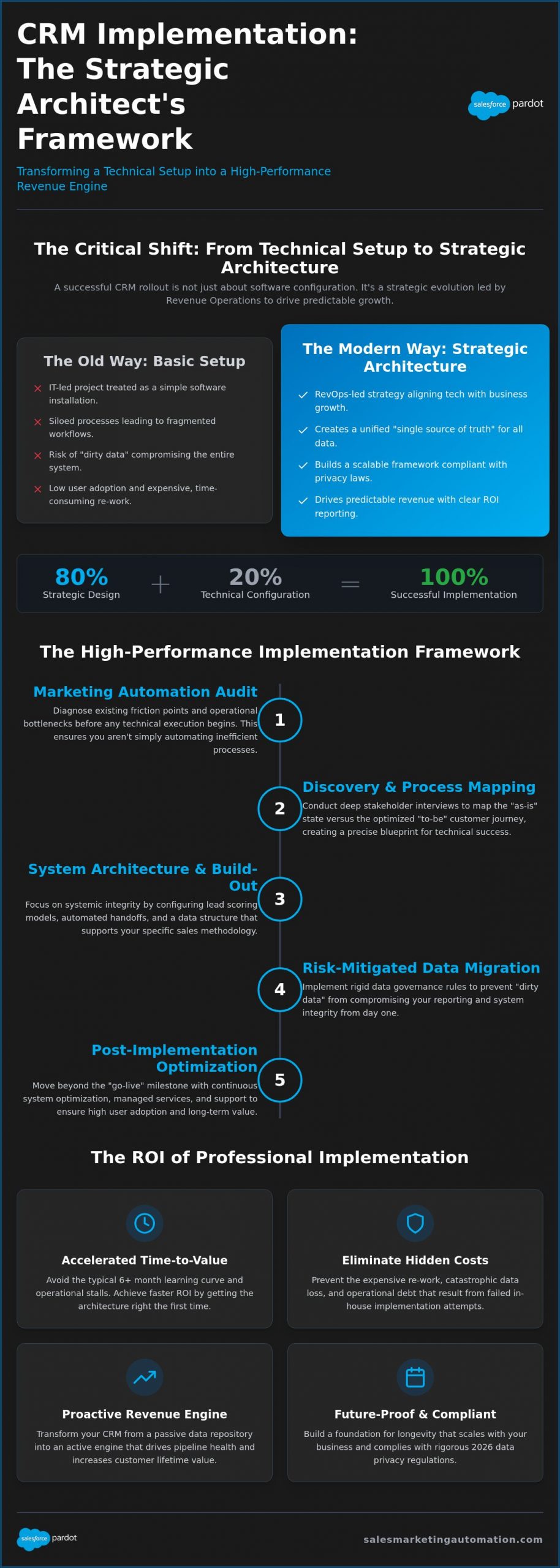
Modern CRM implementation is no longer a checklist of feature toggles. It has evolved into a sophisticated architectural discipline that bridges the gap between technical infrastructure and revenue growth. In the past, these projects were often siloed within IT departments, treated as a “software installation” task. Today, the focus has shifted toward Revenue Operations (RevOps). This transition ensures that every data field, workflow, and integration serves a singular purpose: driving predictable revenue. You aren’t just buying a tool; you’re building the framework for your entire go-to-market strategy.
The 2026 landscape is defined by hyper-complex B2B tech stacks and rigorous data privacy regulations across states like Indiana, Kentucky, and Rhode Island. Navigating this requires a Strategic Architect. You don’t just need someone to turn the system on; you need an expert who understands how AI-driven features, such as Salesforce’s Agentforce or Microsoft’s Copilot, will interact with your unique lifecycle stages. Professional crm implementation services provide this technical precision, ensuring that your foundation is built for longevity rather than a temporary “go-live” fix. This approach treats the CRM as the central nervous system of your business, not just another tab in a browser.
Technical configuration accounts for roughly 20% of a successful rollout. The remaining 80% is purely strategic. Before a single automation is built, a thorough Marketing Automation Audit is essential to diagnose existing friction points and operational bottlenecks. Without this diagnostic phase, you risk simply automating inefficient processes. Lifecycle Automation planning must precede technical construction to ensure that lead handoffs between sales and marketing are seamless, measurable, and data-driven. Professional implementation looks at the “why” behind every field, ensuring the system supports your specific sales methodology.
Failed in-house attempts often lead to expensive re-work, fragmented workflows, and catastrophic data loss. When you invest in professional crm implementation services, you are purchasing an accelerated time-to-value. High-growth teams cannot afford a six-month learning curve or the risk of “dirty data” polluting their analytics. Expert consultants transform your CRM from a passive data repository into a proactive revenue engine. This precision allows for clear ROI reporting, enabling stakeholders to see exactly how technical architecture correlates with pipeline health and customer lifetime value. By getting it right the first time, you eliminate the hidden costs of operational debt.
Executing a successful CRM rollout requires more than a standardized checklist. It demands a rigorous, architecturally-sound framework that aligns technical configuration with your specific business objectives. High-performance crm implementation services follow a methodical progression from initial discovery through to a managed deployment, ensuring that every technical decision supports long-term operational health and scalability. This structured approach prevents the common pitfall of building a system that satisfies IT requirements but fails to serve the sales team’s daily needs.
Strategic discovery involves more than just gathering a list of desired features. It requires deep stakeholder interviews to isolate the specific friction points that currently stall your sales cycle. By documenting the “as-is” state of your operations and contrasting it with an optimized “to-be” customer journey, you create a blueprint for technical success. This stage defines the specific requirements for your environment, whether you’re navigating the user-friendly automation of HubSpot or the extensive, multi-layered customization capabilities of Salesforce and Pardot. Identifying these needs early ensures the system is built to solve actual business problems rather than theoretical ones.
During the build-out phase, the focus shifts to systemic integrity and technical precision. This involves configuring sophisticated lead scoring models that prioritize high-intent buyers based on behavioral data and firmographic fit. We establish automated hand-offs between marketing and sales teams to eliminate lead leakage and ensure no opportunity is ignored. By building custom dashboards that track high-level revenue metrics, you gain immediate visibility into the health of your pipeline. If you’re unsure where your current infrastructure stands, a comprehensive Marketing Automation Audit can identify the architectural gaps before you begin your next build.
Configuration also extends to the granular level of custom objects, properties, and permissions. It’s essential to define who has access to what data, especially as privacy regulations like the California Delete Act (SB 362) become more stringent in 2026. User Acceptance Testing (UAT) serves as the final safeguard, ensuring the system accurately reflects real-world sales workflows before the managed go-live. A successful deployment strategy minimizes business disruption, allowing your team to transition seamlessly into a more efficient, automated environment. This methodical execution ensures that your crm implementation services deliver a system that is both technically sound and highly adopted by your end users.
Deciding between an internal hire and external crm implementation services is a high-stakes architectural choice that dictates your organization’s technical agility for years to come. While an in-house specialist offers immediate proximity, they often lack the breadth of experience required to navigate enterprise-grade platform complexities. When you calculate the total cost of ownership (TCO), an internal hire involves significant overhead, including salary, benefits, and ongoing training. In contrast, a specialized agency provides a collective intelligence that an individual simply cannot replicate, offering a more efficient path to a high-performance system.
Generalist freelancers present a different risk profile. While they might possess the basic technical literacy to configure a portal, they often lack the strategic “why” behind the build. This leads to systemic technical debt where the CRM satisfies immediate needs but fails to scale. Specialized partners who focus exclusively on ecosystems like HubSpot, Salesforce, or Pardot outperform software-agnostic firms because they understand the nuances of those specific tech stacks. They don’t just perform tasks; they build enduring frameworks that align with your Revenue Operations goals.
Boutique agencies offer a “fractional marketing ops” model that is ideal for scaling organizations. This approach allows you to access a diverse team of architects, designers, and developers without the financial burden of multiple full-time executive salaries. By leveraging a partner with over 100 successful implementations, you bypass the common pitfalls that often derail internal projects. These experts have seen a wide variety of challenges and have developed methodical, foolproof ways to solve them, ensuring your system remains a secure and scalable asset.
Assess your potential partner based on their technical depth and strategic consulting capability. Review their certifications for HubSpot, Pardot, or Marketo to verify their platform-specific expertise. Don’t settle for case studies that merely show “live” systems; demand evidence of tangible revenue growth and improved operational health. A critical factor in your evaluation should be the partner’s methodology for CRM data migration services. If their migration framework isn’t risk-mitigated, your new system will inherit the “dirty data” and structural inefficiencies of your previous tool, compromising your reporting from day one.
Technical execution is the crucible where strategic plans either solidify or dissolve. Achieving a high-performance system requires hitting specific technical milestones with surgical precision. Professional crm implementation services prioritize data integrity and systemic connectivity to ensure your platform doesn’t just function, but excels under the pressure of enterprise-scale operations. This phase is about more than just checking boxes; it’s about engineering a framework that maintains its integrity as your lead volume scales.
Executing a risk-mitigated migration requires a departure from the “lift and shift” mentality that plagues many failed rollouts. You must treat your data as a high-value asset that requires protection and refinement during transit. The foundation of this process is a pre-migration Strategic CRM Data Cleanup. This step ensures you aren’t importing legacy errors, redundant records, or outdated formatting into your new architecture. It’s the only way to guarantee that your analytics are trustworthy from day one.
Mapping legacy data fields to your new CRM architecture demands a zero-loss policy. Every property must have a clear destination that supports your 2026 reporting requirements, including compliance with new consumer data privacy laws in states like Indiana and Kentucky. Validating this accuracy involves multi-stage technical audits before, during, and after the migration. This methodical approach prevents the “dirty data” issues that frequently lead to low user adoption and skewed ROI reporting. When your team trusts the data, they’re far more likely to engage with the tool. For a deeper understanding of how to architect this process without compromising your sales pipeline, the Strategic Architect’s Guide to CRM Data Migration Services provides a foolproof framework for preserving every customer touchpoint during your platform transition.
A CRM shouldn’t exist as an island. It must integrate seamlessly with your broader marketing technology (MarTech) stack to provide a holistic view of the customer journey. Connecting Salesforce Pardot or HubSpot with ERP and finance systems allows for real-time data flow, reducing manual entry and eliminating departmental silos. These API-based integrations ensure that your custom business applications communicate fluently with your central revenue engine, providing a single source of truth for stakeholder reporting.
Designing sophisticated lifecycle automation strategies is the final step in transforming your system from a repository into a proactive tool. These workflows nurture prospects through every funnel stage, triggered by precise behavioral data rather than generic timelines. By automating these complex hand-offs, your sales team can focus exclusively on high-intent opportunities. If you’re ready to secure your technical foundation, schedule a technical audit to identify the integration gaps in your current stack.
The “go-live” date is a significant milestone, but it isn’t the finish line. Treating crm implementation services as a one-time technical event is a primary reason systems eventually decay into expensive, underutilized databases. Realizing the full potential of your investment requires a commitment to post-implementation “hyper-care.” This initial phase of intensive support ensures that early user friction is identified and resolved before it hardens into permanent resistance. By providing immediate technical assistance and workflow refinement, you protect the systemic integrity established during the build.
High-growth organizations recognize that business requirements evolve far faster than static software configurations. To maintain operational health, you must transition from a project-based mindset to a model of continuous optimization. Regular marketing automation audits are essential to identify where your processes have diverged from your technical architecture. These diagnostic check-ups allow you to iterate on lead scoring models and automation triggers as your market presence expands, ensuring that your revenue engine remains finely tuned to current buyer behaviors.
Internal teams often find themselves consumed by reactive troubleshooting and basic administrative tasks. This leaves little room for the strategic enhancements that drive long-term ROI. Retainer-based managed services provide continuous access to automation experts who proactively prevent technical debt. Instead of merely maintaining the status quo, these specialists align your technology stack with evolving sales goals, implementing new features and integrations as they become available. This proactive stewardship ensures your CRM remains a high-performance asset rather than a legacy burden.
A truly future-proof CRM framework must support more than just your current operations. It needs the architectural flexibility to accommodate international expansion, new product lines, and shifting regulatory requirements. As your organization matures, your system should be prepared for more advanced Revenue Operations Consulting interventions that further synchronize your tech stack with your financial objectives. This level of scalability is only possible when the initial crm implementation services are performed with a long-term strategic vision.
To ensure your system remains a scalable foundation for growth, follow this final checklist for systemic longevity:
Constructing a scalable revenue engine requires more than a simple software rollout; it demands a rigorous commitment to systemic integrity and architectural precision. You’ve seen how professional crm implementation services bridge the gap between fragmented data and high-performance workflows by aligning your technical stack with a robust RevOps strategy. Prioritizing risk-mitigated data migration and continuous lifecycle automation ensures you secure a foundation that supports long-term operational health and precise ROI reporting.
As Certified HubSpot and Salesforce Partners with over 100 successful implementations, we specialize in navigating the complexities of modern B2B tech stacks. We help you eliminate technical debt through methodical, diagnostic frameworks that produce tangible business results. Take the first step toward a unified single source of truth by leveraging our fixed-fee strategic assessments. Book a Strategic CRM Audit with our Architects today to refine your infrastructure. Your organization’s growth depends on a system built for longevity; start building that future with confidence today.
The timeline for professional crm implementation services typically ranges from 8 to 24 weeks depending on organizational complexity. Small to mid-market builds often reach completion within 90 days, while enterprise-grade architectures requiring extensive custom integrations or global data migrations may extend to six months. This period includes discovery, technical configuration, and multi-stage testing to ensure systemic integrity before the final go-live.
Industry research for 2026 shows that CRM implementation costs vary significantly based on business size and technical requirements. Mid-sized companies typically expect to invest between $50,000 and $150,000, while enterprise-level projects often exceed $500,000. These figures reflect the depth of customization, the volume of records in the CRM data migration, and the complexity of the lifecycle automation workflows being built.
Simple software onboarding focuses on basic portal navigation and “out-of-the-box” feature toggles. Professional crm implementation services provide a strategic architecting of your entire revenue operation. This includes mapping complex business processes, establishing data governance rules, and building custom objects that reflect your unique sales methodology. It transforms the CRM from a passive directory into a proactive revenue engine.
Executing a strategic data cleanup before migration is essential to prevent operational debt. Importing “dirty data” or redundant legacy records will immediately compromise your reporting accuracy and erode user trust in the new system. A methodical audit identifies these friction points early, allowing you to refine your database for higher integrity and compliance with 2026 privacy regulations in states like Indiana and Kentucky.
A specialized implementation partner provides the technical depth required to integrate HubSpot, Salesforce, and Pardot into a unified ecosystem. These integrations eliminate silos by ensuring that lead data flows seamlessly between marketing and sales departments. This connectivity is vital for maintaining a single source of truth and achieving accurate attribution across your entire technology stack, including ERP and finance systems.
Success is quantified through high user adoption rates, reduced manual sales tasks, and the delivery of clear ROI reporting. We monitor the accuracy of your lead data and the speed at which prospects move through automated lifecycle stages. A successful project results in a system that stakeholders actually use to drive predictable revenue growth rather than a tool they avoid due to technical friction.
Implementation partners build advanced lead scoring models that prioritize prospects based on behavioral triggers and firmographic fit. These models move beyond simple point systems to identify ready buyers with high precision. By automating this prioritization, your sales team can focus their energy on the opportunities most likely to convert, significantly improving your overall win rates and reducing time wasted on low-fit leads.
Resistance is often a symptom of a system that doesn’t reflect the user’s daily reality. We mitigate this through early stakeholder interviews and rigorous User Acceptance Testing (UAT). When the sales team sees that the new workflows reduce their administrative burden and provide cleaner lead data, adoption rates increase naturally. Post-implementation support and “hyper-care” further ensure that users feel confident navigating the updated framework.