 Sales & Marketing Automation
The CRM and Marketing Automation Guru's You Can Trust.
Sales & Marketing Automation
Approximately 70% of HubSpot implementations fail to achieve their expected ROI because they’re treated as simple software setups rather than strategic architectural shifts. If you’re currently managing fragmented data across multiple platforms or struggling with an inability to track lead-to-revenue attribution, you’re likely feeling the pressure to justify your technology spend. Developing a robust business case for hubspot implementation requires more than a list of features. It demands a quantified framework that links technical consolidation directly to bottom-line growth.
It’s frustrating to watch sales and marketing teams work in silos while the cost of maintaining “dirty” CRM data continues to climb. You understand that a unified platform is the solution, yet securing C-suite buy-in depends on your ability to project tangible, systemic gains. This article provides a data-driven roadmap to help you build a business case that justifies your investment through quantified operational efficiency. We’ll examine how to leverage 2026 trends like HubSpot Breeze AI and phased rollout strategies to ensure your implementation scales seamlessly with your business.
Inaction is rarely a neutral choice; it is often the most expensive path a business can take. When constructing a business case for hubspot implementation, you must view it as more than a request for capital. It is a diagnostic framework designed to expose the operational friction that currently bottlenecks your revenue. Understanding What is a Business Case? in this strategic context means identifying the “Invisible Tax” paid every day through fragmented data and manual lead entry. This tax manifests as wasted payroll hours and missed opportunities that never reach your sales pipeline. Developing a robust business case for hubspot implementation is the first step toward reclaiming this lost revenue.
Legacy systems often house “Dirty Data” that actively erodes your conversion rates. When CRM records are incomplete or duplicated, your marketing automation triggers fail, and your sales outreach becomes irrelevant. This lack of systemic integrity prevents accurate revenue attribution. Without a unified data layer, you cannot definitively prove which marketing channels drive high-value deals. This ambiguity makes reliable forecasting impossible, leaving leadership to make strategic decisions based on intuition rather than empirical evidence. Precision is the casualty of the status quo.
Siloed departments create a “black hole” where leads vanish during the handoff process. Research indicates that approximately 60 to 70% of HubSpot implementations fail to reach their ROI potential because they don’t address these foundational process gaps. Your teams likely spend hours every week manually syncing data between disparate tools. This administrative burden doesn’t just drain time; it destroys sales team morale. When high-performing reps are forced to hunt for context across multiple platforms, their productivity drops, and the risk of talent attrition rises. A unified platform ensures that no lead is left to stagnate in an unmonitored queue.
Maintaining a patchwork of point solutions creates significant maintenance debt. Each individual subscription, integration, and custom API represents a potential point of failure. Beyond the direct software costs, these fragmented setups pose security and compliance risks, especially as data privacy regulations become more stringent. A comprehensive marketing automation audit often reveals that businesses are paying for overlapping features across five or six different vendors. Consolidating these into a single customer platform eliminates redundant spend and ensures a higher level of systemic security. You aren’t just buying software; you’re retiring technical debt that hinders your ability to scale.
A compelling business case for hubspot implementation focuses on the architectural superiority of a unified customer platform rather than a mere list of software features. While point solutions offer niche functionality, they often create the very data silos that lead to operational friction. Understanding The Strategic Value of CRM requires a perspective that looks past individual email or sales tools toward a centralized ecosystem. HubSpot functions as a single source of truth, providing 360-degree visibility into the customer journey. This systemic integrity is essential for high-growth B2B organizations that require a scalable framework to manage complex sales cycles and multi-channel marketing efforts.
The transition to a “Smart CRM” allows leadership to move from reactive troubleshooting to proactive optimization. When your data resides in one location, you gain the ability to analyze the entire customer lifecycle with precision. This clarity enables more accurate forecasting and ensures that every department is working from the same set of verified facts. Building a business case for hubspot implementation means prioritizing this systemic health over the temporary convenience of disconnected tools. If you’re unsure if your current setup supports this level of visibility, a technical audit of your existing infrastructure can highlight the gaps HubSpot is designed to fill.
Synergy between the Marketing, Sales, and Service Hubs creates a frictionless environment for both your team and your customers. This integration is maximized through a sophisticated lifecycle automation strategy that ensures every touchpoint is captured and utilized for better targeting. The Data Hub plays a critical role here, acting as the engine for long-term system health by automating data cleaning and enrichment. Instead of manual entry, your team benefits from an automated growth engine that scales without a proportional increase in administrative overhead.
Standardized data entry and automated lead scoring are the foundations of technical integrity. By enforcing these standards at the platform level, you eliminate the “garbage in, garbage out” trap that plagues most legacy CRMs. HubSpot’s robust API ecosystem further reduces future integration friction, allowing your tech stack to evolve as your business needs change. Automated data governance serves as a critical fail-safe that prevents revenue leakage by enforcing technical precision across the entire lead-to-cash cycle in 2026. This focus on governance ensures that your data remains an asset rather than a liability as you grow.
Quantifying the financial return of a complex system migration requires a shift from surface-level metrics to deep architectural modeling. Constructing a business case for hubspot implementation involves identifying the specific levers that drive revenue growth while simultaneously reducing operational friction. You must move beyond the promise of “better marketing” and focus on the hard numbers that the C-suite demands. This financial model should emphasize three core pillars: the reduction of Customer Acquisition Cost (CAC), the expansion of Customer Lifetime Value (LTV), and the acceleration of Time to Value (TTV).
Refining your lead scoring and attribution models allows your team to eliminate inefficient ad spend and manual sales prospecting. This precision directly reduces CAC by ensuring that high-value resources are only deployed against qualified opportunities. Automated lifecycle nurturing ensures consistent engagement throughout the post-purchase phase, which historically increases LTV through improved retention and upsell identification. While many organizations attempt a DIY approach, professional implementation by technical experts significantly shortens the ramp-up period. This acceleration of TTV ensures that the system begins paying for itself in months rather than years.
Lead Velocity Rate (LVR) serves as a critical leading indicator of future revenue health. It measures the month-over-month growth in qualified leads, providing a more accurate forecast than lagging sales data. Automated workflows within HubSpot reduce sales cycle duration by ensuring that no prospect waits more than a few minutes for a follow-up. When you compare manual pipeline management to an automated framework, the efficiency gains are stark. Manual systems rely on human memory and fragmented notes, whereas an automated setup triggers tasks, emails, and alerts based on real-time prospect behavior. This systemic discipline ensures that your pipeline remains fluid and predictable.
Total Cost of Ownership (TCO) encompasses more than just seat-based licensing fees. To build a transparent business case for hubspot implementation, you must account for one-time onboarding fees, technical data migration, and ongoing managed services. Refer to our HubSpot implementation pricing guide for a granular breakdown of these variables. Evaluating these costs over a three-year horizon allows you to calculate the Net Present Value of the investment. This long-term perspective demonstrates that while the initial capital outlay is significant, the cumulative operational savings and revenue lift create a compelling ROI that far outweighs the cost of maintaining legacy tech debt.
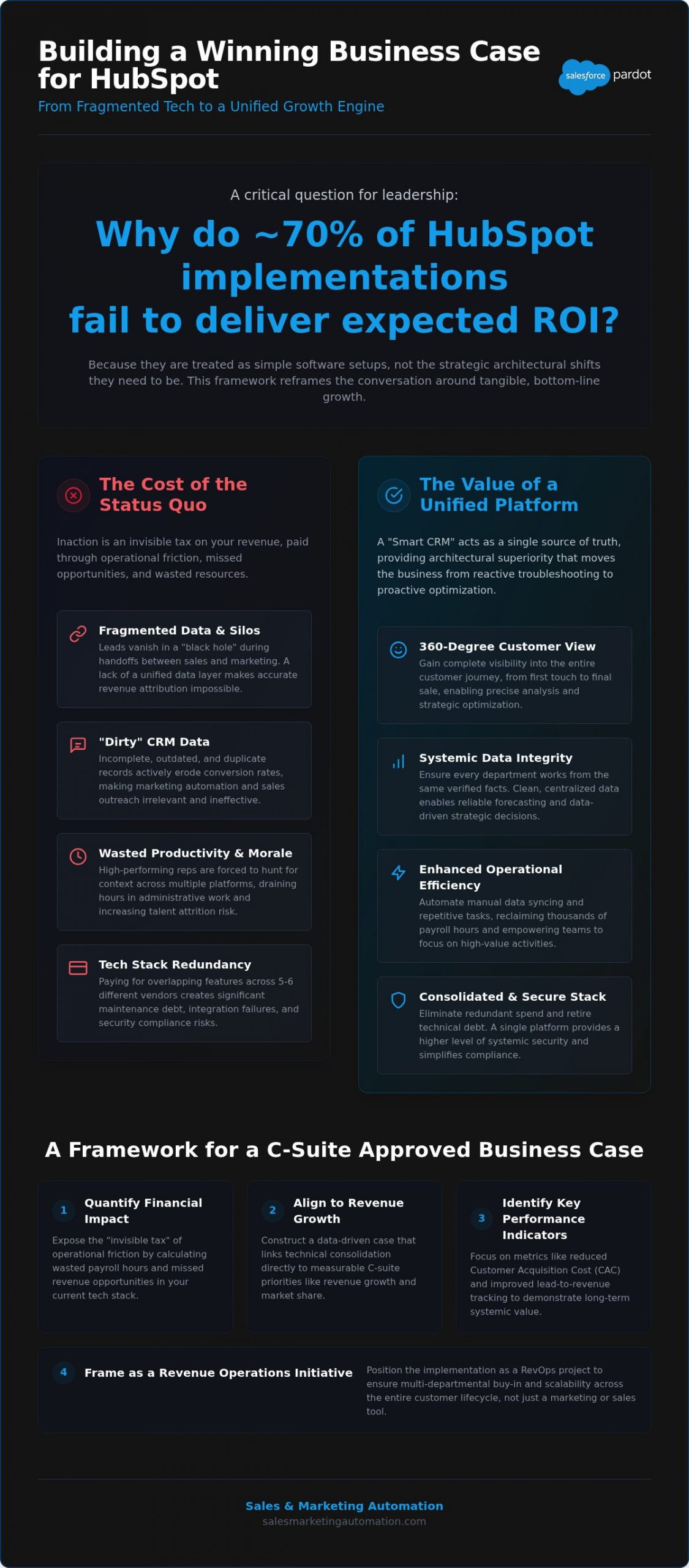
Securing executive approval for a business case for hubspot implementation requires a deep understanding of departmental friction points. You must move away from discussing software features and instead frame the project as a Revenue Operations (RevOps) initiative. This shift in terminology signals that the implementation is a systemic improvement designed to benefit the entire organization rather than a localized marketing upgrade. By positioning the platform as the connective tissue between departments, you address the primary concern of every executive: how to scale without increasing operational chaos.
Tailor your presentation to address the core “wins” that resonate with specific leadership roles. Utilizing a parallel structure helps organize these benefits into a logical, high-impact summary:
A successful business case for hubspot implementation must also include a proactive risk mitigation plan. Address the potential for data migration errors and low user adoption by proposing a phased rollout strategy. This methodical approach ensures that technical integrity is maintained while providing early evidence of ROI. If you are ready to move past fragmented tools and build a unified growth engine, schedule a strategic audit to identify your highest-impact opportunities.
The CFO prioritizes accurate revenue forecasting and the elimination of vendor sprawl. By consolidating multiple subscriptions into a single Customer Platform, you reduce administrative overhead and simplify the audit trail for technology spend. HubSpot implementation shifts marketing from a reactive cost center to a predictable profit center by providing granular visibility into every dollar of revenue generated. This transparency allows for more confident capital allocation and long-term financial planning.
For the VP of Sales, the primary goal is increasing the volume of high-quality MQLs while reducing the “administrative burden” on sales representatives. Advanced lead scoring models ensure that reps only spend time on prospects with a high intent to purchase. Engaging with revenue operations consulting further aligns your sales and marketing teams toward a single, unified goal. This alignment accelerates the sales cycle and ensures that no revenue is lost to departmental friction or manual data entry errors.
A common misconception in the B2B sector is that software onboarding is synonymous with implementation. While onboarding’s often just a feature tour, a strategic technical implementation involves the deep architectural configuration required to align the tool with your unique business processes. Your business case for hubspot implementation remains incomplete if it doesn’t account for the expert precision needed to prevent the “garbage in, garbage out” trap. Professional configuration ensures that your custom integrations with existing ERP or proprietary tools function as a single, seamless ecosystem. Managed services then serve as the essential insurance policy for your investment, providing the ongoing optimization needed to sustain the ROI promised to your stakeholders.
Technical integrity is the foundation of any scalable CRM. If you treat the setup as a secondary task, you risk building your revenue engine on a flawed foundation. Strategic implementation focuses on constructing enduring frameworks that prioritize data hygiene and process automation. This approach transforms HubSpot from a simple database into a proactive growth engine that supports every stage of the customer lifecycle. By investing in professional configuration from the start, you avoid the costly corrective work that follows a failed DIY attempt.
Executing a flawless transition requires specialized CRM data migration services that prioritize systemic health over mere data movement. Data mapping stands as the most critical phase of your business case for hubspot implementation because it defines how information flows between departments. If this mapping is flawed, the resulting data fragmentation will replicate the very inefficiencies you intended to solve. Common migration pitfalls, such as failing to de-duplicate records or ignoring field mapping logic, often lead to budget overruns and delayed timelines. A methodical approach to migration ensures that your new platform’s populated with high-fidelity data from day one.
Engaging a partner provides more than technical support; it offers a long-term roadmap for platform evolution. A strategic architect builds enduring frameworks, such as custom lead scoring and lifecycle stage definitions, that reflect the reality of your sales cycle. This level of customization transforms HubSpot from a generic tool into a proprietary growth engine tailored to your organization’s specific needs. As your business scales, these frameworks adapt, ensuring that your tech stack never becomes a bottleneck for revenue. To start building a data-driven justification for your project, Request a Strategic HubSpot Audit and discover how a professional implementation secures your future growth.
Building a resilient revenue architecture requires a move beyond reactive software adoption toward strategic system design. You’ve seen how the high cost of the status quo and the “invisible tax” of fragmented data can stall growth. By quantifying the impact on Customer Acquisition Cost and aligning your goals with the C-suite’s vision for scalability, you transform a technical project into a core business driver. Constructing a definitive business case for hubspot implementation is the first step toward reclaiming operational efficiency and establishing a single source of truth for your entire customer lifecycle.
Success depends on moving past basic onboarding to embrace technical precision. With over 100 successful implementations, our certified technical architecture experts focus exclusively on delivering measurable revenue growth through systemic integrity. Don’t leave your data architecture to chance. The roadmap to a unified, scalable tech stack is within reach when you prioritize architectural health over temporary fixes.
Secure Your HubSpot ROI with a Strategic Implementation Audit
Primary components of a business case for hubspot implementation include a diagnostic of current operational friction, a quantified projection of revenue growth, and a detailed breakdown of the total cost of ownership. You must also include a risk mitigation plan that addresses data integrity and user adoption hurdles. Highlighting the “invisible tax” of fragmented data helps leadership understand that inaction represents a significant financial liability that grows over time.
Most organizations begin to see measurable operational gains within the first six months, though a complete return on investment typically follows a three-year horizon. This timeline depends heavily on the speed of technical deployment. Given that 60 to 70% of implementations fail to reach their ROI potential due to poor planning, professional implementation accelerates this process by reducing the ramp-up period and ensuring that complex automated workflows are active.
You should always include the cost of a consulting partner in your business case because it often offsets mandatory HubSpot onboarding fees while ensuring technical precision. Partners provide the strategic architecture that prevents the “garbage in, garbage out” trap common in DIY setups. This investment functions as an essential insurance policy that protects the long-term integrity of your CRM data and ensures your automation scales correctly.
Justifying HubSpot over cheaper alternatives requires a shift in focus from monthly licensing fees to the total cost of maintaining a fragmented tech stack. Cheaper CRMs often necessitate multiple third-party integrations and manual workarounds that increase administrative overhead. HubSpot’s unified platform eliminates these redundant point solutions; it ultimately reduces the cost per lead and improves overall pipeline efficiency by providing a single source of truth.
The most significant risk to success is poor data quality compounded by low user adoption across the sales and marketing departments. Research suggests that 60 to 70% of implementations fail to achieve their expected ROI because of inadequate planning. Ensuring that your business case for hubspot implementation prioritizes data governance and phased rollouts is critical to maintaining systemic trust and long-term platform health across the entire organization.
HubSpot is designed to function as a unified customer platform that can replace a vast majority of disparate marketing, sales, and service tools. While it consolidates core functions like email automation and lead scoring, it should still integrate with your existing ERP or proprietary software. This consolidation reduces vendor sprawl and ensures that every department operates from a single source of truth, resulting in much higher data accuracy.
Measuring success after the first year involves tracking long-term metrics such as Lead Velocity Rate and Customer Lifetime Value expansion across your segments. You should also analyze the reduction in sales cycle duration and the improved accuracy of your revenue forecasting. These indicators prove that the system has transitioned from a new implementation into a mature growth engine that scales seamlessly with your business needs.
You must clean duplicate records, verify email deliverability, and standardize lead source properties before initiating any migration to the new platform. Incomplete data or inconsistent naming conventions will break your automation triggers and lead to inaccurate reporting. Focusing on data hygiene during the migration phase ensures that your lead scoring models are effective from the moment the system goes live, preventing future technical debt.