 Sales & Marketing Automation
The CRM and Marketing Automation Guru's You Can Trust.
Sales & Marketing Automation
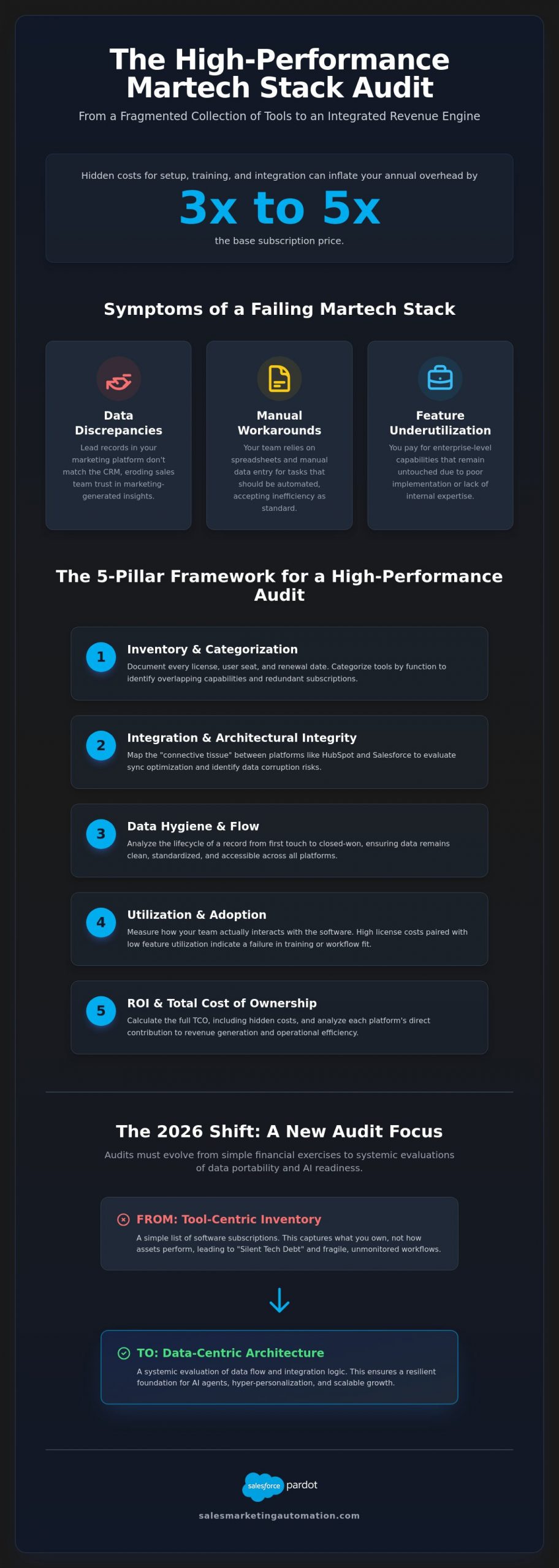
Hidden costs for marketing automation, encompassing setup, training, and complex integrations, often add three to five times the base subscription price to your annual overhead. Most leaders recognize the friction of redundant tool subscriptions and the persistent headache of broken data syncs between HubSpot and Salesforce, yet few possess a methodical framework to resolve them. You understand that low team adoption of expensive platforms isn’t just a training issue; it’s a structural failure that obscures your true ROI and hinders scalability.
Performing a rigorous marketing tech stack audit is the essential first step toward reclaiming operational health and ensuring every dollar spent serves a specific revenue objective. This article outlines the architectural diagnostic process necessary to eliminate technical debt, optimize platform utilization, and secure clean, actionable data across the entire customer lifecycle. We’ll explore how to transition from a fragmented collection of tools to a streamlined, integrated ecosystem that provides clear justification for budget reallocation and long-term systemic integrity.
A comprehensive marketing tech stack audit serves as the foundational diagnostic for any high-growth revenue engine. While most organizations maintain a basic inventory of their software subscriptions, few possess a deep understanding of the architectural integrity connecting those tools. In 2026, an audit is no longer a simple financial exercise to cut costs. It is a systematic evaluation of data flow, integration logic, and operational efficiency. Neglecting this process leads to “Silent Tech Debt,” a condition where disconnected B2B platforms erode profit margins through missed opportunities and expensive manual data remediation.
Simple inventory lists fail because they capture what you own rather than how those assets perform in a live environment. An elite audit examines the “connective tissue” between HubSpot, Salesforce, and adjacent tools to identify where revenue velocity is stalling. This level of scrutiny is a prerequisite for reaching Revenue Operations (RevOps) maturity. Without a resilient technical foundation, even the most sophisticated sales strategies will fail to scale. You cannot build a high-performance customer lifecycle on top of fragile, unmonitored automations.
Identifying a failing stack requires looking past the user interface and into the gaps between systems. These symptoms often signal deep-seated architectural rot:
The historical debate between “all-in-one” suites and “best-of-breed” stacks has evolved into a focus on data portability and AI readiness. Modern audits prioritize how data moves through the ecosystem rather than the specific features of a single platform. As autonomous AI agents begin to execute multi-channel campaigns, the cost of poor data quality becomes exponential. A marketing tech stack audit is a diagnostic of revenue-generating architecture designed to ensure systemic integrity across the entire customer lifecycle. This shift ensures your stack is not just a collection of tools, but a unified system capable of supporting precision targeting and hyper-personalization at scale.
Execute your marketing tech stack audit through a lens of systemic integrity rather than simple cost reduction. A fragmented approach to auditing often misses the subtle friction points that stall revenue velocity. To build a resilient ecosystem, you must evaluate your tools across five distinct pillars of operational health. This structured framework ensures that your technical foundation supports scalable growth rather than creating a ceiling for your team’s performance.
Mapping the path from lead to revenue reveals the true health of your stack. Often, this diagnostic process uncovers “Zombies,” which are legacy integrations or tools that remain connected to your CRM but no longer serve a strategic purpose. These artifacts create security vulnerabilities and unnecessary data noise. Identifying these points of failure is a core component of a professional marketing automation audit, which pinpoints exactly where your architectural logic has begun to fray. If you suspect your current setup is underperforming, a comprehensive technical review can provide the clarity needed to rebuild for efficiency.
By mid-2026, the shift toward autonomous, agentic AI has made high-quality first-party data a requirement for survival. Your marketing tech stack audit must distinguish between native AI capabilities within your CRM and bolt-on third-party tools that may create fragmented data silos. Assess whether your current architecture supports the predictive modeling needs required for hyper-personalization. AI agents require seamless data flow to execute multi-channel campaigns effectively. If your data is siloed or inconsistent, your investment in AI will fail to deliver the expected ROI.
Technical debt is the invisible weight that slows your revenue engine. While a marketing tech stack audit provides a high-level view of your tools, the diagnostic process must delve into the mechanical failures that occur below the surface. Systems that once worked in harmony often drift apart as metadata changes, validation rules are added, or API limits are reached. This drift creates a environment where data is no longer a reliable asset, but a source of operational friction that sabotages your marketing automation ROI.
The “Sync Error” trap is particularly prevalent in the relationship between Pardot and Salesforce. Because these platforms share a deep but complex connection, a single field mapping error or a change in picklist values can stop data flow entirely. When these systems drift apart, marketing teams continue to send campaigns based on outdated sales data, while sales representatives miss critical engagement signals. Resolving these discrepancies requires a methodical approach to how to fix broken crm workflows, ensuring that your automation logic remains resilient against future architectural changes.
Workflow fragility is another common symptom of technical debt. Many organizations rely on automations that break the moment a single field name is updated or a user is deactivated. During a marketing tech stack audit, you must identify these “brittle” workflows and replace them with modular, scalable logic. This refinement prevents the “Silent Tech Debt” mentioned earlier, where processes fail without triggering immediate alerts, leading to weeks of lost data and missed lead handoffs. Engaging a marketing automation strategy consultant can provide the architectural expertise needed to rebuild these fragile systems into resilient, revenue-generating frameworks.
Analyzing the sync behavior between HubSpot, Salesforce, and Marketo requires a granular look at how records are created and updated. Technical debt often manifests as “ghost records,” which are entries that exist in your marketing automation platform but fail to populate in the CRM due to mapping errors or API limitations. These inconsistencies prevent a unified view of the customer journey. Prolonged sync delays between your marketing engine and CRM directly compromise lead response times, often allowing high-intent prospects to cool before a sales representative can engage.
Evaluate the accuracy of your lead scoring models to ensure they reflect current buyer behavior rather than legacy assumptions. Conflicting or redundant automation rules across platforms frequently cause lifecycle stage transitions to fire incorrectly, leading to inaccurate reporting in the CRM. You must verify that every trigger is mapped to a specific business outcome. A clean lifecycle architecture ensures that prospects move seamlessly from marketing qualified to sales accepted without manual intervention or data loss.
Systematic execution transforms a marketing tech stack audit from a simple observation exercise into a powerful driver of business strategy. To move from technical chaos to a streamlined revenue engine, operations teams must follow a rigorous, phased roadmap. This process ensures that every intervention is grounded in data and aligned with long-term scalability. A fragmented approach results in temporary fixes; a phased roadmap builds an enduring framework for growth.
Interrogating API logs is the only way to uncover the silent integration failures that surface-level surveys miss. These logs reveal exactly where data bottlenecks occur and why certain records fail to sync between HubSpot and Salesforce. You must also review user permissions and last-login data to distinguish between necessary licenses and wasted spend. Establishing a documented Source of Truth for every critical data point is non-negotiable; without it, your reporting will remain fundamentally flawed. If you are ready to eliminate these inefficiencies, schedule an expert-led marketing automation audit to secure your technical foundation.
Your roadmap must prioritize revenue-impacting fixes over aesthetic UI cleanups. If your lead scoring is broken or your sync logic is dropping records, these issues take precedence over organizing folder structures. This is also the time to evaluate major architectural shifts, such as a CRM migration from Pardot to HubSpot or a consolidation of legacy platforms. A 12-month technical evolution plan provides your team with a clear path forward, ensuring that your marketing tech stack audit results in a proactive system rather than a reactive one. By aligning your technical milestones with quarterly revenue targets, you transform your operations team into a strategic partner for growth.
A successful marketing tech stack audit yields more than just a list of technical corrections; it provides the blueprint for accelerated revenue velocity. When you eliminate the friction caused by technical debt and fragmented data, your sales cycle naturally compresses. Sales representatives spend less time validating lead quality and more time engaging with high-intent prospects who have been accurately scored and routed by a resilient automation engine. This transition from a defensive, “fix-it” posture to a proactive, growth-oriented strategy is the ultimate objective of systemic optimization.
Leveraging audit data allows operations leaders to move beyond anecdotal complaints and present clear, data-driven justifications for higher-level Revenue Operations (RevOps) investments. By documenting the exact cost of “Silent Tech Debt” and the potential gains from streamlined workflows, you provide the C-suite with a compelling case for budget realignment. For many Marketing Operations (MOps) teams, a fixed-fee strategic audit represents the highest ROI engagement available. It provides a predictable, expert-led intervention that identifies immediate savings while establishing the architectural standards required for long-term systemic integrity.
Maintaining the health of your stack post-audit requires a commitment to ongoing governance. This is where “Managed Services” play a critical role, providing the specialized expertise needed to monitor sync health, manage complex CRM migrations, and implement new features without disrupting existing revenue streams. Rather than allowing your stack to drift back into inefficiency, a managed approach ensures that your technical foundation remains aligned with your evolving business goals.
Your technical stack must be a reflection of your specific B2B Go-To-Market (GTM) strategy. Whether you are executing a high-touch Account-Based Marketing (ABM) approach or a high-velocity Product-Led Growth (PLG) model, your tools must support the specific nuances of that journey. Refining lead management automation reduces the traditional friction between Sales and Marketing by ensuring that every handoff is backed by clean, contextual data. As an expert partner for implementation and strategy, Sales & Marketing Automation specializes in building these enduring frameworks, ensuring that your HubSpot and Salesforce environments are engineered for maximum conversion.
Prevention is more efficient than remediation. Establishing a quarterly “Mini-Audit” allows your team to identify and resolve minor sync errors or workflow redundancies before they accumulate into significant technical debt. These checkpoints should include brief training sessions to update the team on refined architectural standards and new platform capabilities. If your current ecosystem is hindering your ability to scale, the first step toward recovery is a comprehensive diagnostic. Request a Strategic Marketing Automation Audit today to uncover hidden inefficiencies and align your martech stack with your revenue goals.
Securing the integrity of your technical ecosystem is a continuous strategic process, not a one-time project. By transitioning from a simple tool inventory to a comprehensive marketing tech stack audit, you gain the visibility required to resolve fragile sync logic and eliminate the technical debt that stalls growth. This architectural diagnostic ensures that your platforms work in unison to accelerate the sales cycle and provide the C-suite with clear, data-driven evidence of ROI.
Our team brings seasoned experience to every engagement, having completed over 100 successful CRM migrations and expert-level setups for HubSpot and Salesforce. We don’t just fix errors; we build strategic roadmaps focused exclusively on revenue growth and operational longevity. When your technical foundation is optimized, your team is free to focus on high-level strategy rather than manual workarounds. Maximize your ROI with a Strategic Marketing Automation Audit and begin building a more scalable future today. Your path to a streamlined, high-performance revenue engine is well within reach.
A comprehensive audit generally requires four to eight weeks to complete, depending on the complexity of your ecosystem. This timeframe allows for deep technical log analysis, stakeholder interviews, and the development of a prioritized remediation roadmap. Larger enterprises with global instances and custom middleware may require additional time to document every integration point accurately.
Internal teams can perform basic inventories, but an external agency provides the objective technical expertise required to identify systemic architectural flaws. External specialists bring experience from hundreds of implementations, allowing them to spot “Silent Tech Debt” that internal teams often accept as standard operating procedure. A professional marketing tech stack audit requires a level of diagnostic distance that is difficult to achieve from within the daily workflow.
Hidden costs frequently manifest as unused user seats, overlapping tool capabilities, and the “labor tax” of manual data remediation. Research indicates that setup, training, and integration can add three to five times the base subscription price to your annual overhead. Audits often uncover “Zombie” tools that remain integrated and billing despite providing no strategic value to the current GTM strategy.
Perform a full-scale audit annually to align your technology with changing business goals and regulatory requirements. In addition to this yearly deep dive, establish quarterly “Mini-Audits” to monitor sync health and prevent the accumulation of new technical debt. This proactive rhythm ensures that your architecture remains resilient as your team introduces new campaigns and tools.
A CRM audit focuses specifically on your primary system of record, such as Salesforce or HubSpot, while a marketing tech stack audit evaluates the entire ecosystem of connected tools. While the CRM is the core, the martech audit examines email platforms, analytics suites, and sales engagement tools to ensure seamless data flow across the entire customer lifecycle. Both are essential, but the martech audit provides a broader view of your architectural integrity.
No, the audit process is purely diagnostic and does not interfere with live campaigns or active automations. The primary goal is to observe and document existing configurations without altering the production environment. Any recommended changes or optimizations are planned for a phased rollout after the audit is complete, ensuring zero downtime for your revenue-generating activities.
Prepare a complete list of current software subscriptions, including contract renewal dates and seat counts. You should also provide access to API logs, current lead scoring models, and any existing workflow documentation or process maps. Having these assets ready accelerates the discovery phase and allows the audit team to focus on identifying inefficiencies rather than searching for basic access.
Measure ROI by calculating the direct cost savings from canceled redundant subscriptions and the reduction in manual labor hours spent on data cleanup. You can also track improvements in lead conversion rates and sales velocity resulting from cleaner data and more accurate lead routing. Over time, the primary return is found in the scalability of your revenue engine and the elimination of expensive technical failures.