 Sales & Marketing Automation
The CRM and Marketing Automation Guru's You Can Trust.
Sales & Marketing Automation
A standard pardot setup and configuration is no longer enough to compete in a market where 76% of your competitors are already using automation to outpace your lead generation. Most marketing leaders agree that a CRM and a marketing platform should function as a single, cohesive unit, yet many remain overwhelmed by sync complexities and the fear of “dirty data” polluting their Salesforce environment. It’s difficult to prove marketing’s impact on the bottom line when your technical foundation is fractured and your attribution reporting is non-existent.
This guide provides the strategic framework you need to master the technical milestones required to transform Salesforce Marketing Cloud Account Engagement into a high-performance revenue engine. You’ll learn how to build a scalable lead management system that ensures seamless data flow between sales and marketing while providing the precision needed for accurate attribution. We will walk through the essential architectural steps for 2026, covering everything from the Spring ’26 release updates to preparing your data for the autonomous orchestration of Agentforce. This is the blueprint for turning a complex tool into a streamlined driver of predictable growth.
Successful revenue leaders recognize that a pardot setup and configuration is not a one-time technical checkbox. It’s a foundational exercise in revenue alignment. While many organizations treat the implementation of Pardot, now officially known as Marketing Cloud Account Engagement, as a simple software installation, the Strategic Architect views it as the construction of a scalable business framework. In 2026, the margin for error has vanished. With 76% of companies already utilizing automation, the competitive advantage no longer comes from owning the tool; it comes from the precision of its architecture.
There’s a stark contrast between an “out-of-the-box” installation and a strategically engineered system. Simple installs often lead to the accumulation of technical debt, which is the cumulative cost of choosing easy, short-term fixes over robust, long-term solutions. This debt manifests as broken syncs, fragmented reporting, and an inability to adapt to new Salesforce releases. A sophisticated configuration ensures that every technical setting serves a specific business outcome, creating a system that remains resilient as your lead volume and organizational complexity grow.
Basic configurations often collapse under the weight of high-growth demands because they lack the necessary guardrails. One of the most immediate risks is the infiltration of “dirty data” into your Salesforce CRM. Without rigorous field mapping and validation rules during the initial setup, your database becomes polluted with duplicates and incomplete records. This data decay makes it impossible for sales teams to trust the leads they receive, effectively severing the bridge between marketing and sales.
Furthermore, poor folder structures and naming conventions cripple your ability to scale. When assets are disorganized, finding specific campaign data for historical analysis becomes a manual, time-consuming chore. This lack of order directly impacts your attribution modeling. If your tracking pixels and campaign hierarchies aren’t configured with a diagnostic mindset, you’ll never be able to accurately prove which marketing touchpoints are actually driving revenue. You aren’t just losing data; you’re losing the ability to make informed investment decisions.
Adopting the Strategic Architect approach means you don’t start with the software; you start with the strategy. Every technical toggle and connector setting must align with your broader lifecycle automation strategy. This ensures that the buyer’s journey is supported by a technical framework that can handle complex lead routing and multi-channel engagement without manual intervention. It’s about building for the future state of your business rather than just solving today’s immediate pain points.
Prioritize long-term system health by establishing a diagnostic mindset before the first click in the setup wizard. This involves auditing your existing data, mapping out your ideal lead flow, and defining clear governance rules. By focusing on systemic integrity and precision from day one, you transform your pardot setup and configuration from a technical necessity into a powerful engine for predictable, scalable growth. You’re not just setting up a tool; you’re engineering a revenue-generating asset that will withstand the evolving demands of the B2B landscape. When selecting a partner to guide this process, evaluating the top pardot consulting firms ensures you engage technical architects who prioritize system integrity over surface-level configuration.
Engineering a robust technical foundation is the first step in ensuring your pardot setup and configuration translates into measurable ROI. Without this infrastructure, your marketing messages risk being silenced by spam filters, and your data remains siloed between departments. In 2026, the complexity of the B2B tech stack requires a “security-first” mindset. You aren’t just connecting two platforms; you’re hardening a digital perimeter that protects your sender reputation and data integrity.
Establish digital credibility by authenticating your sending domains through SPF and DKIM protocols. These records serve as a digital signature, proving to mailbox providers that your emails are authorized and legitimate. This is particularly critical following the 2024 mandates from Gmail and Yahoo, which permanently reject bulk senders who fail to use proper authentication. Implement these records within your DNS settings to prevent your automated journeys from ending in the spam folder.
Configure your Tracker Domain with a clear CNAME record to ensure brand consistency across all hosted assets. The Tracker Domain serves as the primary link between Pardot assets and your corporate identity. When prospects click a link in your email or visit a landing page, they should see your branded URL rather than a generic Pardot address. This small technical detail significantly improves click-through rates by maintaining prospect trust throughout the buyer journey.
Orchestrate the flow of data between marketing and sales by deploying the Salesforce-Pardot Connector v2. Unlike legacy versions, v2 offers a more secure, streamlined integration that utilizes a dedicated Integration User. Navigate the “Account Engagement Setup” within Salesforce Lightning to authorize the connector and assign the necessary permission sets. Refer to the official Account Engagement Lightning App Implementation Guide for a granular breakdown of required user permissions and object access.
Map custom fields with extreme precision to ensure bi-directional data flow. Every field in Salesforce that triggers a marketing action must be mirrored and synced accurately in Pardot. If your current infrastructure feels unstable or data isn’t flowing as expected, a professional marketing automation audit can identify the specific technical gaps hindering your performance.
For global organizations, managing Pardot Business Units (PBUs) is essential for partitioning data and assets. Ensure your Salesforce org meets the “Advanced” or “Premium” edition prerequisites before attempting a PBU rollout. Finally, execute a methodical IP warming schedule over a 4-6 week period. In 2026, mailbox providers use sophisticated AI to monitor sending patterns; skipping this step will lead to immediate deliverability failures. Mastering these technical layers is what separates a standard pardot setup and configuration from a truly elite revenue engine.
Lead management is the heartbeat of a sophisticated pardot setup and configuration. It transforms a list of anonymous visitors into a prioritized queue of sales-ready opportunities. To achieve this, you must deploy a dual-axis framework that distinguishes between what a prospect does and who a prospect is. While standard implementations often focus only on conversion volume, a strategic architect focuses on the precision of those conversions to ensure the sales team only engages with high-value targets. This dual-axis approach creates a 2D matrix that identifies Marketing Qualified Leads (MQLs) with mathematical certainty.
Scoring measures the intensity of a prospect’s interest based on their interactions with your digital assets. Adjust your baseline scores to prioritize high-intent actions, such as multiple visits to a pricing page or downloading a late-stage implementation guide. These actions signal a higher propensity to buy than a simple blog post view. To maintain data accuracy over time, implement scoring degradation. This process reduces scores for prospects who have remained inactive for a set period, ensuring your sales team doesn’t waste resources chasing cold leads. Scoring Categories are the mechanism for segmenting prospect interest by product hierarchy, allowing you to track engagement across multiple business lines simultaneously.
Grading measures how well a prospect matches your Ideal Customer Profile (ICP). While scoring is dynamic and behavioral, grading is objective and demographic. Start by identifying the “Power Attributes” that define your most successful customers, such as annual revenue, industry, or job title. Use Pardot Profiles to establish these criteria for different segments of your market. This ensures that a decision-maker at an enterprise-level company is weighted more heavily than an entry-level employee at a small business, even if their activity levels are identical.
Use Automation Rules to automate grade adjustments as new data points are collected through form submissions or third-party data enrichment. This removes the manual burden from your marketing team and ensures that every prospect is evaluated against the same rigorous standards. Finally, integrate your grading logic with Salesforce Lead Assignment Rules. By only passing prospects who meet a specific score and grade threshold, you create a reliable filter that protects your sales team’s time. This strategic alignment is the final step in turning your pardot setup and configuration into a high-performance engine that delivers predictable revenue and scalable results.
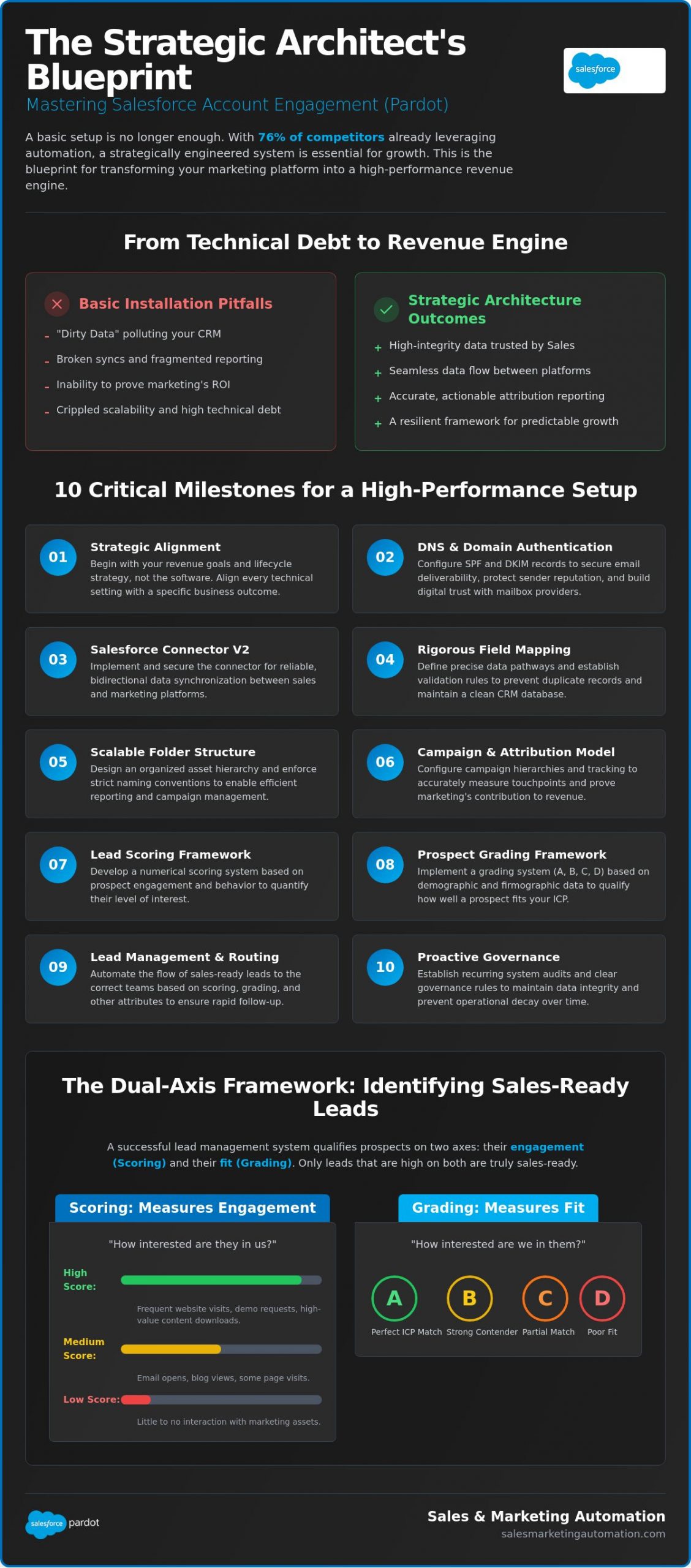
Execution is where strategy meets reality. A high-performance pardot setup and configuration requires a methodical sequence of actions to ensure no technical vulnerability is left unaddressed. By following these ten critical milestones, you build a system that is not only functional but resilient and ready for enterprise-level scale. This checklist serves as the architectural blueprint for your go-live phase, ensuring that every component is engineered for maximum operational health.
Milestone 1: Domain Authentication and Whitelisting. Secure your sender reputation immediately by finalizing SPF, DKIM, and CNAME records. This ensures your communications bypass spam filters and maintain high deliverability rates. Milestone 2: Salesforce Connector v2 Authorization. Establish the primary data pipeline between your marketing automation and CRM. Use the dedicated Integration User to maintain a secure, bi-directional flow of information. Milestone 3: User Sync and Profile Mapping. Automate user management by mapping Salesforce profiles to Pardot roles. This streamlines administrative overhead and ensures appropriate access levels across your team. Milestone 4: Tracking Code Implementation via GTM. Deploy the tracking code through Google Tag Manager to gain visibility into prospect behavior. This is the sensory layer of your revenue engine. Milestone 5: Prospect Field Mapping and Sync Logic. Define how data moves between systems. Align custom fields and set sync priorities to prevent data conflicts from overwriting your source of truth.
Once the technical foundation is secure, shift your focus to the operational environment. Milestone 6 involves establishing a folder hierarchy and naming convention setup. Without this order, your system will quickly become a graveyard of disorganized assets, making historical reporting nearly impossible. Milestone 7 requires the configuration of layout templates and standardized email headers and footers to ensure brand consistency across every touchpoint. Finally, Milestone 8 focuses on form and form handler architecture. This ensures every conversion point is engineered to capture the specific data points required for your lead management framework.
The final phase transitions your system from a technical tool into a strategic engine. Milestone 9 is the activation of your scoring and grading logic, which we architected in the previous section. This allows you to begin identifying sales-ready leads with automated precision. Milestone 10 involves the setup of Connected Campaigns and attribution. Connected Campaigns are the bridge between marketing spend and Salesforce opportunity data. This link is essential for proving the ROI of every dollar invested in your marketing efforts. If you need expert guidance to navigate these technical complexities, our Salesforce & Pardot consulting services provide the strategic oversight required for a flawless implementation. By completing these milestones, you move beyond a basic install and into a strategically engineered revenue architecture.
Finalizing your initial pardot setup and configuration represents a significant operational milestone, but it’s not a terminal event. Systems naturally tend toward entropy as lead volumes increase and organizational requirements evolve. Without a rigorous governance framework, the precision we engineered during the implementation phase will begin to erode. Maintaining a high-performance revenue engine requires a shift from construction to optimization, ensuring that your technical foundation remains resilient against data decay and process inefficiencies.
Recognizing the signs that your system needs a “Technical Reset” is vital for long-term health. If your sales team reports data discrepancies in Salesforce, or if you notice a sudden increase in sync errors within the connector logs, these are clear indicators of systemic friction. Ignoring these red flags leads to fractured reporting and a loss of trust between departments. Proactive maintenance isn’t just about fixing what’s broken; it’s about refining the architecture to support the next stage of your company’s growth.
A recurring Marketing Automation Audit is the only way to guarantee systemic integrity over time. This diagnostic process allows you to identify and resolve sync errors before they impact sales velocity or lead routing accuracy. We focus on identifying “Ghost Assets”—outdated automation rules, legacy landing pages, and abandoned completion actions—that clutter your database and slow down system processing. Cleaning these assets ensures that your automation remains lean and responsive. For organizations whose sales teams have begun to distrust lead scores or who are experiencing persistent Salesforce sync errors, professional pardot audit services provide the disciplined technical framework needed to restore database integrity and rebuild confidence in your automation platform.
During an audit, we also evaluate the alignment of your current setup with emerging industry standards and new Salesforce releases. For organizations evaluating their long-term technology investments, reviewing the HubSpot implementation pricing model provides a necessary benchmark for total cost of ownership. Whether you’re optimizing your current pardot setup and configuration or considering a platform migration, a data-driven audit provides the clarity needed for strategic decision-making.
Scaling a B2B organization requires technical mastery that often exceeds the capacity of internal marketing teams. Managed services offer a solution by providing fractional marketing operations expertise, giving you access to elite architects who understand the granular details of the Salesforce ecosystem. This model allows you to implement a true Revenue Operations (RevOps) framework, bridging the gaps between marketing, sales, and customer success to create a unified customer journey. Organizations that partner with the top pardot consulting firms in this capacity gain a measurable advantage by embedding specialized expertise directly into their revenue operations model.
Our team at Sales & Marketing Automation specializes in this level of ongoing optimization, ensuring your technical stack evolves alongside your business goals. We don’t just maintain the status quo; we proactively refine your scoring models, automation workflows, and attribution logic to maximize ROI. To protect your investment and ensure your revenue engine continues to perform at peak efficiency, Schedule a Pardot Strategic Audit with our team today. Establishing this level of governance is the final step in securing a scalable, future-proof marketing infrastructure.
Mastering your pardot setup and configuration is the first step toward high-performance automation. By prioritizing a strategic architecture over a basic install, you ensure that your technical foundations and lead management frameworks are built for longevity. This approach transforms a complex tool into a streamlined engine that identifies sales-ready opportunities with mathematical precision. We have demonstrated that consistent governance and a diagnostic mindset are the only ways to prevent system decay as your team scales into 2026 and beyond.
With over 100 successful CRM and automation implementations, our expert technical architects specialize in unearthing hidden revenue leaks through a methodical, diagnostic approach. We don’t just perform tasks; we build enduring frameworks that align your marketing spend with tangible business outcomes. To accelerate your journey toward operational excellence and systemic integrity, Download our Advanced Pardot Configuration Framework. You now possess the blueprint required to transform your marketing operations. It’s time to build a system that drives predictable growth and secures your competitive advantage.
The v2 connector is the modern standard, offering a more secure and stable integration through a dedicated Integration User. Unlike the legacy v1 version, which required a specific user license and was prone to sync interruptions, v2 operates as a background process. This architecture ensures that your data synchronization remains active and secure without consuming a paid Salesforce seat.
A comprehensive pardot setup and configuration usually spans four to eight weeks, depending on your data complexity and the number of Business Units involved. This timeline accounts for technical authentication, field mapping, and the non-negotiable 4-6 week IP warming period. Rushing this sequence often results in technical debt that compromises your long-term deliverability and system health.
No, Pardot is strictly engineered to function within the Salesforce ecosystem. The platform requires a Salesforce instance for user management, campaign synchronization, and lead routing. Because the two systems share a deeply integrated data architecture, it’s impossible to deploy Pardot as a standalone marketing automation tool without an active Salesforce environment.
The most frequent error is treating the project as a one-time technical task rather than a strategic alignment exercise. Many organizations fail to establish a folder hierarchy, ignore IP warming protocols, or neglect the scoring and grading frameworks. These oversights result in “dirty data” polluting the CRM and make it impossible to prove marketing attribution or ROI.
The investment for a professional implementation varies based on the scope of work and your organizational complexity. Factors such as data migration needs, custom integrations, and the requirement for advanced lifecycle automation will influence the total cost. We recommend a diagnostic audit to define a precise scope that aligns with your specific revenue goals and architectural requirements.
The Integration User is a dedicated, non-human Salesforce user that facilitates the bi-directional flow of data between the two platforms. By using this dedicated identity instead of a standard seat, you ensure the sync remains active even if individual team members leave the company. This is a critical component for maintaining a secure and uninterrupted pardot setup and configuration.
Multiple Business Units are managed through Marketing Setup in Salesforce, allowing you to partition data and assets by region or brand. You must implement Marketing Data Sharing rules to precisely control which records sync to each specific unit. This architecture is essential for global enterprises that require localized control while maintaining a single, unified Salesforce instance.
While engineered for complex, long-cycle B2B sales, Pardot can support B2C companies selling high-consideration products like financial services or real estate. However, for high-volume retail with rapid transaction cycles, Salesforce Marketing Cloud Engagement is often the superior choice. Its data processing capabilities are better suited for the massive scale and speed required in traditional B2C environments.