 Sales & Marketing Automation
The CRM and Marketing Automation Guru's You Can Trust.
Sales & Marketing Automation
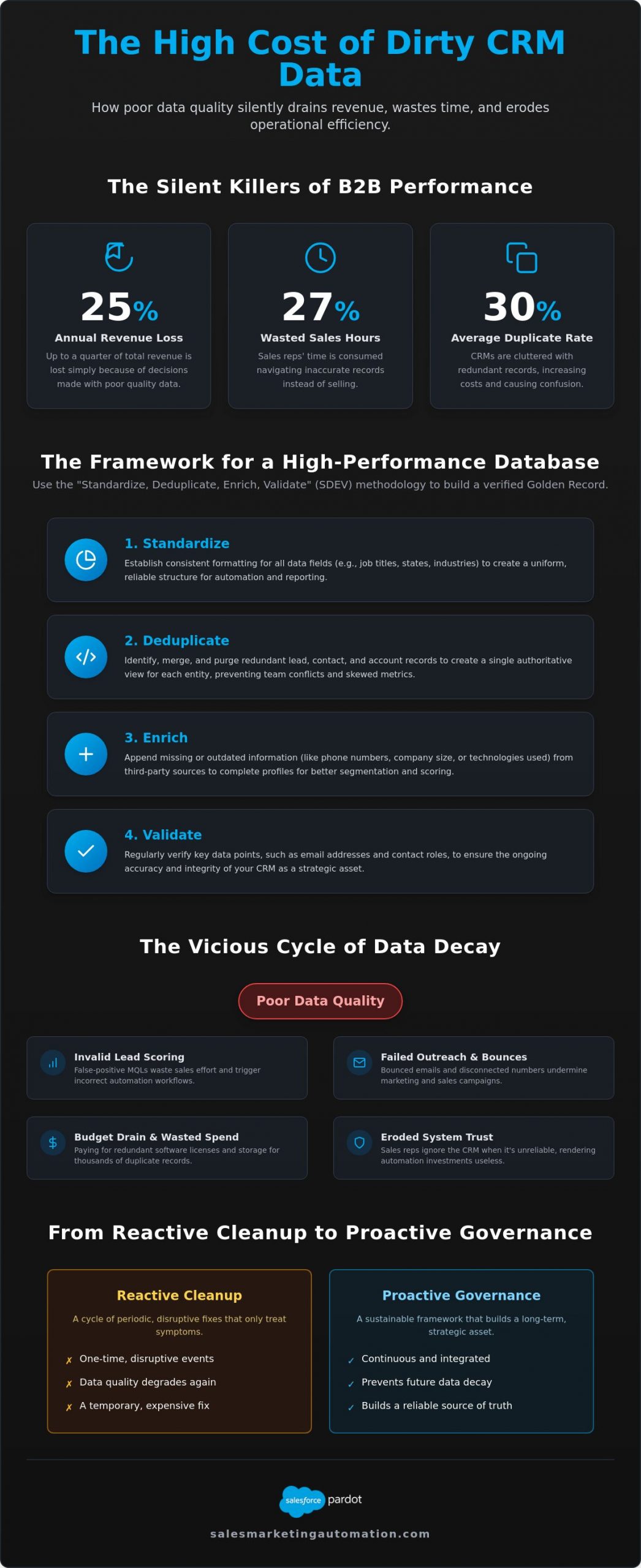
Did you know that the average B2B organization loses up to 25% of its total annual revenue simply because of poor data quality? When your sales reps waste 27% of their work hours navigating inaccurate records, your CRM stops being a growth tool and starts acting as a structural liability. Professional crm data cleanup services are no longer a luxury; they’re a foundational requirement for any firm looking to maintain operational integrity in a landscape of shifting state-level privacy laws and complex lead scoring models.
It’s a common frustration to watch marketing emails bounce or see territorial disputes erupt over duplicate accounts that should’ve been merged months ago. You’re likely aware that your data needs attention, but the fear of breaking existing workflows often leads to technical paralysis. This article outlines how to transform this fragmented system into a high-performance revenue engine through strategic cleansing and architectural governance. We’ll explore a professional framework to establish a single source of truth, ensuring your HubSpot or Salesforce instances sync flawlessly with Pardot while building a scalable system that prevents future decay.
Accumulating data debt is a silent killer of B2B operational efficiency. It functions much like compounding interest on a high-interest credit card; the longer you ignore it, the more expensive it becomes to rectify. In the modern revenue engine, dirty data acts as a pervasive friction point that grinds high-velocity workflows to a halt. When your database is cluttered with stale records and inconsistent formatting, every automated sequence and sales outreach carries an invisible tax. This decay directly undermines a sophisticated lifecycle automation strategy, turning what should be a seamless customer journey into a series of disjointed and embarrassing interactions.
Consider the mechanics of a high-performance tech stack. If the foundational layer is compromised, the entire architectural integrity fails. Organizations often view data cleansing or data cleaning as a minor janitorial task, but it’s actually a strategic necessity for maintaining sales and marketing alignment. When data integrity fails, the trust between these two departments evaporates. Marketing claims to deliver high-quality leads, while Sales sees only a sea of bounced emails and disconnected phone numbers. Research suggests that businesses can lose between 15% and 25% of their total annual revenue due to poor data quality, making professional crm data cleanup services a critical investment for protecting your bottom line.
Lead scoring models rely on the precision of your input data to function effectively. When job titles are stale or industry fields are missing, your CRM produces false-positive Marketing Qualified Leads (MQLs) that waste valuable sales resources. This creates a technical ripple effect in HubSpot or Salesforce, where inaccurate behavioral data triggers the wrong automation workflows. The most damaging consequence is the “vicious cycle” of distrust. Once sales reps encounter enough “bad” automated alerts, they begin to ignore the system entirely, rendering your expensive automation investments useless.
Duplicate records are more than just a nuisance; they’re a direct drain on your budget. With an average duplicate rate of 30% in many CRMs, companies frequently pay for redundant software licensing and storage fees for records that shouldn’t exist. Beyond the hard costs, duplicates create a significant risk of “Double-Touch” marketing. Sending the same promotional offer twice to the same prospect damages your brand reputation and suggests a lack of internal coordination. Furthermore, these duplicates fracture your attribution reporting. When deals are split across multiple account entries, it’s impossible to accurately calculate ROI or understand which marketing channels truly drive growth. Utilizing crm data cleanup services allows you to consolidate these fragments into a single, authoritative record.
Diagnosis must always precede prescription. Before engaging in professional crm data cleanup services, you must establish a baseline for what “Clean Data” looks like within your specific B2B business model. This isn’t a generic standard; it’s a functional requirement that ensures your data supports your specific sales cycles and compliance needs. Perform a comprehensive technical audit of your current CRM architecture to uncover where the system is failing to serve the revenue team. Evaluate the health of your primary objects, specifically Leads, Contacts, Accounts, and Deals, while scrutinizing custom objects that may have drifted from their original purpose over time.
Strategic crm data cleanup services begin with this diagnostic phase to identify “Ghost Fields” that occupy valuable architectural space without providing strategic value. These are often remnants of retired marketing campaigns or legacy integrations that no longer serve a purpose. A recent study by Drexel University highlights current Trends in Data Governance and Data Quality, noting that robust governance programs are essential for maintaining the trust required for confident, data-driven decision-making. Removing these inefficiencies isn’t just about tidiness; it’s about reclaiming system performance and clarity for your users.
Audit the logic used for lead creation across all integrated web forms to ensure consistency. When different forms use varying field naming conventions, it confuses automated workflows and results in massive field fragmentation. You must also document where “shadow data” is being kept outside the CRM in isolated spreadsheets. These silos are often created because users don’t trust the CRM’s integrity, but they ultimately prevent you from achieving a single source of truth. Performing a comprehensive marketing automation audit can reveal these architectural gaps before they lead to permanent data loss.
Analyze the Pardot-to-Salesforce or HubSpot-to-Salesforce sync queue to identify persistent errors that block data flow. These errors often hide “orphaned records” that exist in your marketing tool but fail to sync with your CRM, creating blind spots in your lead history. Sync Friction is the technical misalignment between marketing intent and sales execution. When these two systems aren’t in perfect harmony, your lead scoring and lifecycle transitions will inevitably fail, leading to missed opportunities and frustrated sales representatives.
Executing a successful cleanup requires a transition from reactive “fixing” to a methodical architectural refinement. Professional crm data cleanup services utilize a “Standardize, Deduplicate, Enrich, Validate” (SDEV) methodology to ensure every record serves a strategic purpose. This framework begins by establishing a unified data standard, followed by the removal of redundancies, the addition of missing context, and finally, a verification process to confirm accuracy. Before any technical execution begins, all stakeholders must reach a consensus on the “Golden Record” definition. Without a clear agreement between Sales, Marketing, and Operations on which data points constitute the absolute truth, you risk deleting critical lead history or overwriting valuable contact insights.
Prioritize your efforts by focusing on high-impact objects that directly influence your current sales pipeline. While cleaning your entire database is the eventual goal, securing the integrity of active Deals and target Accounts provides the fastest return on investment. Implement a rigorous backup and rollback strategy before initiating any mass updates. Even the most sophisticated crm data cleanup services carry inherent risks; having a restorable snapshot of your database ensures that an unforeseen logic error doesn’t result in catastrophic data loss. This disciplined approach transforms your CRM from a cluttered archive into a precise instrument for revenue growth.
Eliminate free-text errors by implementing strict picklists for industry, country, and job function fields. Free-text entry is the primary catalyst for data decay, as it allows for infinite variations that break automated routing and segmentation. Standardize phone numbers and physical addresses to improve geo-targeting and ensure your sales team can reach prospects without manual correction. This process includes normalizing company names to a single standard. For example, your system shouldn’t treat “IBM” and “International Business Machines” as separate entities; they must be consolidated to ensure account-based marketing (ABM) efforts remain cohesive and targeted.
Utilize advanced matching logic that looks beyond simple email addresses to identify duplicates. In complex B2B environments, matching by “Domain + Last Name” or “Company Name + Zip Code” often reveals redundant records that basic tools miss. You must also manage parent-child account hierarchies carefully to ensure accurate roll-up reporting across global enterprises. Establish clear “survivorship rules” to determine which record remains the master when a merge occurs. Typically, the record with the most recent activity or the deepest integration history should “survive,” ensuring that your sales reps don’t lose the context of their most recent conversations during the cleanup process.
Select your execution path with caution. While automated “one-click” cleanup tools offer an attractive entry point, they frequently fall short in complex B2B environments where data relationships are nuanced and deeply integrated. Junior internal staff, though well-intentioned, often lack the architectural oversight to manage these projects without creating new technical debt. Entrusting a junior administrator with a mass-deduplication task often results in the loss of critical lead history or the accidental deletion of active opportunity data. Managed crm data cleanup services provide the strategic layer that software lacks, ensuring that technical actions align with your broader business objectives.
Before committing to a specific solution, conducting a marketing automation audit serves as an essential diagnostic step. This audit reveals the underlying causes of data decay, allowing you to address systemic issues rather than just treating the symptoms. A strategic consulting partner doesn’t just perform a task; they build a framework that protects your tech stack’s health over the long term. This professional intervention ensures that your database remains a high-performance asset rather than a fragmented liability.
Software tools cannot fix underlying architectural flaws or broken business processes. If your lead routing logic is flawed, an automated tool will simply accelerate the creation of bad data. This is the “Garbage In, Garbage Out” reality of automated enrichment; if the source data is mismatched, the tool will confidently populate your CRM with incorrect information. Tools are tactical accelerators, but managed services are strategic executions. A professional team evaluates the “why” behind the data errors, adjusting your system’s configuration to prevent the same mistakes from recurring. This distinction is what separates a temporary fix from a permanent operational improvement.
Hiring a consultant provides immense value in navigating internal “data ownership” politics. Different departments often have conflicting views on which data points are essential, and an external expert can facilitate the consensus needed to establish a “Golden Record.” Professional crm data cleanup services build permanent governance frameworks that standardize how data enters and moves through your system. By establishing these guardrails, you directly reduce the Total Cost of Ownership for platforms like HubSpot or Salesforce. Clean data reduces wasted seat costs, improves campaign accuracy, and ensures your sales team spends their time closing deals instead of fixing records. If you’re ready to stabilize your database architecture, consider a professional Salesforce and Pardot consultation to secure your revenue engine.
Transition from a reactive cleanup event to a permanent governance mindset to secure the longevity of your database. While initial crm data cleanup services stabilize your system, only a rigorous governance framework prevents the inevitable return of data decay. Establish clear data ownership roles across sales, marketing, and customer success to ensure accountability at every stage of the lead lifecycle. Integrate comprehensive data quality checks directly into your HubSpot implementation process to catch errors at the point of entry. By positioning Sales & Marketing Automation as the Strategic Architect of your revenue data, you build a foundation that supports complex automation and precise forecasting.
Operational excellence depends on the consistency of your data inputs. When every department follows a unified set of rules for data entry and maintenance, the entire revenue engine runs with greater precision. This systematic approach eliminates the “territorial disputes” often caused by duplicate accounts and ensures that your lead scoring models remain accurate. Professional crm data cleanup services provide the baseline, but your internal governance policy provides the endurance needed to scale without compromise.
Managed data integrity requires shifting away from one-time fixes toward continuous refinement. Monthly retainer-based managed services provide the consistent oversight necessary to maintain technical health as your database grows. Utilize a Data Health Dashboard to monitor decay rates and sync errors in real-time, allowing for immediate intervention before issues compound. This proactive approach includes continuous enrichment, ensuring your contact records remain accurate even as your target market undergoes personnel shifts and corporate restructuring. Regular audits ensure that your custom objects and workflows continue to align with your evolving business goals.
Align your data governance with a comprehensive revenue operations roadmap to ensure long-term scalability. Maintaining a clean database ensures your tech stack remains Migration-Ready, significantly reducing the friction of future platform transitions or mergers. A well-governed CRM is a competitive advantage that empowers your team to make decisions based on facts rather than assumptions. By treating data hygiene as a foundational business process, you protect your technological investments and maximize your team’s productivity. Schedule a Strategic Audit with Sales & Marketing Automation to diagnose your CRM health and begin the transition toward a high-performance revenue engine.
Transforming your database from a fragmented liability into a high-performance revenue engine requires moving beyond tactical fixes. Successful organizations recognize that data integrity is a continuous architectural commitment rather than a one-time project. By adopting the SDEV methodology and establishing clear ownership across departments, you ensure your CRM supports complex automation and provides the single source of truth necessary for precise forecasting. This transition protects your technology investment and empowers your sales team to focus on high-value interactions rather than record corrections.
At Sales & Marketing Automation, we function as the Strategic Architect of your revenue operations. With over 100 successful CRM implementations and deep expertise in HubSpot, Salesforce, Pardot, and Marketo, we provide the technical mastery needed to stabilize your system. Professional crm data cleanup services are the first step toward a resilient, migration-ready tech stack that evolves with your business.
Request a Strategic CRM Audit from Sales & Marketing Automation to diagnose your system’s health and establish an enduring framework for growth. Your data is the foundation of your success; it’s time to treat it with the precision it deserves.
B2B organizations should ideally conduct a comprehensive database audit once per quarter, supplemented by automated monthly maintenance routines. This cadence accounts for the natural decay of professional contact data as prospects change roles or companies undergo restructuring. Regular oversight ensures that minor formatting errors don’t evolve into systemic architectural failures that compromise your lead scoring.
A professionally managed cleanup won’t disrupt active workflows if it’s executed with a rigorous backup and rollback strategy. By performing heavy deduplication and standardization during off-peak hours, you protect the daily operations of your sales team. Strategic architects always test matching logic on a subset of data before applying changes to the entire production environment.
Data cleansing focuses on the removal of inaccuracies, duplicates, and stale records to restore system integrity and performance. In contrast, data enrichment adds missing context, such as current job titles, company size, or technographic data, to existing records. While cleansing improves the health of your database, enrichment enhances your ability to perform advanced segmentation and account-based marketing.
AI functions as a powerful tactical accelerator for identifying patterns and verifying email formats, but it shouldn’t be used without professional oversight. In 2026, complex regulatory environments like the CCPA and GDPR require precise data handling that automated tools might misinterpret. Human expertise remains essential for establishing the “Golden Record” and ensuring compliance with evolving state-level privacy laws.
The investment for crm data cleanup services varies based on the volume of records and the complexity of your custom objects. Factors such as the depth of your account hierarchies and the number of active integrations, like HubSpot or Salesforce syncs, influence the total project scope. Most organizations find that the cost of professional remediation is significantly lower than the revenue loss associated with poor data quality.
Common indicators include high email bounce rates, sales representatives maintaining private spreadsheets, and territorial disputes caused by duplicate accounts. If your lead scoring models produce frequent false positives or your attribution reports don’t align with actual deal history, your data architecture is likely compromised. These symptoms signal an immediate need for professional crm data cleanup services to restore operational trust.
Preventing duplicates requires implementing strict validation rules and mandatory picklists at every point of entry. Standardize your integrated web forms to ensure consistent data capture and utilize domain-based matching logic to block redundant lead creation. Establishing a governance mindset ensures that all departments follow the same architectural standards, maintaining database health over the long term.
You should always clean your data before initiating a CRM migration to avoid importing legacy technical debt into a new system. Migrating “dirty” data increases the complexity of the mapping process and unnecessarily inflates your storage costs in the target CRM. Starting with a sanitized dataset ensures that your new Salesforce or HubSpot instance functions as a high-performance revenue engine from day one.