 Sales & Marketing Automation
The CRM and Marketing Automation Guru's You Can Trust.
Sales & Marketing Automation
A fragmented tech stack isn’t just an operational nuisance; it’s a structural failure that quietly erodes your revenue potential every single day. You’ve likely felt the friction of data silos where marketing leads vanish before reaching sales or finance tools fail to reflect closed deals. Relying on manual entry or brittle, surface-level connections creates a fragile environment prone to errors. To build a scalable business, you need professional hubspot integration services that do more than just link apps. You need a bi-directional data bridge designed for systemic integrity and long-term growth.
It’s frustrating to watch your team waste hours reconciling mismatched reports across different platforms. We’ll show you how to execute a high-performance integration strategy that eliminates these silos and synchronizes your entire tech stack with HubSpot. This guide explores how to leverage the 1,500 plus integrations in the marketplace while navigating the latest 2026 date-based API standards. You’ll learn the methodology for automating lead-to-cash workflows and maintaining the technical frameworks required for a single source of truth.
Revenue operations (RevOps) relies on the seamless flow of data across every department, yet many organizations operate with a disjointed collection of tools that fail to communicate. Professional hubspot integration services represent the strategic alignment of these disparate data sources into a unified revenue engine. It’s not just about making two platforms talk; it’s about building a framework where data informs every tactical decision. By connecting your CRM with external platforms, you transform HubSpot from a simple database into a centralized command center for your entire business.
This lack of cohesion imposes a “fragmentation tax” on the business. It manifests as lost productivity, missed opportunities, and a clouded view of the customer journey. When sales and marketing tools are disconnected, teams spend more time reconciling spreadsheets than engaging with prospects. Modern Marketing automation bridges this gap by ensuring that lead intelligence flows directly into the hands of your sales representatives. A seamless integration facilitates a 360-degree customer view, which is essential for accurate attribution. You gain the ability to trace a closed-won deal back to the specific marketing touchpoint that initiated the relationship, providing clarity on which channels actually drive growth.
It’s vital to distinguish between simple data syncing and true process automation. Basic syncing merely moves information from point A to point B, often without context. Strategic hubspot integration services focus on automation that creates intelligent, bi-directional workflows. For example, instead of just copying a contact record, an automated integration can trigger a finance ledger update the moment a contract is signed, or alert a customer success manager when a specific product usage threshold is reached. Organizations that struggle with fragmented data schemas and underutilized platform features often benefit from specialized hubspot technical consulting to align their portal architecture with these advanced automation requirements.
Integrated systems provide the single source of truth required for high-level C-suite reporting. Common silos often exist between Marketing Hub, Sales Hub, and external finance tools like NetSuite or Sage. Without a persistent bridge between these systems, executive teams are forced to make decisions based on lagging or conflicting indicators. Real-time data synchronization directly improves forecasting accuracy. It transforms guesswork into a precise science by ensuring that every pipeline update is reflected across the entire organization instantly, allowing leaders to pivot strategies based on current market realities rather than month-old reports.
Poorly architected connections often result in “dirty data” and a surge in duplicate records that compromise the integrity of your CRM. These errors create friction for sales teams and erode trust in the system’s reliability. Manual data reconciliation is a significant operational drain that diverts valuable resources away from revenue-generating activities. Understanding these technical risks is a critical component when evaluating HubSpot implementation pricing and the long-term ROI of your tech stack. A cheap, poorly managed integration often costs more in remediation and lost data integrity than a professionally architected solution costs to build correctly from the start. Working with the best HubSpot implementation agency for your specific requirements ensures that your integration is built on a foundation of technical rigor, protecting your data integrity from day one.
Choosing the right technical path for hubspot integration services determines the long-term viability of your revenue stack. A high-performance architecture requires a decision matrix based on three primary factors: data volume, update frequency, and the complexity of your business logic. While a one-way push is often sufficient for simple notification triggers, bi-directional synchronization is essential for maintaining parity between sales and finance tools. Bi-directional sync ensures that an update in your ERP immediately reflects in your CRM, preventing the departmental friction caused by outdated information. Enterprise-scale integrations must also prioritize API limit management. HubSpot’s 2026 date-based API versioning requires a disciplined approach to call frequency to prevent system lockouts during peak synchronization periods.
Data mapping logic is the invisible backbone of any successful integration. It involves more than just matching field names; it requires a deep understanding of data types, validation rules, and transformation logic. For instance, a “Date” field in your ERP might need to be converted into a specific Unix timestamp before HubSpot can ingest it correctly. Ignoring these nuances leads to the data integrity issues that plague non-architected systems. If you’re unsure which path fits your current scale, a technical Marketing Automation Audit can clarify your requirements and identify potential bottlenecks before they impact your operations.
A Native Integration is a standardized, vendor-maintained connection designed for rapid deployment. These tools are ideal for high-utility platforms like Slack, Zoom, or LinkedIn where the data requirements are relatively static and follow industry norms. However, these “plug-and-play” solutions often struggle with custom property mapping or complex conditional logic. If your business relies on unique data fields that fall outside standard object schemas, native apps may create data gaps. They’re excellent for speed, but they rarely offer the granular control needed for a truly bespoke revenue engine.
Custom builds become mandatory when proprietary software or legacy ERPs lack off-the-shelf connectors. Establishing a coherent data strategy is the prerequisite for any custom build, ensuring that every data point has a clear purpose and destination. Organizations often choose between hard-coded API scripts and middleware platforms like Workato or Zapier. Middleware acts as an abstraction layer, allowing your team to update workflows without touching the core codebase. This is particularly valuable for businesses experiencing rapid growth, as it allows for the agile addition of new tools into the ecosystem without disrupting existing bi-directional syncs. Expert strategic HubSpot implementation services specialize in managing these custom schema designs, ensuring that your hubspot integration services remain resilient even as your underlying tech stack evolves.
Constructing a resilient B2B revenue stack requires more than just connecting disparate apps; it demands a logical mapping of the entire customer lifecycle. High-performance hubspot integration services focus on the critical flow of data from the initial lead capture through to final revenue recognition. This process ensures that every department operates from the same dataset, reducing the friction that typically occurs when marketing, sales, and finance use isolated systems. Maintaining data integrity across these platforms involves implementing strict validation rules and transformation logic to prevent corrupt data from propagating through the stack. Security remains a non-negotiable component of this architecture. Every data transfer must adhere to global compliance standards, including GDPR and SOC2, to protect sensitive customer information and mitigate corporate risk.
Establishing these connections creates a persistent data bridge that supports every stage of the funnel. It’s not enough to simply move contact information. You must ensure that the context of every interaction is preserved as a prospect moves from an anonymous visitor to a loyal client. This level of technical precision prevents the data decay that often happens in non-architected systems, where valuable insights are lost during platform handoffs. By prioritizing a unified data structure, you enable your teams to act on real-time intelligence rather than historical guesses.
Architecting the synchronization between your front-office CRM and back-office ERP systems is essential for managing complex “Lead to Cash” workflows. When you integrate HubSpot with platforms like SAP or NetSuite, you enable real-time visibility into contract status and financial reconciliation. This connection allows sales teams to see payment histories while finance teams receive automated updates on newly closed deals. While the HubSpot-Salesforce native integration is a popular choice, it contains common pitfalls that require careful management. These include sync errors caused by mismatched picklist values or the accidental creation of duplicate records during high-volume transfers. A strategic approach involves audit-logging every transaction to ensure that contract synchronization remains flawless.
Synchronizing Shopify or Magento data with HubSpot allows for advanced e-commerce lifecycle marketing that goes beyond simple purchase receipts. By pulling granular transaction data into your CRM, you can segment audiences based on lifetime value, purchase frequency, and specific product interests. Integrating external ad platforms like Google and Meta further refines this ecosystem by enabling precise ROI tracking. You can see exactly which campaigns generated the highest quality leads by linking ad spend directly to CRM deal data. To maximize these connections, leverage lifecycle automation strategies to trigger cross-platform workflows. For instance, an abandoned cart in Magento can trigger a personalized re-engagement sequence in HubSpot, while a high-value lead from a LinkedIn ad can be fast-tracked to a senior sales representative. This level of connectivity ensures that your hubspot integration services drive tangible business outcomes rather than just moving data.
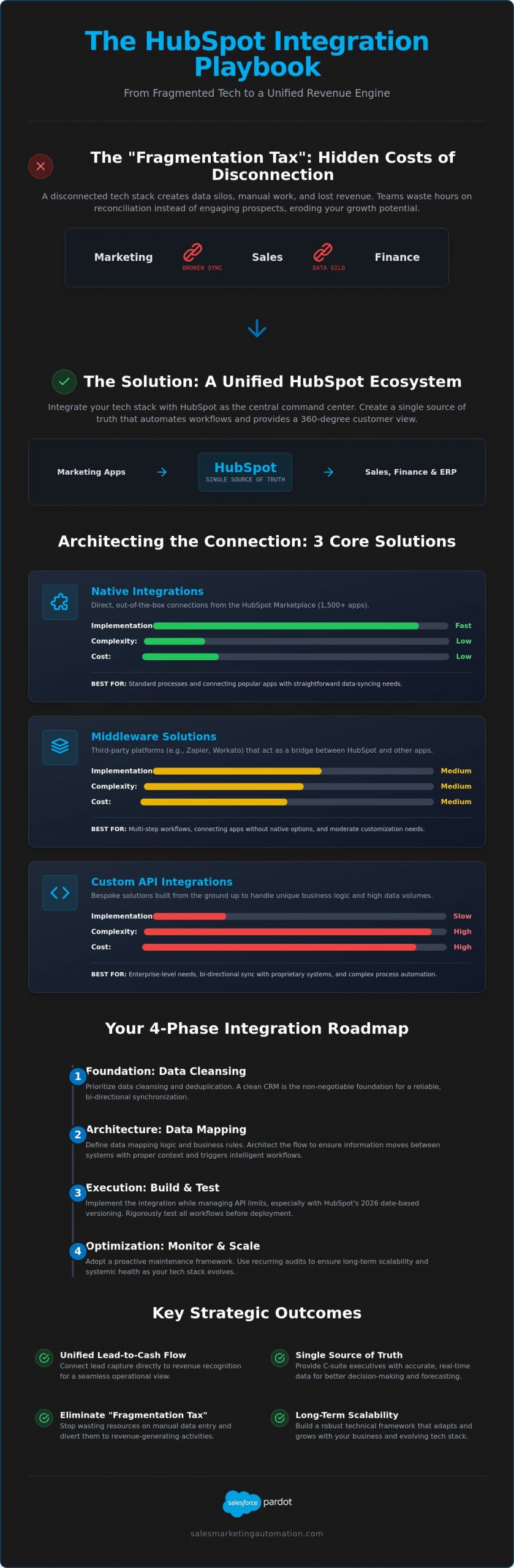
Executing a seamless integration requires a methodical departure from trial and error approaches. Professional hubspot integration services follow a rigorous technical framework that treats the connection as a piece of infrastructure rather than a simple software toggle. You must prioritize data cleansing and deduplication before establishing the bridge. Migrating legacy errors or duplicate records into a new bi-directional sync only scales your existing operational problems. Once the connection is live, establishing error-handling protocols is essential. These systems should automatically notify administrators of sync failures or API timeouts, ensuring that data gaps are addressed before they impact customer-facing teams. You should document the entire data flow to prevent the creation of black box technical debt, where the logic of the system remains hidden from those who maintain it.
This disciplined roadmap ensures that your revenue stack remains stable as you scale. Without a documented plan, integrations often become brittle and fail during high-volume periods or after API updates. By building a persistent, documented framework, you protect the business from the risks associated with personnel turnover and system upgrades. If your team is ready to move from planning to execution, a professional CRM Data Migration can ensure your records are pristine before the first sync occurs.
Successful architecture begins with meticulous field-level mapping. You need to document exactly which HubSpot property corresponds to which external field in your ERP or secondary CRM. This phase is also where you define the Master System for every specific data point. If a conflict occurs between two platforms, the system must know which record takes precedence to resolve the discrepancy. Identifying the precise triggers and actions that define your automation logic ensures that data moves only when necessary, which helps manage API limits and maintains system performance.
Development should never occur in your production environment. Run all integration tests in a HubSpot Sandbox to protect your live customer data from accidental corruption during the build phase. This isolated environment allows you to stress-test the logic and verify that bi-directional syncs behave as expected under various scenarios. Once the technical build is complete, conduct User Acceptance Testing (UAT) with your sales and marketing stakeholders to ensure the data flow meets their daily operational needs. UAT is the final validation step before production deployment. This phase confirms that the technical solution actually solves the business problems identified during the discovery stage.
Achieving a seamless integration is a significant milestone, but maintaining systemic health requires a transition from a “set and forget” mindset to a model of continuous optimization. A static connection eventually becomes a liability as your business processes evolve and your data volume grows. High-performance hubspot integration services focus on the longevity of the revenue stack, ensuring that the bi-directional bridge built today can support the complex requirements of tomorrow. You should implement recurring audits to verify integration health and data accuracy, identifying any drift in field mapping or synchronization logic before it impacts your reporting. As your organization adds new tools or introduces sophisticated custom objects, the architecture must scale without compromising the integrity of your primary data sets.
Success in the modern B2B environment depends on the ability to adapt to technical shifts with minimal disruption. Relying on a HubSpot implementation partner as a long-term architectural guide provides the strategic continuity needed to navigate these changes. This partnership ensures that your technical framework remains aligned with your broader business objectives, transforming your tech stack from a collection of tools into a resilient, unified revenue engine. By treating your integration as a living ecosystem, you protect your investment and maintain a persistent competitive advantage.
Retainer-based managed services provide the technical oversight necessary to handle the frequent API updates and platform changes inherent in the HubSpot ecosystem. With the transition to date-based API versioning in 2026, including the scheduled releases every March and September, proactive monitoring is no longer optional. A managed approach provides early warnings for sync errors and API threshold limits, allowing for remediation before data flow is interrupted. This service model ensures that technical updates are always synchronized with your evolving business strategy, preventing the technical debt that occurs when systems are left to age without professional supervision.
A fully optimized integration unlocks the ability to build sophisticated multi-touch attribution models based on clean, integrated data sets. You can finally move beyond surface-level metrics to understand the specific touchpoints that drive revenue across the entire lifecycle. Leverage your hubspot integration services to automate internal notifications based on cross-platform behavioral signals, such as alerting a sales rep when a high-value lead interacts with a specific product page in your e-commerce store. This integrated data also serves as the foundation for predictive lead scoring and churn analysis, allowing your team to intervene proactively based on real-time data rather than reacting to historical losses. By centralizing these insights, you empower your leadership to make high-stakes decisions with absolute confidence in the underlying data. Pairing these capabilities with dedicated hubspot technical consulting ensures your portal architecture is optimized to support these advanced reporting and automation frameworks at enterprise scale.
Building a high-performance tech stack requires a transition from fragmented tools to a unified, bi-directional ecosystem. You’ve seen how professional hubspot integration services move beyond basic syncing to create resilient automated workflows that connect lead capture to final revenue recognition. By prioritizing rigorous data mapping and a sandbox-first development approach, you eliminate the technical debt that often cripples scaling B2B organizations. Success isn’t found in a one-time connection; it’s the result of the ongoing refinement of these systemic frameworks.
As you refine your operational health, partner with an expert who understands the nuances of enterprise-scale architecture. With over 100 successful integrations and a team of Certified HubSpot Architects, we specialize in high-complexity B2B tech stacks. We ensure your data remains pristine and your systems remain synchronized as you scale. Ready to eliminate your data silos and secure your revenue engine? Schedule a Technical Integration Audit today to begin constructing your seamless revenue stack. You have the vision for your business; we provide the architectural precision to make it a reality.
HubSpot integration services involve the strategic alignment and technical synchronization of your CRM with external software to create a unified revenue engine. These services ensure that data flows seamlessly between HubSpot and other platforms, such as ERPs or finance tools, to eliminate manual entry. Professionals architect these connections to support bi-directional data parity and automated business processes across the organization.
A custom integration typically requires four to twelve weeks to build, depending on the complexity of the data mapping and the number of objects involved. Simple one-way pushes can be deployed faster, while complex bi-directional syncs with legacy systems require extensive discovery and Sandbox testing. Following a rigorous technical roadmap ensures that the final connection is resilient and meets all security requirements.
The choice depends on your specific data requirements and the need for custom property mapping. Native marketplace apps are ideal for standard connections like Slack or Zoom where rapid deployment is the priority. However, a custom API is superior for proprietary software or complex B2B schemas that require granular control over transformation logic and data validation rules.
HubSpot can integrate with legacy ERP systems like SAP or Oracle through custom API development or specialized middleware platforms. These integrations facilitate “Lead to Cash” workflows by synchronizing front-office sales data with back-office financial records. Technical architects use these connections to provide real-time visibility into contract status and payment histories, ensuring that executive teams have a single source of truth.
Integration project costs vary based on the scope of the data migration and the number of Hubs involved. Basic onboarding for one or two Hubs generally ranges from $3,000 to $6,000; however, complex implementations involving multiple systems and custom development can exceed $50,000. Ongoing management through monthly retainers typically falls between $4,000 and $15,000 to ensure the long-term health of the integrated ecosystem.
Zapier poses risks for enterprise environments due to its lack of robust error logging and limited support for complex bi-directional logic. While it’s effective for simple triggers, it often fails to handle high data volumes or sophisticated transformation requirements. Enterprise-scale hubspot integration services prioritize middleware like Workato or custom scripts that provide superior API limit management and comprehensive audit trails.
Data deduplication must occur before you establish the integration bridge to prevent legacy errors from corrupting the new system. You should identify a “Master System” for every object and use unique identifiers, such as email addresses or internal IDs, to merge records during the migration phase. Implementing strict validation rules at the point of entry further ensures that your CRM remains pristine as data flows between platforms.
Native marketplace integrations don’t require a developer, but complex custom builds and middleware configurations certainly do. Professional hubspot integration services utilize architects who understand API versioning and schema design to ensure the connection is secure and scalable. While non-technical users can toggle simple apps, a developer is essential for architecting bi-directional syncs that involve proprietary software or legacy databases. When evaluating your options, reviewing a strategic selection guide for the best HubSpot implementation agency can help you identify a partner with the certified architectural expertise your integration demands.