 Sales & Marketing Automation
The CRM and Marketing Automation Guru's You Can Trust.
Sales & Marketing Automation
While 90% of organizations have adopted automated workflows by 2026, a significant portion of these systems operate as expensive cost centers rather than high-performance revenue engines. You’ve likely felt the friction of inaccurate lead scoring or the drain of software licensing fees that don’t translate into measurable growth. It’s a common challenge to manage a tech stack where the data sync between your CRM and marketing automation platform remains fundamentally broken, stalling your momentum.
A comprehensive marketing automation audit serves as the diagnostic foundation required to resolve these systemic inefficiencies. This strategic process identifies hidden revenue leaks and ensures your technical architecture supports scalable, long-term expansion. By following this guide, you’ll gain a clear roadmap for technical optimization that leads to improved lead-to-revenue conversion and clean, actionable CRM data. We’ll examine how to refine your internal logic and build a framework that prioritizes precision over simple execution, ensuring your technology finally aligns with your strategic vision.
A marketing automation audit is a rigorous diagnostic evaluation of your entire Marketing Automation Platform (MAP) and CRM ecosystem. Historically, many businesses viewed these tools as simple mechanisms for batch-and-blast emails. However, as the industry has matured, understanding what is marketing automation requires looking at it as a complex revenue engine that demands precise calibration. You can’t treat your automation stack as a “set and forget” utility; instead, you must manage it as foundational business architecture that directly influences your bottom line.
Adopting the perspective of a Strategic Architect means moving beyond surface-level fixes like changing email templates or adjusting a single landing page. You focus on the core infrastructure. This involves examining the logic of your lead routing, the integrity of your data flows, and the scalability of your workflows. A marketing automation audit is the primary mechanism for ensuring your martech investments deliver a measurable return on investment (ROI) by aligning technical execution with strategic business objectives.
Systems don’t fail overnight; they decay through incremental technical debt and misaligned updates. Recognizing these early indicators allows you to intervene before the damage reaches your revenue reports. Look for these specific friction points:
Neglecting your automation health creates a silent drain on your capital. Dirty data forces your sales and marketing teams to waste time on invalid records, which significantly inflates your customer acquisition costs (CAC). Many organizations also suffer from the hidden expense of paying for unused or under-configured software seats, essentially subsidizing features that provide zero value. When workflows are broken or misconfigured, you lose revenue opportunities in the mid-funnel because prospects aren’t nurtured effectively through the buyer’s journey. Precision in your tech stack isn’t just a technical preference; it’s a financial necessity for scalable growth. A rigorous marketing tech stack audit is the essential first step toward identifying these hidden costs and reclaiming operational health.
Construct a robust framework for your marketing automation audit by focusing on four foundational pillars: Technical Health, Data Integrity, Strategy Alignment, and Performance Analytics. This systematic approach ensures that no technical debt or operational friction remains unexamined within your ecosystem. By treating these areas as interconnected components of a single revenue engine, you move beyond isolated fixes toward a scalable architecture that supports long-term growth.
Investigate the structural integrity of your technology stack. Begin with a rigorous review of API connections and native integrations between Salesforce and your selected Marketing Automation Platforms (MAPs). Silent failures in these connections often result in lead leakage or delayed follow-ups. You must also verify tracking scripts, DNS settings, and deliverability protocols to ensure your communications actually reach the inbox. Identify and decommission “zombie” workflows; these are legacy automations that continue to consume system resources and API calls without contributing to current business outcomes.
Perform a comprehensive marketing automation risk assessment to identify vulnerabilities in your database hygiene. Focus on duplicate management and field normalization to ensure your CRM remains a single source of truth for the entire organization. You should map the data flow across every lifecycle stage, from initial prospect acquisition to post-sale customer success. This pillar is critical for maintaining compliance with evolving global data privacy standards, such as GDPR and CCPA, which require precise control over how customer information is processed and stored.
Validate that your automated nurture tracks actually reflect the current needs and behaviors of your buyer personas. Many organizations fall into the trap of running campaigns that no longer align with their market position or sales cycle. Assess the accuracy of your lead scoring models by comparing them against historical sales data to ensure they correctly identify high-intent prospects. It’s a fundamental truth of revenue operations that your overarching business strategy must dictate your technical setup, not the other way around. Aligning these elements ensures that every automated action serves a specific commercial purpose. For Salesforce-native environments specifically, engaging pardot audit services can surface misaligned scoring models and persistent sync errors that undermine your lead quality.
These pillars serve as the technical engine for a comprehensive lifecycle automation strategy. By stabilizing these four areas, you create the predictable environment required for scalable revenue operations. If your current systems feel disjointed or inefficient, a professional evaluation of your automation architecture can provide the clarity needed to refine your processes and reclaim lost revenue. Engaging a dedicated marketing automation strategy consultant ensures these four pillars are not only assessed but rebuilt into a cohesive revenue architecture designed for long-term scalability.
Not every marketing automation audit requires a total teardown of your existing infrastructure. Determining the appropriate depth of your investigation depends on your current operational stability and your long-term commercial objectives. You must distinguish between a rapid diagnostic health check and a comprehensive strategic assessment to ensure you are allocating resources effectively. While a quick check might solve a temporary sync error, only a deep-dive audit can realign a mismanaged tech stack with your revenue goals.
Diagnostic health checks serve as essential quarterly maintenance. They are designed to ensure your system’s basic technical integrity remains intact without requiring a fundamental strategy shift. These assessments focus on immediate red flags, such as sudden spikes in bounce rates or broken links within high-volume nurture tracks. If your team is stable and your processes are already high-performing, these regular tune-ups prevent the accumulation of technical debt. This level of oversight provides a practical baseline for how to conduct a marketing automation audit on a recurring basis without disrupting daily campaign execution. It ensures that your deliverability remains high and your basic CRM sync remains healthy, protecting your current revenue streams from avoidable technical friction.
In contrast, a full strategic audit is an architectural necessity rather than a maintenance task. This deep-dive assessment is required after major organizational shifts, such as platform acquisitions, mergers, or significant changes in your go-to-market strategy. High-growth companies often reach a tipping point where legacy workflows can no longer support increased lead volumes or more complex sales cycles. When fixing broken CRM workflows requires more than a simple patch, a ground-up redesign becomes the only viable path to scalability. A comprehensive marketing automation audit of this magnitude acts as a critical prerequisite for any major platform migration. It prevents you from migrating “dirty” data or inefficient logic into a new system, which would otherwise sabotage your implementation from day one.
Internal teams often develop blind spots due to familiarity with their own workarounds and legacy “hacks.” An objective third-party perspective identifies these hidden friction points that internal stakeholders might overlook or accept as standard operational hurdles. Professional auditors bring a cross-industry viewpoint that recognizes patterns of failure before they impact your revenue. This external scrutiny ensures that your technical architecture doesn’t just function; it actively propels your growth strategy forward by aligning every tool with your commercial goals. By choosing the right depth for your audit, you ensure that your technology remains an asset rather than a bottleneck.
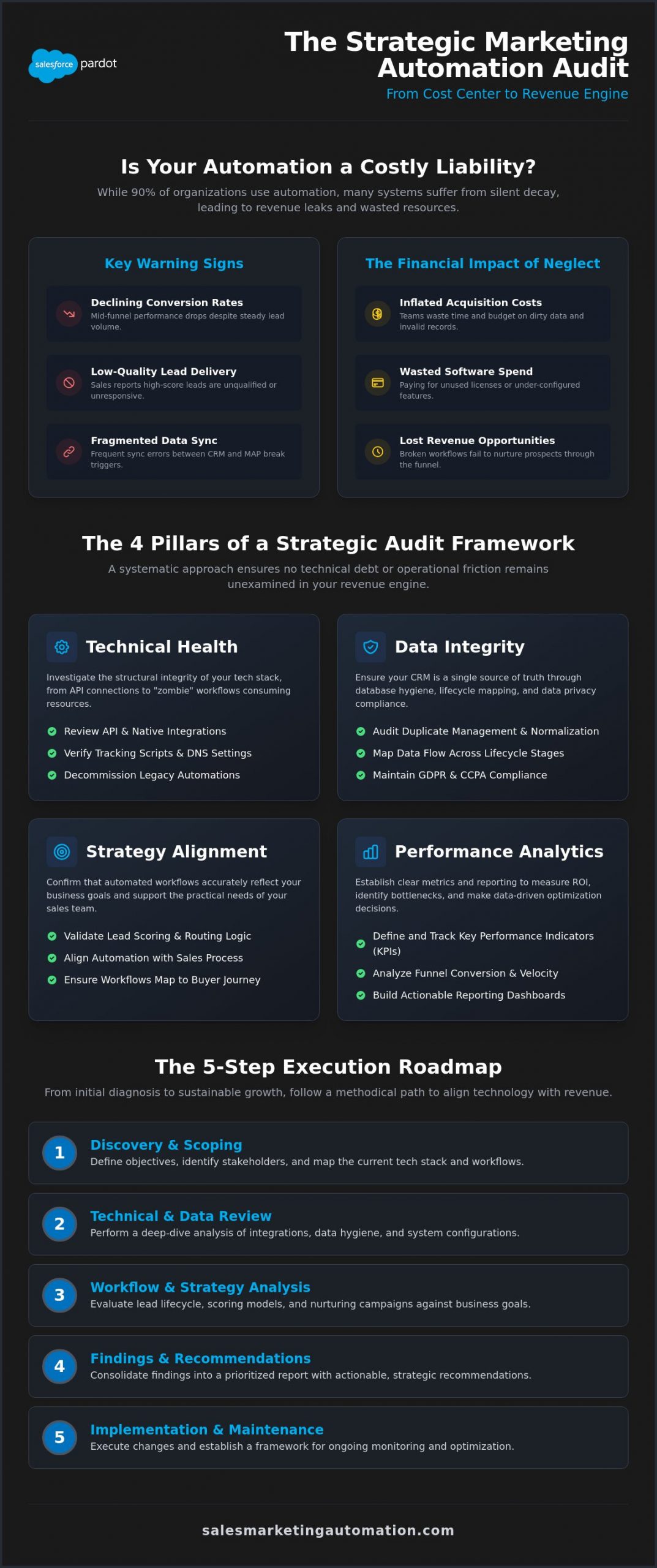
Executing a marketing automation audit requires a methodical approach that minimizes operational disruption while maximizing strategic insight. By adopting Revenue Operations (RevOps) as your guiding principle, you ensure that every technical adjustment serves the ultimate goal of frictionless growth. This process is not merely a technical checklist; it is a strategic realignment of your technology with your commercial reality. Following a structured roadmap allows you to identify systemic weaknesses without pausing your active lead generation efforts.
Begin by cataloging every asset within your ecosystem. This inventory must include active email sequences, lead capture forms, and complex automation rules currently running in the background. Simultaneously, conduct stakeholder interviews with sales and marketing leadership to identify perceived friction points that data alone might hide. These conversations are vital for understanding where the technology fails to support the human elements of the sales process. You must set clear KPIs for the audit, such as reducing lead routing latency or improving data accuracy across integrated platforms, to ensure the project remains focused on high-value outcomes.
Move into the technical deep-dive by running comprehensive diagnostic reports to uncover database health issues and integration error logs. Scrutinize the logic behind your active lead scoring and routing rules to ensure they still reflect your ideal customer profile and current market conditions. It’s common to find significant discrepancies between your MAP data and your CRM truth. Reconciling these differences is essential for maintaining a reliable revenue engine. This phase requires a diagnostic mindset, looking for the “how” and “why” behind data sync failures or misattributed lead sources. Organizations running Pardot as their MAP will find that dedicated pardot audit services provide the specialized diagnostic depth needed to resolve persistent Salesforce sync errors and bloated database issues that generic audits often miss.
Perform a thorough gap analysis by comparing your current system performance against industry benchmarks and specific business goals. Prioritize your findings using an effort vs. impact matrix. This allows you to secure immediate ROI by addressing low-effort, high-impact fixes first, such as repairing broken triggers or updating outdated landing page forms. Conclude this phase by drafting a technical blueprint for your future-state architecture. This document provides a clear vision for a scalable tech stack that can grow alongside your organization. If you find that your internal resources are stretched thin, seeking a professional marketing automation audit and roadmap can provide the expert oversight needed to ensure these changes are implemented correctly.
Throughout these steps, prioritize detailed documentation. This is the most critical phase for ensuring future continuity and preventing the re-accumulation of technical debt. A well-documented audit provides the baseline for all future optimizations and ensures that the logic behind your systems is understood by all current and future team members. By treating the audit as a living framework rather than a one-time event, you build an enduring foundation for scalable revenue growth.
Identifying a friction point is merely the beginning of the journey toward operational health. A marketing automation audit is only as valuable as the subsequent execution of its findings. Without a disciplined implementation phase, the most sophisticated diagnostic report remains a static document rather than a catalyst for growth. Sales & Marketing Automation acts as the strategic partner that bridges this gap, transforming technical observations into high-performance revenue engines. We ensure your tech stack isn’t just fixed but optimized for the competitive demands of 2026.
Refining your ecosystem often involves a thorough re-evaluation of your platform’s configuration. During this phase, understanding HubSpot implementation pricing and the total cost of ownership is essential for ensuring your technical investments remain sustainable. Managed services play a vital role here, providing the consistent oversight required to maintain a “clean” state post-audit. This proactive maintenance prevents the gradual accumulation of technical debt and ensures that your data integrity doesn’t decay as your lead volume scales. Working with a qualified marketing automation strategy consultant during this implementation phase ensures that audit findings are translated into a coherent revenue architecture rather than a disconnected series of tactical fixes.
Rapidly improving your system’s performance requires focusing on high-impact adjustments that yield immediate results. Start by resolving critical sync errors between your CRM and MAP that prevent timely lead follow-up. These technical bottlenecks often represent the most significant source of lost revenue. Simultaneously, deactivate redundant or legacy workflows that clutter your system logic and cause processing delays. You should also audit and update outdated brand assets across high-traffic automated touchpoints to ensure your buyer’s journey remains cohesive and professional. These initial steps build internal momentum and demonstrate the tangible value of the auditing process.
Long-term success depends on your ability to maintain the systemic integrity established during the audit. You must implement rigorous data governance policies that dictate how information is captured, normalized, and stored across all lifecycle stages. This framework serves as a protective barrier against future data fragmentation. Establishing a regular cadence for strategic reviews and technical recalibration ensures your automation logic evolves alongside your market strategy. By treating your tech stack as a living architecture rather than a static tool, you create a foundation for predictable, scalable growth. If you’re ready to transform your automation from a cost center into a performance engine, schedule your professional marketing automation audit today.
Transforming a fragmented tech stack into a precision revenue engine requires more than surface-level adjustments. By prioritizing the four pillars of technical health, data integrity, strategy alignment, and performance analytics, you ensure your systems support rather than hinder your growth. A comprehensive marketing automation audit serves as a strategic necessity for any B2B organization aiming for scalable operations. It provides the clarity needed to decommission legacy friction and align your technical logic with your commercial reality.
Secure your competitive advantage by addressing the technical debt that limits your team’s potential. With over 100 successful implementations and deep expertise across HubSpot, Salesforce, Pardot, and Marketo, we specialize in the technical B2B revenue operations that drive modern growth. We bridge the critical gap between identifying technical debt and executing a high-performance roadmap. Don’t let operational inefficiencies or broken data syncs stall your momentum. Request a Strategic Marketing Automation Audit Assessment today to align your technology with your long-term business goals. Your path to a streamlined, high-conversion future begins with a single, methodical step toward architectural precision.
Perform a comprehensive marketing automation audit at least once per year to ensure long-term strategic alignment. For high-growth organizations with complex tech stacks, quarterly diagnostic checks are recommended to identify deliverability issues or integration errors before they impact revenue. Regular calibration prevents the accumulation of technical debt and keeps your system responsive to market shifts.
A standard audit typically requires two to four weeks to execute thoroughly. This timeline includes the initial asset inventory, technical diagnostic phase, stakeholder interviews, and the final roadmap development. The duration varies based on the size of your database and the complexity of your integrated ecosystem.
Investment levels for a professional marketing automation audit vary significantly based on the depth of the assessment and the complexity of your technology architecture. Factors influencing the total cost include the number of active workflows, the volume of records in your database, and the number of native or custom integrations. While some firms offer rapid health checks, a strategic deep-dive requires a more extensive commitment of expert resources.
Yes, conducting an audit shortly after a new implementation verifies that your technical configuration actually supports your sales reality. Many out-of-the-box setups fail to account for specific business logic or complex lead routing requirements. A post-implementation review ensures your new investment is optimized for maximum ROI from day one.
A CRM audit focuses primarily on customer data integrity and sales pipeline management, whereas a marketing automation audit examines the logic of your engagement workflows and lead nurturing tracks. While they’re interconnected, the automation audit focuses on the technical triggers and behavioral scoring that propel prospects through the funnel. Both are essential for a cohesive revenue operations strategy. Understanding the distinctions between these approaches is explored in depth through a strategic CRM audit focused on uncovering inefficiency across your integrated platforms.
While internal teams can perform basic health checks, they often struggle with blind spots caused by familiarity with existing workarounds. External auditors provide an objective, cross-industry perspective that identifies systemic inefficiencies that internal stakeholders might overlook. Professional expertise ensures that your audit follows established best practices and focuses on scalable architecture.
Frequent red flags include high bounce rates, broken data syncs between systems, and “zombie” workflows that trigger outdated communications. You might also discover lead scoring models that prioritize low-intent behaviors, leading to friction between marketing and sales teams. Identifying these issues early allows for immediate remediation before they damage your brand reputation or revenue.
A rigorous audit is a critical component of your data governance and privacy compliance strategy. It identifies where customer data is collected, how it’s processed, and whether your opt-in mechanisms remain legally sound. Regular technical reviews ensure your system adheres to evolving global standards, reducing the risk of costly regulatory breaches.