 Sales & Marketing Automation
The CRM and Marketing Automation Guru's You Can Trust.
Sales & Marketing Automation
What if your marketing automation platform is actually a silent drain on your bottom line rather than a catalyst for growth? Many organizations find themselves paying for bloated databases and struggling with persistent Salesforce sync errors that render their data unreliable. If your sales team has started ignoring lead scores because they don’t reflect buyer intent, you’ve likely outgrown a basic configuration. Professional pardot audit services are no longer just a maintenance task; in 2026, they’re a strategic necessity to ensure your technical architecture supports complex, multi-agent orchestration.
It’s frustrating to watch potential revenue slip through the cracks of a fragmented system, and you’re right to expect more from your technology investment. This guide will show you how to transform your Pardot instance from a simple email tool into a high-performance revenue engine through disciplined technical architecture. We will explore the framework for achieving a clean, high-integrity database, developing lead scoring models that sales actually trusts, and establishing the precise marketing attribution reporting required to prove your ROI in a competitive market.
The landscape of B2B marketing has moved far beyond the era of simple drip campaigns. In 2026, Salesforce Pardot consulting has undergone a fundamental transformation, shifting from tool-based configuration to the discipline of revenue architecture. While the history of Salesforce Pardot (now officially Marketing Cloud Account Engagement) began with a focus on basic email automation, modern consulting now centers on the strategic alignment of technical systems with aggressive business growth goals. Organizations that invest in pardot audit services early on find they can bypass the common pitfalls of rapid scaling by establishing a robust technical foundation from the start. It’s no longer enough to simply “send emails.” You must now orchestrate a complex, data-driven revenue engine that powers the entire customer lifecycle.
Many organizations discover that “out-of-the-box” setups crumble as lead volume scales. These standard configurations often lack the nuance required to handle sophisticated buyer behavior, leading to data silos and missed opportunities. This is where the “Strategic Architect” persona becomes essential. Unlike a generalist admin who focuses on day-to-day tickets, a Strategic Architect doesn’t just manage the tool; they build the enduring frameworks that ensure long-term operational health and technical integrity across your entire Salesforce ecosystem. For organizations looking to unify their entire go-to-market technology stack, revenue operations consulting provides the broader strategic framework that connects marketing automation to sales and customer success outcomes.
Modern B2B buyer journeys are non-linear and involve dozens of multi-touch points across various digital platforms. A basic implementation fails because it treats these interactions as isolated events rather than a continuous narrative. Without constant monitoring and expert oversight, technical debt accumulates rapidly. Sync errors, duplicate records, and outdated automation rules quietly degrade the system’s performance. There’s a stark contrast between admin-level tasks, like building a one-off landing page, and architect-level strategic interventions. Architects optimize the underlying data flow to ensure every lead is captured, correctly scored, and attributed to the right campaign.
A Strategic Architect focuses on longevity and precision. They don’t just fix symptoms; they diagnose the root causes of systemic friction that prevent your team from hitting revenue targets. By utilizing professional pardot audit services, these experts uncover hidden inefficiencies that drain your marketing budget and frustrate your sales team. They link technical actions, such as API sync refinements and custom object mapping, directly to tangible business outcomes like increased pipeline velocity. This diagnostic perspective is critical for identifying why your current model might be failing. An architect provides the external, objective lens needed to transform a stagnant instance into a high-performance engine that scales without adding unnecessary headcount.
A Pardot audit serves as the essential diagnostic foundation for any high-performance consulting engagement. Many stakeholders ask, “Our system is currently sending emails, so why do we need an audit?” The reality is that “running” is not the same as “optimized.” Without regular pardot audit services, technical debt accumulates behind the scenes, quietly eroding the integrity of your data and the efficiency of your sales team. Think of it as a structural inspection for a skyscraper; you don’t wait for the walls to crack before checking the foundation. Identifying these fractures early prevents a total system failure when you decide to scale your lead volume.
Data hygiene directly impacts your bottom line through software licensing costs and email deliverability. Salesforce Pardot (MCAE) pricing is often tied to prospect database limits, meaning unmonitored growth can lead to unnecessary expense. Bloated databases filled with unengaged or duplicate records don’t just hinder performance; they actively increase your annual spend. Cleaning these records ensures you aren’t paying a premium for “ghost” prospects that will never convert while simultaneously protecting your sender reputation from high bounce rates.
The Salesforce-Pardot Connector is the nervous system of your revenue engine. When it falters, the entire organization loses visibility. Comprehensive pardot audit services specifically target “Sync Drift” to prevent data silos. Sync Drift is the discrepancy between Salesforce records and Pardot prospects that leads to missed follow-ups. This often occurs when field mappings are broken or validation rules in Salesforce block updates from Pardot. When a sales representative sees outdated information in the CRM, trust in the marketing team evaporates, leading to a breakdown in the lead handoff process. Establishing a properly configured Pardot Salesforce integration with bidirectional data flow and V2 connector precision is the architectural foundation that prevents sync drift from recurring.
Most scoring models are merely “informed guesses” inherited from previous admins. A strategic audit validates these models by back-testing them against your actual closed-won deal data. We differentiate between “Activity” (Scoring), which measures interest, and “Fit” (Grading), which measures the prospect’s value to your business. High activity from a low-fit prospect shouldn’t trigger a sales alert. By refining these models, you ensure that Sales only receives leads with a high probability of closing, maximizing their time and your revenue potential.
Maintaining compliance isn’t just about avoiding fines; it’s about protecting your brand’s systemic integrity. Automated preference centers and clear opt-out processes are vital for staying within FTC advertising and marketing guidelines and global regulations like GDPR. For a deeper look at this process, consult The Strategic Guide to Marketing Automation Audits in 2026. If your team is struggling with database bloat or unaligned scoring, consider requesting a technical assessment to identify immediate cost-saving opportunities.
Strategic alignment requires more than a technical handshake between platforms. It demands a total synchronization of departmental goals and operational workflows. Many organizations suffer from a “Leaky Pipeline,” where high-quality leads vanish into a vacuum because the hand-off process is undefined or technically flawed. Professional pardot audit services often reveal that the primary point of failure isn’t the software itself, but the lack of shared reality between Marketing and Sales teams. When Sales ignores marketing-generated leads, it’s usually because the criteria for “readiness” haven’t been mutually established or technically enforced. Addressing these systemic failures at the organizational level is precisely what revenue operations consulting is designed to solve, by aligning sales, marketing, and customer success around a unified data framework.
To solve this friction, we position Pardot as the high-performance engine that generates and refines leads, while Salesforce acts as the dashboard providing total revenue visibility. When these roles are clearly defined, Sales gains a roadmap they actually trust. They stop seeing “marketing leads” as a nuisance and start seeing them as qualified opportunities backed by data-driven scoring. This transformation converts your tech stack from a source of frustration into a unified system for growth. A well-architected Pardot Salesforce integration blueprint ensures that automated lead assignment and accurate funnel reporting are built into the system’s foundation, not bolted on as an afterthought.
Speed-to-lead is a critical metric in 2026. Automated hand-off points must be engineered to reduce friction and eliminate manual delays. By implementing a Mastering Lifecycle Automation Strategy: A Technical Blueprint for B2B Growth in 2026, you can ensure that every prospect journey is mapped and monitored. Engagement Studio plays a pivotal role here, allowing you to nurture “not ready yet” leads through personalized, automated tracks. This keeps your brand top-of-mind without requiring constant manual intervention from your sales reps, ensuring that no lead is ever truly “lost” due to timing.
True revenue architecture moves beyond vanity metrics like opens and clicks. We focus on multi-touch attribution and pipeline influence to provide a clear picture of marketing’s contribution to the bottom line. Configuring Campaign Influence in Salesforce is essential for this level of transparency. It allows leadership to see exactly how specific marketing touchpoints impacted the sales cycle. A comprehensive review of your reporting through pardot audit services ensures that your attribution models reflect reality rather than optimistic projections. A consultant’s role also includes building documentation your team actually uses. Without standardized reporting definitions and clear process guides, even the best technical setup will eventually suffer from data degradation and lost visibility.
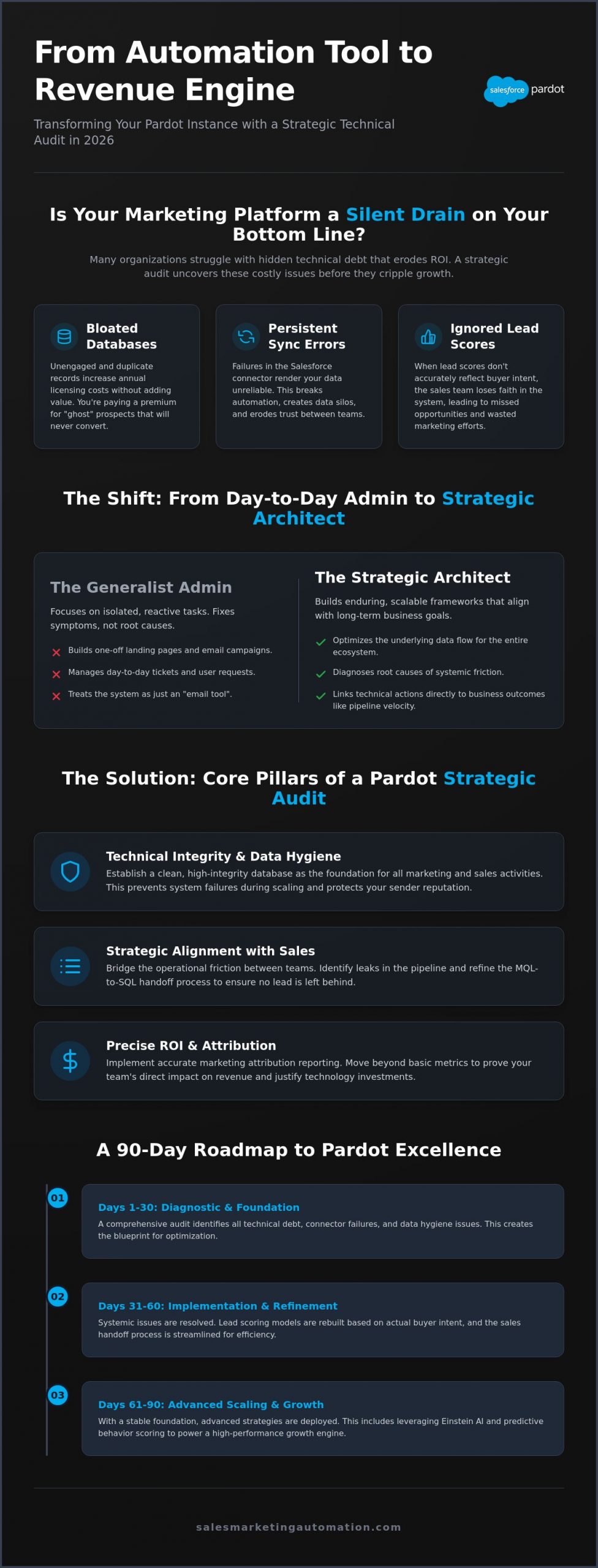
Transitioning from a “Fixed” instance to a “Scaling” instance requires a fundamental shift in operational discipline. Once the structural fractures identified during pardot audit services are repaired, the focus must move toward continuous platform optimization. This evolution is guided by a 90-day prioritized roadmap, a strategic document that ensures every technical refinement contributes directly to measurable revenue growth. In 2026, excellence is no longer about maintaining the status quo; it’s about leveraging advanced AI and deep integrations to outperform the competition and capture market share.
Scaling requires systemic integrity. By integrating your Pardot instance with the broader tech stack, including webinar platforms, intent data providers, and ABM tools, you create a unified ecosystem. This connectivity allows for real-time data activation, ensuring that your marketing efforts are always informed by the latest buyer signals. A Strategic Architect ensures these integrations are seamless, preventing the data silos that often plague rapidly growing organizations.
Static scoring models often fail to capture the nuance of modern buyer behavior. Transition to Einstein Behavior Scoring to gain real-time intent signals based on actual engagement patterns. Einstein Behavior Scoring uses machine learning to identify patterns in prospect engagement. This allows you to set up sophisticated “MQL Alerts” that provide Sales with deep context rather than just a generic notification. When a rep understands exactly why a lead is “hot,” their follow-up becomes more relevant and effective.
Many organizations reach a point where project-based audits are no longer sufficient to maintain peak performance. Shifting to monthly retainer-based managed services provides continuous access to automation experts who can execute complex campaigns and monitor system health in real time. This proactive approach prevents the “re-audit” cycle by maintaining platform health and resolving minor inefficiencies before they escalate into structural failures. It allows your internal team to focus on high-level strategy while we handle the technical heavy lifting.
Conversion rates are heavily influenced by the quality of your digital assets. Custom-coded, responsive email and form templates ensure a professional, consistent brand experience across all devices. Furthermore, integrating third-party data sources allows you to enrich prospect profiles automatically, providing a more comprehensive view of your target accounts. For a detailed breakdown of these requirements, consult our Pardot Setup and Configuration: A Strategic Architect’s Checklist for 2026. If you’re ready to transform your instance into a scaling engine, explore our Pardot consulting services to begin your 90-day optimization journey.
Selecting a consulting partner is the most critical decision you’ll make for your marketing technology stack. The choice between a “freelance fixer” and a Strategic Architect is the difference between patching a leak and re-engineering the entire plumbing system. While a freelancer might resolve an immediate sync error, a Strategic Architect builds a framework that prevents that error from recurring. This systemic approach is why we adhere to an “Audit First” philosophy. You wouldn’t accept a surgical recommendation without a diagnostic scan; similarly, you shouldn’t invest in platform optimization without professional pardot audit services to identify the root causes of operational friction.
Before signing a contract, evaluate potential partners against a rigorous checklist to ensure they possess the necessary technical depth and strategic vision. To help narrow your search, reviewing a comprehensive guide to the top Pardot consulting firms in 2026 can provide a structured framework for comparing technical architects against generalist agencies. Look for these specific indicators of a high-performance firm:
Complex Salesforce integrations demand a team-based approach that a single generalist simply cannot provide. A Strategic Architect leverages a team of specialists who understand the nuances of CRM data migration, lifecycle automation, and creative design. This collective expertise ensures your advice is unbiased and grounded in cross-platform reality. If your strategy requires custom-coded, responsive templates or sophisticated third-party data enrichment, an agency provides the technical bandwidth to execute these tasks without compromising your system’s integrity.
Your engagement should begin with a methodical discovery phase designed to protect your data while uncovering hidden inefficiencies. During these first 30 days, a professional firm prioritizes security by utilizing “read-only” access to perform a technical deep dive. This diagnostic period is essential for moving from “Diagnosis” to “Treatment” with precision. The phase concludes with the delivery of your strategic assessment, providing the clarity needed to begin your 90-day optimization journey. This structured transition ensures that your investment is focused exclusively on high-level performance and long-term scalability.
Sales & Marketing Automation specializes in building the enduring revenue frameworks that modern B2B organizations require. Our pardot audit services serve as the foundation for transforming your instance from a basic tool into a high-performance engine. If you’re ready to stop patching symptoms and start building for growth, explore our Pardot consulting services to secure your technical future.
Transforming a Pardot instance into a high-performance revenue engine requires more than just configuration; it demands a disciplined architectural approach. By prioritizing technical integrity and departmental alignment, you ensure that your automation efforts translate directly into measurable pipeline growth. Professional pardot audit services provide the diagnostic clarity needed to eliminate sync drift and establish a lead scoring model that your sales team will actually trust. This foundation is essential for leveraging advanced AI tools and scaling your operations without increasing headcount in an increasingly complex market.
Sales & Marketing Automation brings the expertise of over 100 successful implementations to your high-growth B2B tech stack. Our diagnostic-first methodology ensures that every optimization we perform is rooted in data and aligned with your long-term scalability goals. Stop reacting to system errors and start orchestrating a proactive growth strategy that drives results. Book a Strategic Pardot Assessment with Our Architects today to begin building an enduring framework for success. Your journey toward a streamlined, data-driven future starts with a single strategic step.
An audit is a diagnostic assessment that identifies technical debt and structural flaws, while optimization is the subsequent process of refining those elements for performance. Think of pardot audit services as the architectural blueprint and optimization as the construction that follows. You can’t effectively optimize a system without first understanding the underlying fractures in its current configuration.
A standard strategic engagement typically spans four to eight weeks from initial discovery to the delivery of a prioritized roadmap. This timeline allows for a thorough technical deep dive, data hygiene review, and stakeholder alignment. More complex enterprise implementations or CRM migrations may require a longer duration to ensure systemic integrity across all integrated platforms.
Sync failures often stem from “Sync Drift,” usually caused by mismatched field types or restrictive validation rules within Salesforce. If the CRM requires a specific field value that Pardot doesn’t provide, the record will fail to update. Identifying these specific points of failure is a primary objective of professional pardot audit services, ensuring that your lead handoff process remains reliable.
An in-house admin typically focuses on day-to-day execution, whereas a consultant provides the high-level architectural oversight required for long-term scalability. Consultants bring a seasoned, diagnostic perspective developed across hundreds of diverse implementations. This external lens helps uncover hidden inefficiencies and technical debt that internal teams might overlook due to their operational familiarity.
The most frequent issues include bloated databases with duplicate records, broken connector mappings, and outdated automation rules that conflict with modern workflows. We also often find scoring models that Sales ignores because they don’t accurately reflect buyer intent. Resolving these structural fractures is essential for transforming your instance into a high-performance revenue engine that identifies ready buyers.
Pricing varies significantly based on the complexity of your technical stack and the volume of your prospect database. Most strategic assessments are delivered as fixed-fee engagements to provide budget certainty while ensuring a comprehensive 90-day roadmap is established. It’s best to request a custom quote that reflects your specific architectural needs and integration requirements.
Yes, a consultant ensures your platform architecture adheres to global regulations like GDPR and CAN-SPAM through automated preference centers. They help design opt-in workflows and data retention policies that protect your brand’s reputation. Maintaining this technical compliance is a core pillar of platform health and prevents costly deliverability issues or legal complications.
Einstein Behavior Scoring uses machine learning to analyze engagement patterns and identify real-time intent signals. You need it if your current static scoring model fails to distinguish between casual browsing and genuine buyer readiness. It provides your sales team with the necessary context to prioritize leads that are most likely to convert, maximizing their efficiency and your revenue potential.