 Sales & Marketing Automation
The CRM and Marketing Automation Guru's You Can Trust.
Sales & Marketing Automation
Treating your move to a new platform as a simple file upload is the fastest way to compromise your sales pipeline. A CRM migration is not a technical data transfer; it’s a strategic re-architecting of your entire revenue engine. You’ve likely felt the anxiety that comes with evaluating crm data migration services, fearing that years of historical activity records might vanish or that your complex lead scoring workflows will break on day one. It’s a valid concern, as a fragmented transition can paralyze your sales team and leave your reporting in shambles.
We’ve designed this guide to replace that uncertainty with a methodical, foolproof framework for success. You’ll learn how to master the complexities of the migration process to ensure a seamless transition with zero downtime. By focusing on architectural precision, we’ll show you how to preserve every customer touchpoint while building a cleaner, more structured database that empowers better reporting. We’ll explore the critical steps of data cleanup and system mapping that turn a risky move into a catalyst for accelerated revenue growth.
Migrating your CRM is the single most important architectural decision your revenue team will make this decade. Most organizations view Data migration as a backend chore to be finished as quickly as possible. This perspective is a costly mistake. When you invest in crm data migration services, you aren’t just moving rows in a spreadsheet; you’re redefining how your business interacts with its customers. Transferring “dirty data” into a pristine new environment is like building a skyscraper on a cracked foundation. It leads to inaccurate forecasting, broken lead scoring models, and a sales team that fundamentally distrusts the system.
A migration is your best opportunity to audit and purge legacy inefficiencies. Over years of operation, CRMs accumulate redundant fields, outdated picklist values, and duplicate records that slow down your RevOps engine. By adopting a “Strategic Architect” mindset, you can design a schema that prioritizes data integrity from the start. This ensures that your reporting for 2026 and beyond is based on a single source of truth that reflects the actual state of your pipeline. The cost of ignoring this cleanup is high; it results in wasted marketing spend and missed sales opportunities due to fragmented customer profiles.
Simple “copy-paste” migrations fail because they ignore the complex interdependencies within B2B data structures. If you don’t map associations correctly, you end up with “orphaned data.” These are contacts who aren’t linked to companies or deals that lack historical context. This fragmentation breaks your multi-touch attribution models. It makes it impossible to see which marketing channels actually drive revenue. Precision mapping is the only way to prevent these systemic failures and ensure your sales follow-up processes remain uninterrupted during the transition.
Use this transition to implement a more robust lifecycle automation strategy that aligns with your 2026 growth goals. Clean, structured data is a prerequisite for the AI and machine learning tools that are becoming standard in high-performance sales environments. When your historical activity records map perfectly to the new architecture, your account managers can maintain deep context for every high-value relationship. This preservation of customer touchpoints ensures that your revenue engine doesn’t just survive the move but accelerates immediately after launch.
Modern CRM data migration is a sophisticated engineering process that goes far beyond moving simple lists of names. It requires a deep understanding of relational data structures, specifically how objects like Contacts, Companies, and Deals are associated through unique identifiers. High-tier crm data migration services utilize an API-led approach to preserve these complex relationships. Unlike flat-file CSV imports, which often strip away the connective tissue of your records, API-led migrations allow for the systematic transfer of custom properties and historical activity logs. This ensures that when a salesperson opens a record in the new system, they see the full context of every previous interaction without missing data points.
The backbone of this process is the ETL (Extract, Transform, Load) methodology. According to Gartner research, data quality remains a primary barrier to successful digital transformations, making the Transform stage the most critical phase of any migration. Without a rigorous ETL framework, you risk importing legacy errors that will eventually degrade your system’s performance and reporting accuracy. If you’re concerned about how your current data will translate to a new architecture, a professional marketing automation audit can identify these architectural risks before you begin the move.
Extraction is more than just hitting an export button. It involves securing a full-database backup while maintaining strict data security and compliance standards. This phase requires identifying every custom object and proprietary data structure within your legacy system. Professional architects ensure that no metadata is left behind, creating a comprehensive snapshot of your organization’s history before any transformation begins. This level of precision prevents the loss of historical context that often occurs during amateur transfers.
The transformation phase is where strategic cleanup occurs. We normalize data formats, such as dates, phone numbers, and industry tags, to ensure consistency across the new platform. Deduplication is also prioritized here to prevent immediate system bloat. Integrating strategic CRM data cleanup services during this stage ensures that your new CRM environment is optimized for high-level performance from day one. This proactive refinement prevents the “garbage in, garbage out” scenario that plagues poorly executed migrations and secures the integrity of your future forecasting.
Selecting the right path for your data requires a cold assessment of your system’s complexity. Small businesses with a few thousand records and no custom objects might find success with native importers. However, for mid-market and enterprise firms, these tools often become a liability. When you evaluate crm data migration services, you’re investing in a risk mitigation strategy that protects your historical context. Automated tools are designed for the “average” user, but your business architecture is rarely average. A botched DIY migration isn’t just a technical delay; it’s a significant loss in sales productivity that can take months to rectify.
Professional architects view the investment in expert implementation as an insurance policy for data integrity. If your sales team spends weeks manually fixing broken records, the perceived savings from a low-cost tool vanish instantly. You must weigh the initial cost against the long-term operational health of your revenue engine. High-performance organizations prioritize precision over speed, knowing that a clean start is the only way to ensure reliable reporting and forecasting.
Automated tools frequently fail when they encounter custom property mapping. They often ignore the relational associations between deals and activities, leading to the “broken association” trap. This leaves your sales team with records that exist in isolation, stripped of the context needed to close high-value deals. Most low-cost tools don’t provide post-migration validation or support. You’re left to discover errors on your own, usually when a critical report fails to reconcile or a lead scoring workflow breaks without warning.
Expert consultants don’t just move data; they build a foundation for growth. By utilizing CRM implementation services, you ensure that your new environment is architected for scalability from day one. Consultants use custom scripting to handle complex transformations that standard tools can’t touch. This alignment ensures your move supports your broader marketing automation platform migration goals. You aren’t just switching software; you’re upgrading your entire revenue engine to meet the demands of 2026.
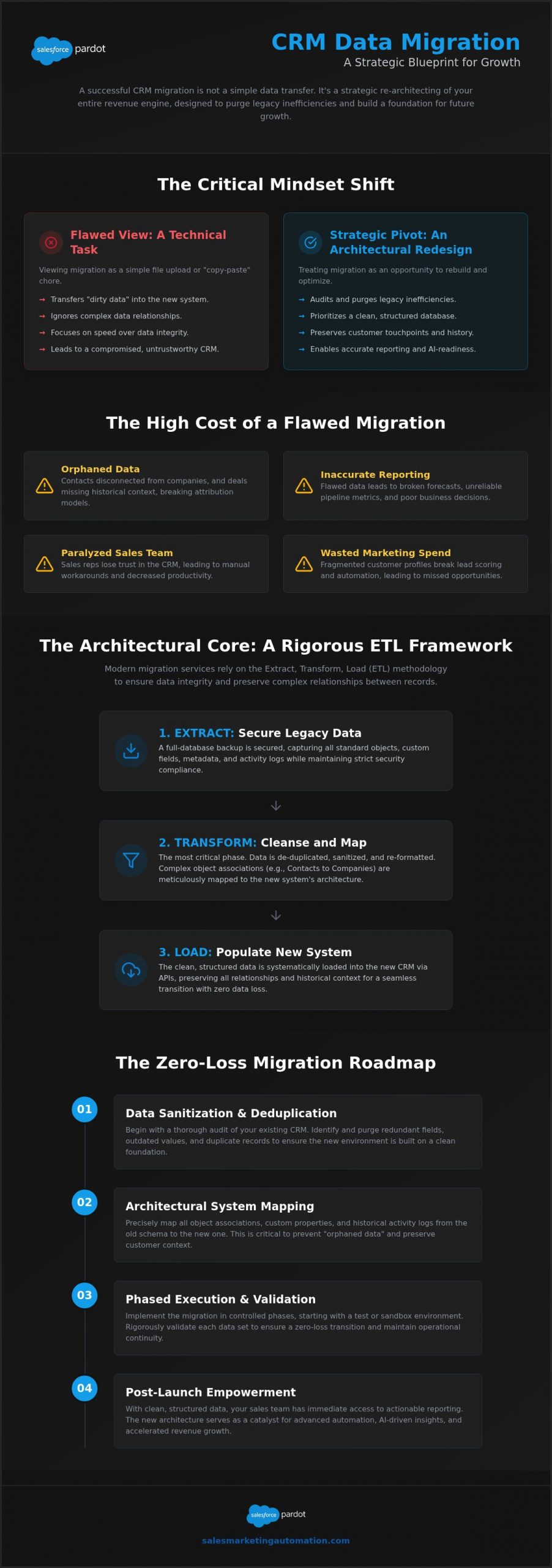
Execution of a complex migration requires a methodical progression that balances technical precision with operational continuity. A fragmented approach leads to downtime and data loss, which can cripple your sales momentum. We utilize a five-phase roadmap designed to navigate these risks and ensure your new system is functional from the moment of cutover. High-performance crm data migration services don’t just move data; they orchestrate a transition that respects the delicate balance of your existing revenue engine.
Successful discovery starts with a ruthless audit of your current database. We identify custom objects and properties that are no longer serving your business goals. By designing a data schema that supports your 2026 revenue targets, we ensure your new environment is built for scalability. This phase also includes identifying critical integrations, such as your ERP or email marketing tools, that must be reconnected. We map these touchpoints early to prevent the “orphaned data” scenarios that break multi-touch attribution models after the move.
Validation is the most overlooked step in amateur migrations, yet it’s the only way to ensure a zero-loss transition. We conduct extensive User Acceptance Testing (UAT) with your key sales stakeholders to verify that the system meets their daily operational needs. Our team spot-checks record counts and historical activity accuracy to confirm that years of customer context have been preserved. We pay special attention to lead source attribution; it’s vital that your marketing reporting remains intact across the transition. If you’re ready to secure your data’s future, our team specializes in comprehensive crm data migration services that prioritize architectural health and zero-loss execution.
Achieving a seamless move requires more than just technical proficiency; it demands a partner who understands the architectural implications of every data point. At Sales & Marketing Automation, we operate as the Strategic Architect for your revenue engine. Our crm data migration services are built on a foundation of precision and systemic integrity, ensuring that your transition is a catalyst for growth rather than a period of operational recovery. We don’t just perform a task; we build an enduring framework that supports your long-term business objectives.
Our team brings deep technical expertise across the industry’s most complex environments, including HubSpot, Salesforce, and Pardot. We understand that these platforms aren’t interchangeable silos; they’re integrated systems that require a unique approach to object mapping and API connectivity. Beyond the initial move, we focus on optimizing your new environment for immediate ROI. This includes realigning your lead scoring, refining your automation workflows, and ensuring your reporting dashboards provide the clarity needed for executive decision-making. By accessing our national network of automation and data experts, you gain a partner dedicated to the long-term health of your digital infrastructure.
High-growth organizations prioritize stability and scalability. With a track record of over 100 successful technical implementations, our methodology has been refined through a wide variety of complex B2B challenges. We treat data integrity as the non-negotiable foundation for all revenue growth. Working with a boutique agency provides you with a level of attention and B2B nuance that larger, volume-based firms often overlook. We understand the specific requirements of multi-touch attribution and account-based marketing, ensuring these critical functions remain operational throughout the migration process.
Securing your data legacy starts with a clear understanding of your current system’s health. We recommend initiating a strategic audit to identify potential friction points and legacy inefficiencies before they’re transferred to a new environment. Planning your 2026 migration early allows for the thorough discovery and architectural mapping required for a zero-loss transition. Don’t wait for a system failure or a broken report to realize the importance of data precision. Consult with our strategic architects today to begin designing a migration roadmap that accelerates your revenue growth and protects your historical context.
A successful migration transforms your CRM from a legacy database into a high-performance revenue engine. By prioritizing architectural integrity and strategic data cleanup, you ensure that your sales team operates with full historical context and accurate reporting from day one. We’ve explored how a methodical roadmap and API-led methodology prevent the “broken association” traps common in automated transfers. Investing in professional crm data migration services is a decision to protect your most valuable asset: your customer data.
Our team brings the seasoned experience of over 100 successful implementations to every project. As HubSpot and Salesforce certified experts with a national strategic consulting reach, we specialize in the complex technical re-architecting required for modern B2B growth. Secure your revenue engine with our expert CRM data migration services. Your platform transition is the ideal moment to reset your operational standards and build a scalable foundation for 2026 and beyond. We’re ready to help you turn technical complexity into a definitive competitive advantage.
CRM data migration services involve the systematic transfer of records, object associations, and historical engagement data from one system to another. These services ensure that your architectural data structure remains intact while moving to a new platform. Professional providers focus on maintaining the integrity of relational data to prevent the loss of customer context during the transition.
Total investment varies based on the volume of records, the complexity of your custom objects, and the number of integrations requiring reconnection. Strategic providers typically conduct a discovery audit to determine the scope of work before providing a project-based estimate. This approach ensures that the architectural requirements of your specific revenue engine are accurately accounted for in the deployment plan.
A comprehensive migration typically spans several weeks to several months depending on the depth of the discovery and validation phases. While a basic data transfer might appear fast, a strategic architect’s approach includes rigorous testing loops and pilot migrations to ensure zero downtime. This methodical timeline protects your sales operations from the disruptions caused by rushed, error-prone executions.
Native importers are suitable for simple datasets but often fail to preserve complex relational associations or historical activity logs. Attempting a DIY migration in a sophisticated B2B environment carries a high risk of creating orphaned records and broken attribution models. Professional crm data migration services use custom scripting and API-led transfers to handle the nuances that standard tools frequently overlook.
The loss of relational data integrity is the most significant threat to your operational health. When associations between contacts, companies, and historical deals are severed, your sales team loses the context needed to manage high-value accounts effectively. This fragmentation also compromises your reporting accuracy, making it impossible to generate reliable pipeline forecasts or marketing attribution insights in the new system.
You won’t lose these critical touchpoints if you utilize an API-led migration strategy designed to capture engagement history. Standard CSV imports often struggle with these engagement objects, but professional architects prioritize the preservation of every historical activity record. This ensures that your sales team maintains a complete view of the customer journey without any gaps in the communication timeline.
High duplicate rates, inconsistent field formatting, and a large volume of orphaned records are clear indicators that a cleanup is necessary. If your current reporting feels unreliable or your sales team complains about cluttered contact views, you should initiate a data sanitization phase. Performing this cleanup before the move prevents legacy inefficiencies from polluting your new, high-performance environment.
Yes, our team specializes in technical implementations and crm data migration services for HubSpot, Salesforce, and Pardot environments. We serve as a strategic partner to ensure your move follows a foolproof architectural roadmap. Our expertise focuses on maintaining data integrity while optimizing your new platform for immediate revenue growth and long-term scalability.