 Sales & Marketing Automation
The CRM and Marketing Automation Guru's You Can Trust.
Sales & Marketing Automation
A Salesforce Pardot implementation is not a simple software setup; it is a fundamental reconfiguration of your revenue engine that determines whether your data scales or stagnates. For many B2B organizations, the total cost of ownership for Marketing Cloud Account Engagement can reach three times the initial license fee, making a “trial and error” approach an expensive architectural risk. You likely recognize the anxiety of seeing critical emails land in spam folders or the frustration of dirty data syncing between systems because of misaligned connector settings.
This article provides a comprehensive pardot implementation checklist designed to move your team from technical confusion to operational mastery. We’ll help you execute a flawless deployment that aligns your technical architecture with your specific revenue goals. Our guide covers the non-negotiable steps for securing high deliverability from day one, configuring the Salesforce-Pardot connector for a clean sync, and establishing a clear roadmap for automated lead nurturing that produces tangible results. By following this blueprint, you can build a framework that values order, data-driven logic, and seamless integration.
Successful deployment begins long before the first technical configuration. It requires a rigorous focus on data governance to ensure your marketing engine runs on high-quality fuel. If you neglect this foundational phase of your pardot implementation checklist, you risk syncing thousands of duplicate or incomplete records, which complicates reporting and wastes your database limits. Pardot is designed to mirror your Salesforce architecture, so any structural flaws in your CRM will inevitably manifest in your marketing automation. You must treat this stage as an architectural exercise where you define the rules of engagement for your entire database.
Clean data is the prerequisite for effective automation. You must identify and merge duplicate records in Salesforce before initiating the initial sync to prevent fragmented prospect profiles that confuse your sales team. Verify that all required lead fields, such as industry, job title, and geographic data, are populated to support your future scoring models. If your current database is cluttered or fragmented, engaging professional crm data migration services ensures you maintain historical integrity while building a scalable environment. This audit allows you to map custom fields between systems with confidence, ensuring data parity across your entire technology stack and preventing the “garbage in, garbage out” cycle that plagues many implementations.
Precision in your lead lifecycle definitions prevents friction between marketing and sales departments. You need to standardize definitions for Marketing Qualified Leads (MQL), Sales Accepted Leads (SAL), and Sales Qualified Leads (SQL) across the entire organization. Document the exact triggers and handoff processes that move a prospect from automation to a live sales representative. Aligning your technical architecture with a broader lifecycle automation strategy ensures that every automated touchpoint serves a specific conversion milestone. This documentation serves as a blueprint for your automation rules, ensuring that leads don’t fall through the cracks during the transition from Pardot to Salesforce.
Finally, you must establish clear user roles and access levels based on specific organizational functions. Not every user requires administrator privileges; in fact, over-provisioning access can lead to accidental deletions or configuration errors. By restricting access based on marketing and sales roles, you protect the systemic integrity of your setup. This prescriptive approach turns your pardot implementation checklist from a simple task list into a strategic framework for long-term B2B scalability and operational health.
Moving from the strategy phase to technical execution requires a shift in focus toward systemic integrity. Every step in this stage of your pardot implementation checklist acts as a bridge between your marketing efforts and your CRM’s database. This technical alignment is a core component of a broader digital transformation strategy, ensuring that your tech stack supports long-term business agility rather than creating technical debt. You’re not just connecting two pieces of software; you’re architecting a unified environment for growth.
Install the Pardot AppExchange package and assign permission sets as your first order of business. This isn’t a mere formality; it establishes the security protocols and access controls needed for a secure integration. You’re building the infrastructure that allows data to flow securely between platforms, which is essential for maintaining a single source of truth across your marketing and sales teams.
Selecting the right sync user is a high-stakes decision that dictates how data moves between systems. We recommend utilizing the V2 Connector for its enhanced performance and simplified management interface. You’ll need to configure object sync settings for Leads, Contacts, and Accounts with precision. Don’t simply accept default settings; evaluate how your “Syncing Prospects” logic impacts your database limits and record ownership. Enable Connected Campaigns immediately to bridge the reporting gap between marketing spend and sales outcomes, providing a unified view of the customer journey.
High email deliverability is built on a foundation of technical trust. You must implement SPF and DKIM records to validate your sending authority and protect your sender reputation. Setting up a DMARC policy further secures your domain against unauthorized use and spoofing. Additionally, configure a Tracker Domain (CNAME) to ensure all links and assets appear branded and trustworthy to your prospects. Verifying these settings within the dashboard is a non-negotiable step to prevent your communications from being flagged as spam or blacklisted by major providers.
A critical part of any pardot implementation checklist involves whitelisting Pardot IP addresses to ensure internal email receipt during testing phases. Finally, deploy the Tracking Code across your entire website to enable real-time prospect activity monitoring. This data is the engine behind your future scoring and grading rules. If these technical requirements seem daunting, a professional Marketing Automation Audit can identify and rectify misconfigurations before they impact your revenue goals.
Once technical foundations are secure, you must pivot toward the assets that drive prospect engagement. Designing responsive, branded email templates and landing pages is more than a creative task; it is an architectural requirement for B2B credibility. These assets must be mobile-optimized and aligned with your corporate identity to ensure a seamless user experience across all devices. By including asset creation in your pardot implementation checklist, you ensure that every touchpoint is ready to capture and convert inbound demand from the moment of launch.
Effective lead management depends on how you capture and categorize data. Build Pardot Forms to leverage progressive profiling, which gathers prospect data over time, or utilize Form Handlers to integrate with existing high-performing web forms without disrupting your current frontend architecture. Organize this data using a mix of static and dynamic lists. Static lists are ideal for one-time mailings or specific events; dynamic lists provide automated, rule-based segmentation that keeps your database organized as prospect attributes change in real time.
Develop a dual-lens framework to evaluate prospect quality with precision. Scoring rules must be based on behavioral activity, such as white paper downloads or pricing page visits, which serve as critical intent signals. Conversely, grading profiles should reflect firmographic and demographic fit, such as job title or company revenue. Utilizing a “Scoring vs. Grading” matrix allows your sales team to distinguish between an engaged researcher who lacks purchasing power and a high-priority ready buyer who fits your ideal customer profile.
Architect your first “Welcome” or “Lead Nurture” program within Engagement Studio to provide a structured path for new prospects. Successful programs utilize wait steps and triggers based on specific engagement actions, such as link clicks or form completions, to branch the journey logically. Don’t let these journeys exist in a vacuum. Integrate automated tasks for sales follow-up within the Engagement Studio flow to ensure that high-intent behavior triggers immediate human intervention. This ensures that your pardot implementation checklist moves beyond simple setup and into the realm of active revenue generation.
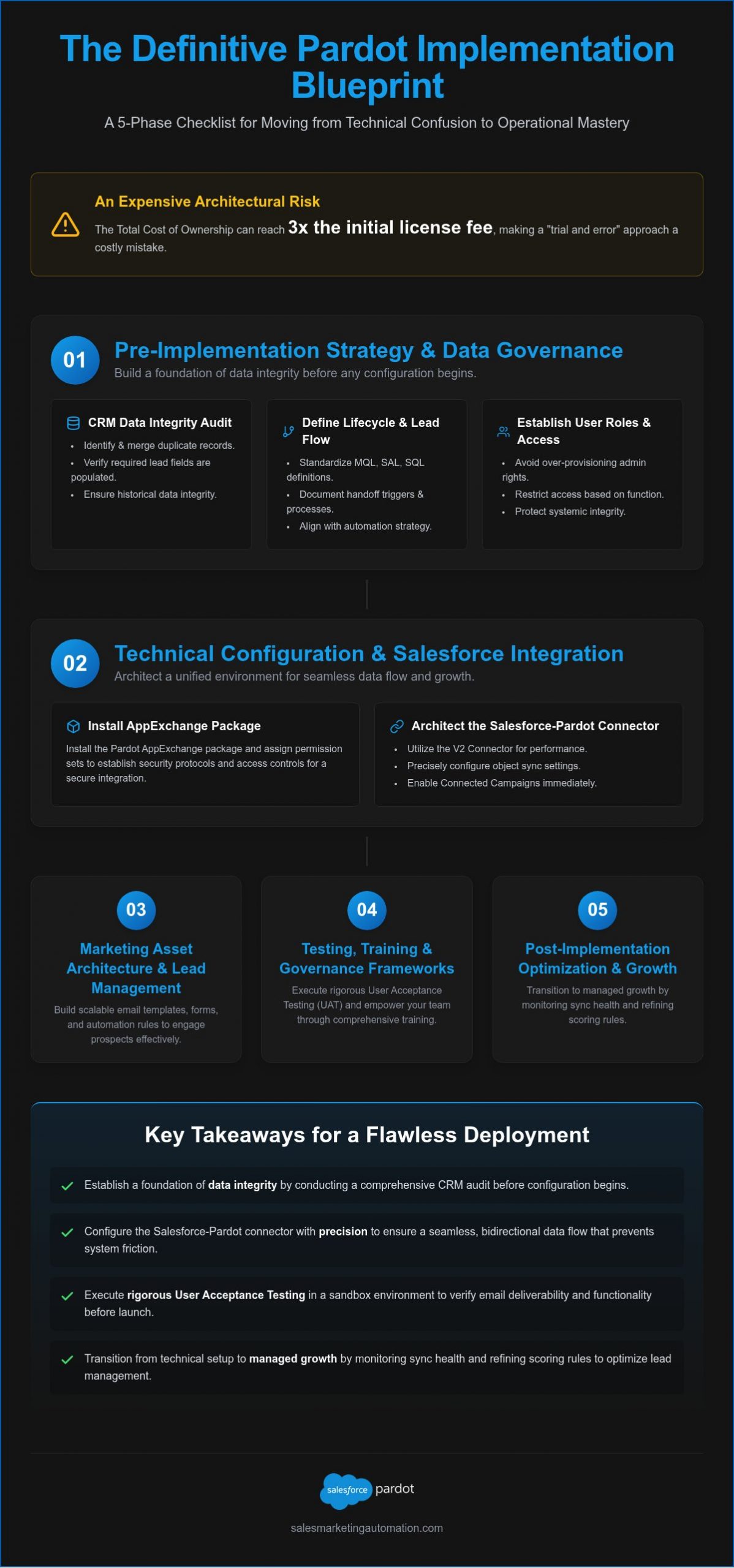
Validation is the final barrier between a theoretical strategy and a high-performance reality. You must transition from construction to rigorous verification to ensure that every technical component functions as intended under real-world conditions. A common failure in a pardot implementation checklist is the rush to “go live” without a dedicated testing phase, which often leads to broken syncs or misrouted leads. By executing a formal User Acceptance Testing (UAT) protocol in a sandbox or controlled test environment, you safeguard your CRM’s integrity and ensure your first campaign launches with absolute precision.
Training your marketing team on asset creation and reporting is equally critical. You need to ensure that every user understands how to build within the new framework without compromising systemic health. This includes establishing a clear understanding of how Pardot data influences Salesforce reports. When your team is proficient in the platform’s nuances, they can focus on strategy rather than troubleshooting technical errors.
Systematic testing requires you to verify the entire lead lifecycle from the prospect’s perspective. Submit test data through every Pardot Form and Form Handler to confirm that prospects are created correctly and that all completion actions fire without delay. You must conduct end-to-end sync tests to verify that data flows seamlessly into Salesforce. Confirm that Salesforce tasks are assigned to the correct owners and that lead source fields are populated accurately upon conversion. This verification process prevents technical friction from undermining your sales team’s trust in the new system.
Long-term scalability depends on a disciplined approach to platform organization. Implement a strict naming convention for all campaigns, lists, and marketing assets to ensure that reporting remains clear and searchable as your database grows. For example, use a standardized prefix system that includes the year, channel, and campaign name. Establish a hierarchical folder structure and set specific folder permissions to prevent unauthorized modification of master templates. This level of control is essential for maintaining brand consistency and operational order across global or multi-departmental teams.
Finally, you must document your system architecture and internal workflows in a “Center of Excellence” document. This serves as the definitive guide for your marketing team, covering asset creation standards and reporting protocols. Detailed documentation is not just for current users; it provides an essential baseline for future pardot audit services that will eventually be required to optimize the system as your business evolves. If you want to ensure your setup meets these elite standards, consider a professional Salesforce & Pardot Consulting engagement to audit your framework before the final launch.
The “go-live” date marks the beginning of your system’s operational life, not the conclusion of your strategic efforts. Viewing the completion of a pardot implementation checklist as a final destination is a common mistake that leads to architectural debt and missed revenue opportunities. You must transition into a phase of active monitoring and continuous refinement to ensure the platform scales alongside your business requirements. This stage is about moving from technical deployment to operational excellence, where every data point is used to sharpen your competitive edge.
Monitor the sync queue with daily frequency during the first 30 days to identify bottlenecks or field-level validation errors. These early friction points often reveal misaligned settings between Pardot and Salesforce that were not apparent during the initial testing phase. Addressing these issues immediately prevents data silos and ensures that your sales team maintains confidence in the automated alerts they receive. This proactive maintenance phase is essential for establishing the systemic integrity required for long-term growth.
Schedule a comprehensive marketing automation audit exactly 90 days after deployment to evaluate systemic health. This review allows you to analyze lead-to-opportunity conversion rates and validate whether your scoring logic accurately predicts buyer intent. You should audit asset engagement metrics, such as click-through and open rates, to optimize your content strategy based on actual prospect behavior. Additionally, identify and deactivate “dead” automation rules or completion actions that no longer serve a strategic purpose; this keeps your system lean, responsive, and efficient.
Determine when your internal team’s requirements exceed their technical capacity. Many B2B organizations find that moving from a project-based setup to a managed services retainer provides the elite technical expertise needed for complex growth. Managed services allow you to leverage external specialists for advanced integrations involving the Pardot API or custom objects. This partnership ensures your platform evolves as your tech stack changes, maintaining a unified revenue engine. Transitioning your focus toward revenue operations consulting ensures that your marketing automation remains a high-performance asset rather than a static tool. By following this final stage of the pardot implementation checklist, you secure the long-term scalability of your B2B ecosystem and ensure your technology investment delivers a measurable return.
Executing a successful deployment requires more than a series of technical checkboxes; it demands a commitment to systemic integrity and long-term data governance. By following this methodical pardot implementation checklist, you’ve moved from a fragmented setup to a unified revenue engine. You’ve secured your email deliverability through proper authentication, established a rigorous scoring and grading framework, and built a foundation for scalable growth through disciplined naming conventions and testing protocols. These steps ensure your technology investment translates into measurable business outcomes rather than technical debt.
The transition from implementation to optimization is where true competitive advantage is realized. Our team of Salesforce Certified Pardot Consultants brings over 10 years of B2B automation experience and a methodical 5-phase implementation framework to every engagement. We don’t just configure software; we build enduring frameworks that align technical architecture with your specific revenue goals. We invite you to Download our Strategic Pardot Implementation Guide or Schedule a Consultation to ensure your marketing automation stack is engineered for maximum performance from day one. Your journey toward operational excellence starts with a single, strategic step.
A standard implementation generally requires six to twelve weeks to reach full operational capacity. This timeframe accounts for the initial technical configuration, CRM data migration, and the development of foundational marketing assets. Complex enterprise environments involving multiple business units or extensive custom object syncing may require additional time to ensure systemic integrity.
While an internal team can manage basic setup tasks, engaging a consultant ensures your technical architecture aligns with long-term revenue goals. Experienced architects prevent the accumulation of technical debt and ensure that your pardot implementation checklist addresses complex connector settings that internal teams often overlook. This professional oversight minimizes the risk of system friction and data silos from day one.
Pardot, now officially termed Marketing Cloud Account Engagement, is specifically engineered for lead-based B2B sales cycles characterized by long consideration periods. Marketing Cloud Engagement is a separate platform designed for high-volume, transactional B2C communications across multiple channels. Pardot’s deep, native integration with Salesforce CRM makes it the superior choice for organizations focused on account-based marketing and lead nurturing.
You must conduct a comprehensive CRM data audit before initiating the first system sync. Identify and merge duplicate records while ensuring all mandatory Salesforce fields are populated to support your scoring models. Establishing strict field-mapping protocols and selecting a dedicated sync user with precise permissions prevents “garbage in, garbage out” scenarios that compromise your database integrity.
The most frequent errors include neglecting technical DNS configurations like SPF and DKIM, which leads to immediate deliverability failures. Many organizations also fail to establish a standardized naming convention or ignore sync queue errors during the first month of operation. These oversights result in a disorganized database that is difficult to report on and even harder to scale as your business grows.
Professional implementation services in 2026 typically range from $5,000 for basic configurations to over $50,000 for enterprise-level deployments. These costs are separate from monthly licensing fees, which range from $1,250 for the Growth edition to $15,000 for the Premium edition. You should also account for the total cost of ownership, which includes ongoing optimization and the required Salesforce CRM licensing.
Standard implementation packages often include basic layout configuration, but custom, responsive email template design is typically a separate creative service. You should verify whether your partner provides Creative Design Services to ensure your assets are mobile-optimized and aligned with your brand identity. High-quality asset architecture is a critical component of any comprehensive pardot implementation checklist.
Schedule your first Marketing Automation Audit 90 days after the initial launch to refine your scoring and grading logic based on real-world data. Following this initial review, you should perform a technical audit every six to twelve months to identify “dead” automation rules and ensure the platform still supports your evolving business strategy. Regular assessments prevent technical decay and ensure your tech stack remains an efficient revenue driver.