 Sales & Marketing Automation
The CRM and Marketing Automation Guru's You Can Trust.
Sales & Marketing Automation
Why are you paying for a premium HubSpot or Pardot instance if your sales team still spends hours manually triaging leads? It’s a common paradox in high-growth companies. You invest in a sophisticated tech stack to drive efficiency, yet you end up buried under technical debt and leaky sales funnels. This is where fractional marketing ops becomes a vital strategic intervention. It’s not just about filling a seat; it’s about deploying an architect to refine your business systems from the ground up.
You already know that dirty CRM data and inaccurate reporting are more than just minor inconveniences. They’re systemic failures that obscure your true ROI and prevent predictable scaling. We’ll show you how to access elite marketing technology expertise to stabilize your revenue engine without the overhead of a full-time executive hire. This guide previews the transition from manual, reactive workflows to a clean, automated lead-to-revenue lifecycle. We’ll explore how to build enduring frameworks that ensure your MarTech stack finally delivers on its promise of performance and operational health.
Fractional marketing ops is a specialized service model that provides organizations with senior-level technical expertise on a part-time or project basis. It’s designed for companies that have outgrown basic administrative support but aren’t ready for the overhead of a full-time operations director. While a Fractional CMO focuses on high-level Marketing Management and brand strategy, a fractional marketing ops partner focuses on the underlying systems. They ensure the tools you’ve invested in actually communicate with one another to drive revenue. This role is less about “what” you are saying and entirely about “how” the message is delivered and tracked.
Most businesses hit a technical debt threshold long before they realize it. This occurs when the complexity of your HubSpot or Salesforce instance outpaces your team’s ability to manage it. Instead of a streamlined engine, your CRM becomes a fragmented archive of dirty data and broken workflows. Adopting a Strategic Architect approach means you stop treating your tech stack as a series of isolated campaign tools. You begin building enduring frameworks that prioritize data integrity and systemic health over short-term hacks. This methodology ensures that your infrastructure supports growth rather than acting as a bottleneck.
Modern marketing has transformed from simple creative execution into a complex technical discipline. In the early days of MarTech, tools were siloed; you had an email sender and a separate spreadsheet for leads. Today, the global landscape has expanded to over 15,505 products, turning your stack into a sophisticated revenue ecosystem. This shift requires a move from task-based freelancing to system-based fractional partnerships. You don’t just need someone to set up a sequence. You need an operational layer that bridges the gap between Sales and Marketing through automated lead-to-revenue lifecycles. This layer provides the stability required to scale without adding manual labor.
Identify the friction points in your current setup before they compromise your growth. If you recognize these patterns, your operational health is likely at risk:
By integrating fractional marketing ops into your business, you eliminate these bottlenecks. You gain the precision of an expert who understands how to engineer a scalable system that doesn’t require constant manual intervention. This partnership allows your internal team to focus on high-value creative and strategic initiatives while the technical framework runs autonomously in the background.
Building a scalable revenue engine requires more than just installing software; it demands a rigorous architectural framework. When you engage fractional marketing ops, the focus shifts from surface-level tweaks to the engineering of four foundational pillars. These pillars ensure that your systems don’t just function, but actively accelerate the sales cycle. Without this structural integrity, even the most expensive MarTech stack will eventually collapse under its own complexity.
Establish a unified data schema to ensure HubSpot, Salesforce, and Pardot communicate without friction. This CRM architecture is the bedrock of your operations. It allows for seamless data flow across the entire funnel, ensuring that a lead’s history is preserved as they move from marketing qualified to a closed-won opportunity. A comprehensive Marketing Automation Audit often reveals that most “technical” issues are actually architectural flaws in how these platforms are integrated.
Engineer automated transitions through lifecycle automation. This process involves designing the technical journey from the moment an anonymous visitor hits your site to the final signature on a contract. By instituting data-driven lead scoring and management protocols, you prioritize high-intent buyers and eliminate manual triaging. Data hygiene and governance must be woven into this fabric. You need automated cleansing routines to prevent “dirty data” from polluting your pipeline, ensuring your sales team always works with accurate, actionable intelligence.
Advanced technical configuration moves beyond the basic onboarding phase to unlock the full power of your ecosystem. Technical configuration is the alignment of software capabilities with specific business revenue goals. This involves deploying custom API integrations and ensuring third-party tool synchronization remains stable. It’s about refining the system so it handles complex logic, such as multi-currency reporting or intricate territory routing, without requiring constant manual intervention.
Construct dashboards that provide a single source of truth for both Sales and Marketing. To prove marketing ROI, you must implement multi-touch attribution models that track every interaction across the buyer’s journey. This requires a precise technical setup for GA4 and CRM reporting synchronization. When these systems are aligned, you stop guessing which channels drive growth. You gain the clarity needed to allocate budget based on hard data, transforming your marketing department from a cost center into a predictable revenue driver.
Compare the financial and operational impact of a traditional hire against the efficiency of a fractional model. A senior-level Marketing Operations Manager typically commands a salary between $150,000 and $200,000, a figure that excludes the additional burden of benefits, taxes, and recruitment fees. Deploying fractional marketing ops allows you to bypass these heavy overhead costs while securing the same high-level architectural oversight. This model shifts your budget from fixed personnel costs to variable, results-oriented investments that scale with your business needs.
Speed to impact remains a primary differentiator. A full-time hire often requires three to six months to reach full productivity as they navigate internal culture and learn your specific tech stack. Fractional experts operate on a compressed timeline; they arrive with pre-built frameworks and diagnostic tools that allow them to begin auditing and refining your systems within days. This rapid onboarding is paired with a depth of expertise that a single hire cannot replicate. While an individual’s knowledge is limited to their personal career history, a fractional agency team draws from collective experience across dozens of diverse platform environments and industries. For a deeper analysis of how these models compare in practice, explore this strategic breakdown of outsourced marketing operations versus in-house hiring to understand which approach best fits your scaling objectives.
Scalability is the final strategic advantage. Your need for technical support isn’t static. During a major CRM data migration or a complete platform overhaul, you may require intensive, 40-hour weeks of technical labor. Once those systems are stabilized, your needs might drop to a strategic maintenance level. Fractional partnerships offer the flexibility to adjust these hours based on your project cycles, ensuring you never pay for idle capacity.
Relying on a single individual to manage your entire MarTech ecosystem creates a single point of failure. If your sole operations manager leaves the company, your institutional knowledge and technical documentation often depart with them, leaving your revenue engine vulnerable. Furthermore, finding “Unicorn” hires who possess both high-level strategic vision and deep technical execution skills is increasingly difficult. Most organizations end up with a specialist who is either too strategic to handle the technical “weeds” or too technical to understand the broader business objectives. The hidden costs of ongoing training through providers like ClickAcademy Asia to keep a single employee current with the rapid churn of MarTech tools further erode the perceived value of the full-time model.
Distinguish between “executing a task” and “owning a system” when evaluating external talent. A freelancer is typically a reactive resource, hired to fix a specific broken workflow or build a single landing page. An agency partner acts as a proactive architect who owns the integrity of the entire ecosystem. They ensure every technical change aligns with your long-term revenue goals and maintains data governance standards. Institutional knowledge remains secured within the agency’s documentation, providing a layer of stability that individual contractors cannot provide. When deciding on your path, remember that choosing a HubSpot Implementation Partner vs Freelancer is ultimately a choice between a temporary technical fix and a permanent operational framework.
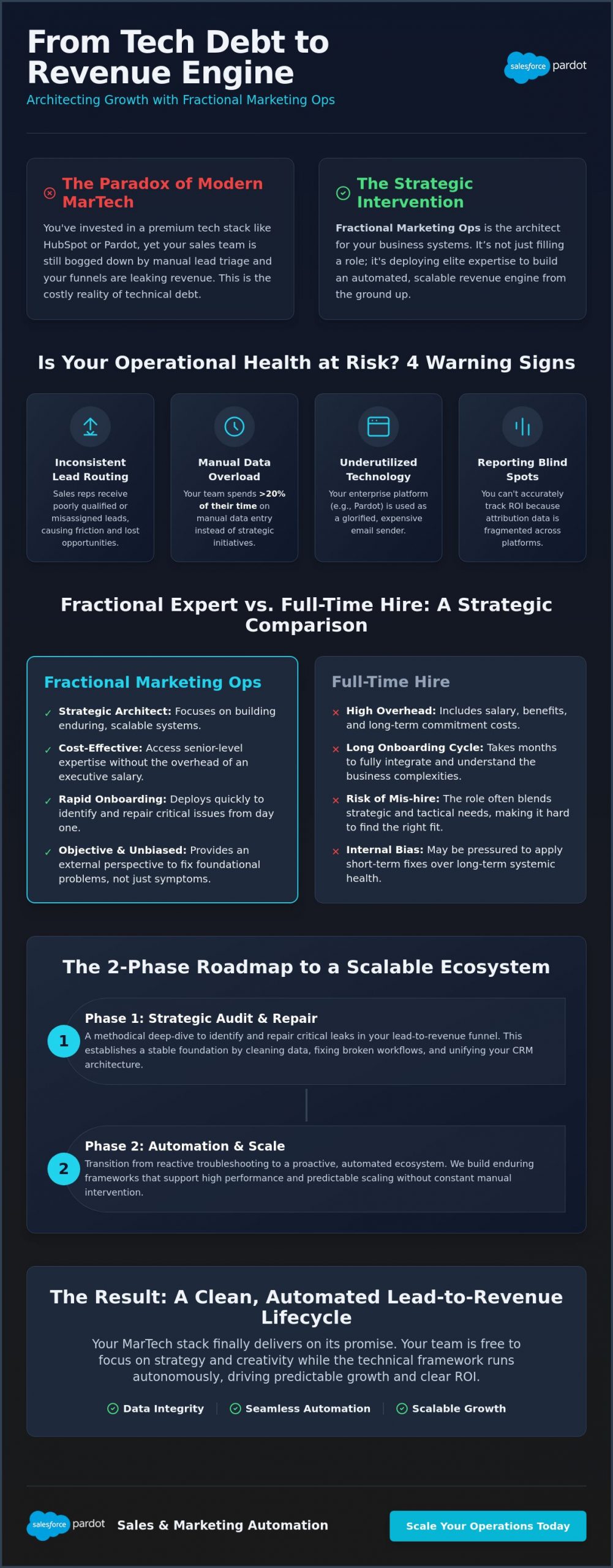
Successfully integrating fractional marketing ops requires a methodical, four-phase approach that moves from diagnostic discovery to long-term system optimization. This isn’t a simple talent acquisition; it’s a structural alignment of your technology with your business objectives. By following a rigorous roadmap, you ensure that every technical intervention serves a specific revenue goal, preventing the accumulation of new technical debt while systematically retiring the old.
The engagement begins with Phase 1: The Strategic Audit. During this initial stage, the expert identifies critical leaks in your funnel and assesses the depth of technical debt within your stack. Phase 2 transitions into Architectural Design, where the “future state” of your automation ecosystem is mapped out in detail. This blueprint serves as the master plan for Phase 3: Technical Implementation. This is where the heavy lifting occurs, including CRM data migration, complex integrations, and the construction of automated lifecycles. Finally, Phase 4 focuses on Optimization and Managed Services, providing the ongoing refinement necessary to adapt to real-time data and changing market conditions.
If you’re ready to identify the structural weaknesses in your current setup, start with a comprehensive Marketing Automation Audit to benchmark your system’s health and prioritize your technical roadmap.
Establish measurable goals early to ensure the partnership delivers tangible value. Focus on high-impact metrics such as lead-to-MQL conversion rates, data accuracy percentages, and system uptime. MarOps KPIs are the metrics that quantify the efficiency and health of the revenue engine. To maintain momentum, organize the workload into weekly or bi-weekly technical sprints. This agile approach allows for rapid iterations and ensures that the most critical bottlenecks are addressed with priority, providing a clear trail of progress for stakeholders.
Effective integration relies on transparent communication and clearly defined roles. Establish dedicated channels in Slack or your preferred project management tool to facilitate real-time collaboration. Your fractional expert shouldn’t operate in a silo. Instead, they act as a vital bridge between Marketing Directors and Sales leaders, translating strategic desires into technical realities. Documenting every new process is essential for maintaining systemic integrity. This ensures that as your company grows, the logic behind your automation remains accessible and understandable for all internal team members, protecting your investment in fractional marketing ops for the long term.
Sales & Marketing Automation serves as a specialized partner for organizations navigating the intricacies of HubSpot and Salesforce ecosystems. We don’t simply perform tasks; we deploy our “Strategic Architect” methodology to construct enduring revenue frameworks. This approach moves beyond the basic onboarding provided by generalist agencies, focusing instead on expert-level technical consulting that aligns your tech stack with long-term business goals. With a track record of over 100 successful implementations and migrations, our team possesses the seasoned experience required to solve complex operational challenges before they impact your pipeline.
Positioning managed services as your operational foundation is the most effective way to ensure continuous growth. When your technical infrastructure is handled by specialists, your internal leadership can focus exclusively on market expansion and brand strategy. This transition from reactive troubleshooting to proactive system management allows your business to scale without the typical growing pains associated with fragmented data or broken automation. Our goal is to transform your MarTech stack from a source of frustration into a high-performance asset that drives predictable revenue. A critical component of this transformation is ensuring your departments operate in lockstep, which is why many of our clients also invest in sales and marketing alignment consulting to eliminate the structural friction between lead generation and closed-won revenue.
Engaging with a fractional marketing ops partner should lead to a state of continuous improvement. Our managed services represent the logical conclusion for businesses seeking sustained growth without technical friction. We provide ongoing platform optimization and campaign execution support, ensuring your systems evolve alongside your market strategy. Proactive diagnostic audits are central to our process, allowing us to identify and resolve potential issues before they contribute to technical debt accumulation. You gain direct access to a global team of automation experts, managed from our Florida-based headquarters, providing a blend of high-level strategy and granular technical execution.
Stabilizing your revenue engine begins with a clear understanding of your current infrastructure. We recommend starting with a Fixed-Fee Strategic Audit to benchmark your operational health and identify immediate opportunities for refinement. This diagnostic phase is essential for Strategic CRM Audits: Uncovering Inefficiency and preparing your stack for rapid scaling. Once the foundation is secure, we work with you to implement the “future state” automation ecosystem described earlier in this guide. Don’t let technical complexity hinder your revenue potential. Contact our team today to book a discovery session and learn how fractional marketing ops can transform your MarTech stack into a high-performance asset.
Transitioning from a reactive, task-based approach to a structured, operational framework is the only way to ensure your technology supports your revenue goals. You’ve seen how elite expertise eliminates technical debt and creates a seamless lead-to-revenue lifecycle. By choosing fractional marketing ops, you gain the agility to scale your systems without the friction or high overhead of a full-time executive hire. This architectural intervention ensures your HubSpot and Salesforce instances function as an integrated engine rather than a collection of siloed tools.
Our team at Sales & Marketing Automation leverages the Strategic Architect Methodology to deliver results that last. With over 100 successful implementations and a deep bench of HubSpot and Salesforce certified experts, we provide the technical precision your business demands. Don’t let operational inefficiencies stall your momentum. Take the first step toward a scalable future and Book Your Strategic Marketing Automation Audit today. It’s time to build a system that works as hard as your sales team does.
A fractional marketing operations manager architects and maintains the technical infrastructure that powers your marketing department. They handle CRM configuration, lead routing logic, data governance, and lifecycle automation to ensure your tech stack aligns with sales objectives. Their primary focus is building a stable, scalable engine that captures and tracks revenue with precision.
Engagement levels vary based on your organizational complexity and current project scope. Most consultants commit between 5 to 20 hours per week depending on the needs of the business. This flexible model allows you to scale support up during intensive periods, such as a platform migration, and down during standard maintenance phases.
Yes, specialized fractional partners frequently manage complex CRM data migrations. They oversee technical mapping, data cleansing, and the integration logic required to move data from HubSpot to Salesforce or Pardot. This hands-on oversight ensures that data integrity is maintained throughout the transition without disrupting your active sales cycles.
The choice depends on the level of systemic integration your business requires. While an agency often handles project-based execution, fractional marketing ops provides a deeper, system-led partnership. A fractional expert acts as an extension of your leadership team, owning the long-term health and strategic architecture of your entire MarTech ecosystem rather than just individual campaigns.
Most engagements operate on either a monthly retainer model or a fixed-fee project basis. This structure provides predictable costs while allowing for adjustments in scope as your business needs evolve. Organizations find this model significantly more cost-effective than the total compensation package required for a full-time senior executive hire.
Initial technical wins often appear within the first 30 days of an engagement. These typically include the identification of funnel leaks and the repair of broken lead routing logic. Comprehensive system optimization and accurate ROI reporting usually materialize after the first 90 days as data hygiene protocols and automated lifecycles are fully implemented.
Yes, because these roles focus on different aspects of the business. A Marketing Director handles brand strategy, creative direction, and campaign messaging. A fractional marketing ops expert focuses on the technical “engine room.” The fractional partner provides the specialized technical execution that allows your Director to focus on strategic growth without getting bogged down in CRM configuration.